School of Sport and Health Sciences, University of Brighton, Brighton, UK.
School of Applied Sciences University, Brighton, UK.
Br J Sports Med. 2024 May 28;58(11):586-597. doi: 10.1136/bjsports-2023-108029.
The primary objective of this cross-sectional study was to compare standard laboratory performance metrics of transgender athletes to cisgender athletes.
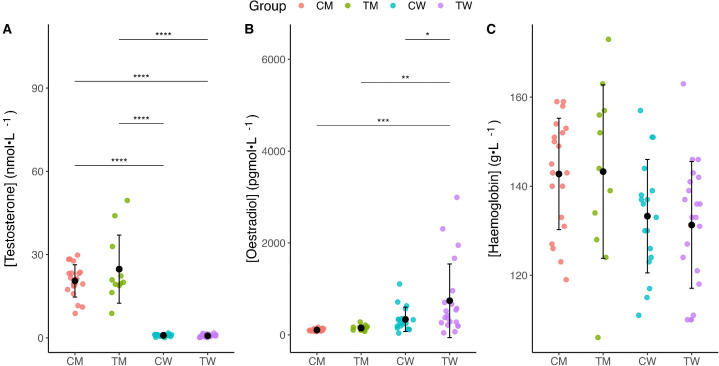
19 cisgender men (CM) (mean±SD, age: 37±9 years), 12 transgender men (TM) (age: 34±7 years), 23 transgender women (TW) (age: 34±10 years) and 21 cisgender women (CW) (age: 30±9 years) underwent a series of standard laboratory performance tests, including body composition, lung function, cardiopulmonary exercise testing, strength and lower body power. Haemoglobin concentration in capillary blood and testosterone and oestradiol in serum were also measured.
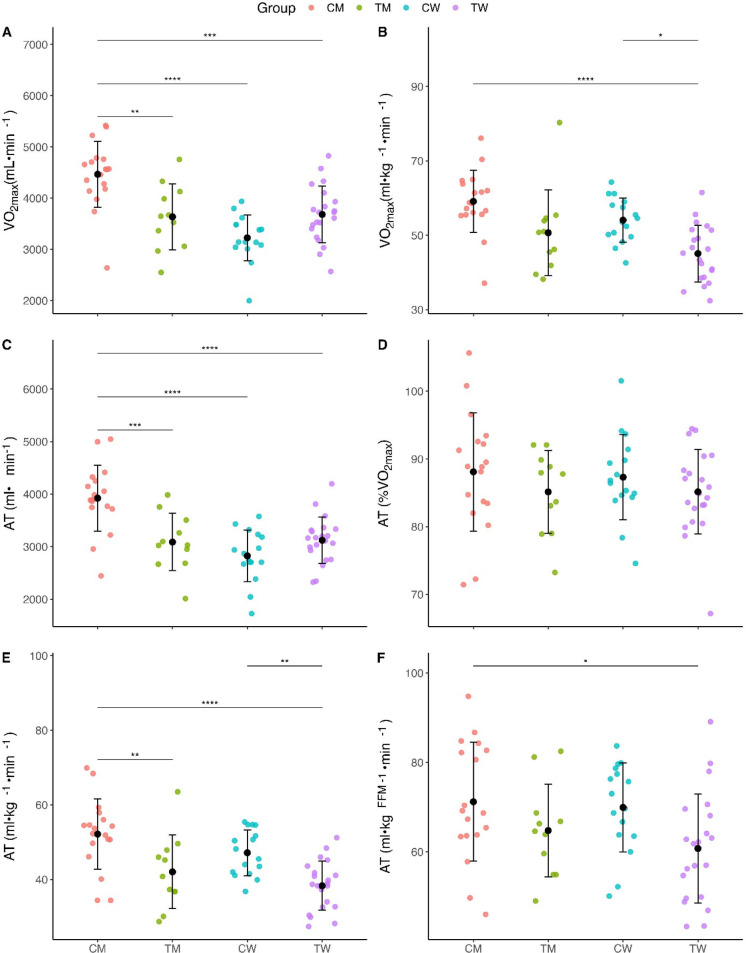
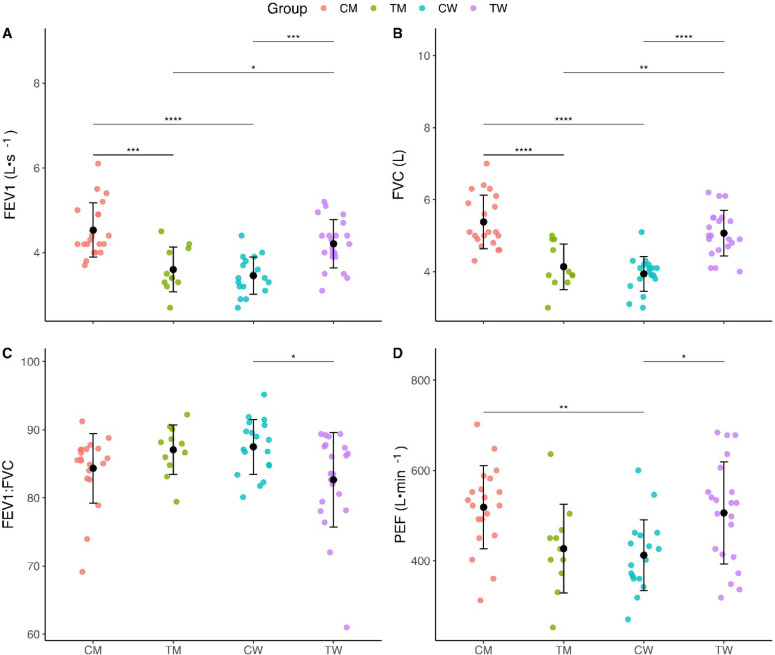
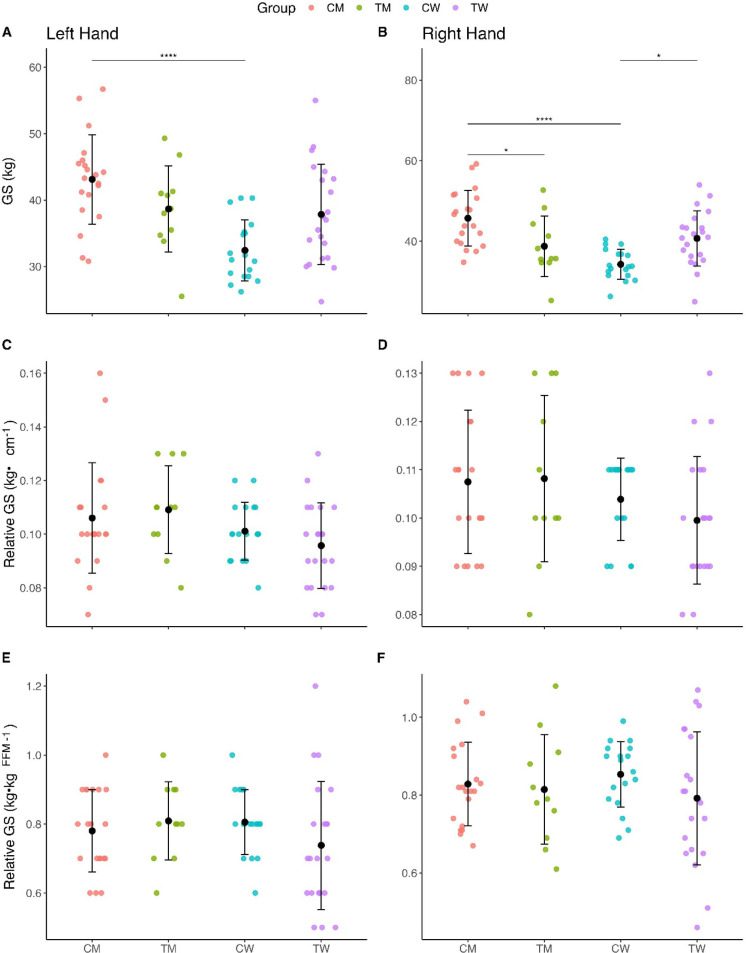
In this cohort of athletes, TW had similar testosterone concentration (TW 0.7±0.5 nmol/L, CW 0.9±0.4 nmol/), higher oestrogen (TW 742.4±801.9 pmol/L, CW 336.0±266.3 pmol/L, p=0.045), higher absolute handgrip strength (TW 40.7±6.8 kg, CW 34.2±3.7 kg, p=0.01), lower forced expiratory volume in 1 s:forced vital capacity ratio (TW 0.83±0.07, CW 0.88±0.04, p=0.04), lower relative jump height (TW 0.7±0.2 cm/kg; CW 1.0±0.2 cm/kg, p<0.001) and lower relative V̇Omax (TW 45.1±13.3 mL/kg/min/, CW 54.1±6.0 mL/kg/min, p<0.001) compared with CW athletes. TM had similar testosterone concentration (TM 20.5±5.8 nmol/L, CM 24.8±12.3 nmol/L), lower absolute hand grip strength (TM 38.8±7.5 kg, CM 45.7±6.9 kg, p0.03) and lower absolute V̇Omax (TM 3635±644 mL/min, CM 4467±641 mL/min p0.002) than CM.
While longitudinal transitioning studies of transgender athletes are urgently needed, these results should caution against precautionary bans and sport eligibility exclusions that are not based on sport-specific (or sport-relevant) research.
本横断面研究的主要目的是比较跨性别运动员和 cisgender 运动员的标准实验室性能指标。
19 名 cisgender 男性(CM)(平均±标准差,年龄:37±9 岁)、12 名 transgender 男性(TM)(年龄:34±7 岁)、23 名 transgender 女性(TW)(年龄:34±10 岁)和 21 名 cisgender 女性(CW)(年龄:30±9 岁)接受了一系列标准实验室性能测试,包括身体成分、肺功能、心肺运动测试、力量和下肢力量。还测量了毛细血管血中的血红蛋白浓度以及血清中的睾酮和雌二醇。
在本运动员队列中,TW 的睾酮浓度相似(TW 0.7±0.5 nmol/L,CW 0.9±0.4 nmol/L),雌激素水平更高(TW 742.4±801.9 pmol/L,CW 336.0±266.3 pmol/L,p=0.045),绝对握力更大(TW 40.7±6.8 kg,CW 34.2±3.7 kg,p=0.01),1 秒用力呼气量/用力肺活量比值更低(TW 0.83±0.07,CW 0.88±0.04,p=0.04),相对跳跃高度更低(TW 0.7±0.2 cm/kg;CW 1.0±0.2 cm/kg,p<0.001),相对最大摄氧量(V̇Omax)更低(TW 45.1±13.3 mL/kg/min/,CW 54.1±6.0 mL/kg/min/,p<0.001)与 CW 运动员相比。TM 的睾酮浓度相似(TM 20.5±5.8 nmol/L,CM 24.8±12.3 nmol/L),绝对握力更低(TM 38.8±7.5 kg,CM 45.7±6.9 kg,p0.03),绝对 V̇Omax 更低(TM 3635±644 mL/min,CM 4467±641 mL/min p0.002)比 CM。
虽然迫切需要对跨性别运动员进行纵向过渡研究,但这些结果应该告诫人们不要基于非特定运动(或与运动相关)的研究来预防性地禁止和排除运动资格。