Department of Anesthesiology and Intensive Care, Saint-Antoine and Tenon Hospitals, Assistance Publique-Hôpitaux de Paris, Paris, France.
DMU DREAM, Sorbonne Université, Assistance Publique-Hôpitaux de Paris, GRC 29, Paris, France.
BMC Med Ethics. 2024 Apr 10;25(1):44. doi: 10.1186/s12910-024-01046-8.
The often poor prognosis associated with cancer necessitates empowering patients to express their care preferences. Yet, the prevalence of Advance Directives (AD) among oncology patients remains low. This study investigated oncologists' perspectives on the interests and challenges associated with implementing AD.
A French national online survey targeting hospital-based oncologists explored five areas: AD information, writing support, AD usage, personal perceptions of AD's importance, and respondent's profile. The primary outcome was to assess how frequently oncologists provide patients with information about AD in daily clinical practice. Additionally, we examined factors related to delivering information on AD.
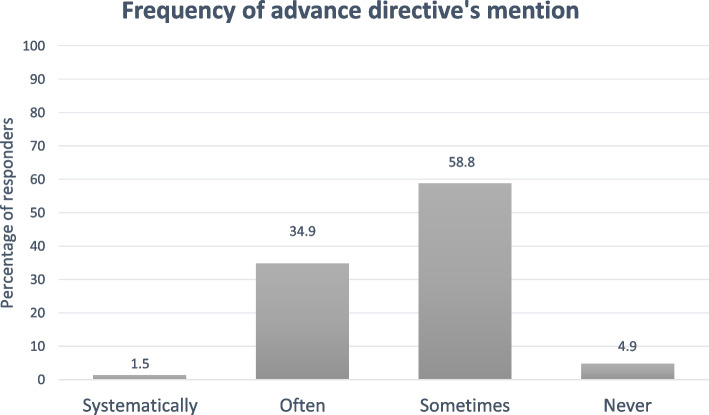
Of the 410 oncologists (50%) who responded to the survey, 75% (n = 308) deemed AD relevant. While 36% (n = 149) regularly inform patients about AD, 25% (n = 102) remain skeptical about AD. Among the respondents who do not consistently discuss AD, the most common reason given is the belief that AD may induce anxiety (n = 211/353; 60%). Of all respondents, 90% (n = 367) believe patients require specific information to draft relevant AD. Physicians with experience in palliative care were more likely to discuss AD (43% vs 32.3%, p = 0.027). Previous experience in critical care was associated with higher levels of distrust towards AD (31.5% vs 18.8%, p = 0.003), and 68.5% (n = 281) of the respondents expressed that designating a "person of trust" would be more appropriate than utilizing AD.
Despite the perceived relevance of AD, only a third of oncologists regularly apprise their patients about them. Significant uncertainty persists about the safety and relevance of AD.
癌症往往预后不良,这就需要赋予患者表达自己护理偏好的能力。然而,肿瘤患者的预先医疗指示(Advance Directives,AD)的普及率仍然很低。本研究调查了肿瘤学家对实施 AD 相关利益和挑战的看法。
一项针对医院肿瘤学家的法国全国在线调查探讨了五个领域:AD 信息、写作支持、AD 使用、个人对 AD 重要性的看法以及受访者的概况。主要结果是评估肿瘤学家在日常临床实践中向患者提供 AD 信息的频率。此外,我们还研究了与提供 AD 信息相关的因素。
在 410 名(50%)回应调查的肿瘤学家中,75%(n=308)认为 AD 是相关的。虽然 36%(n=149)定期向患者告知 AD,但 25%(n=102)对 AD 持怀疑态度。在不持续讨论 AD 的受访者中,最常见的原因是认为 AD 可能会引起焦虑(n=211/353;60%)。所有受访者中,90%(n=367)认为患者需要特定信息来起草相关 AD。有姑息治疗经验的医生更有可能讨论 AD(43% vs 32.3%,p=0.027)。有重症监护经验与对 AD 的更高程度不信任相关(31.5% vs 18.8%,p=0.003),并且 68.5%(n=281)的受访者表示,指定“信任的人”比使用 AD 更合适。
尽管 AD 被认为具有相关性,但只有三分之一的肿瘤学家定期向患者告知 AD。对 AD 的安全性和相关性仍然存在很大的不确定性。