Faculty of Medicine of the University of Porto, Porto, Portugal.
João de Barros Barreto University Hospital, Federal University of Pará, Dom Romualdo de Seixas, 1476/2207, Belém, PA, 66055-200, Brazil.
BMC Palliat Care. 2022 Sep 22;21(1):165. doi: 10.1186/s12904-022-01052-w.
Advance care planning (ACP) and goals of care discussions are important instruments that enable respect for patient autonomy, especially in patients with a life-threatening disease, such as cancer. Despite their well-established benefits, ACP and goals of care discussions are still not frequently performed in clinical oncology practice. Understanding the barriers to this topic is the first step toward developing future interventions that are more likely to improve professional practice and patient satisfaction with care.
To explore Brazilian oncologists' barriers to discuss goals of care and advance care planning.
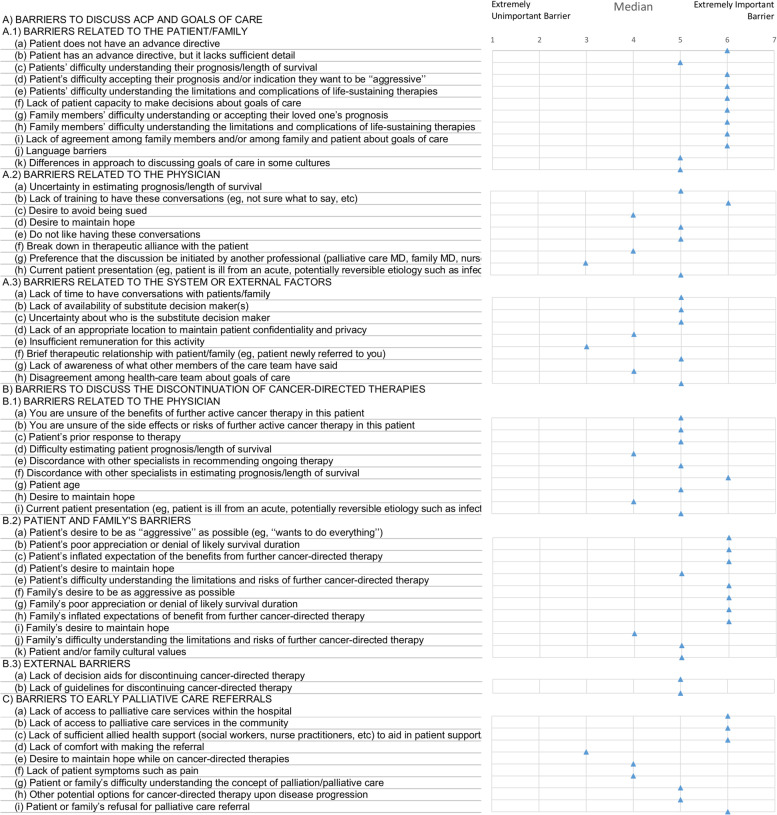
A cross-sectional study was developed to identify Brazilian oncologists' barriers to discussing goals of care and ACP. The Decide-Oncology questionnaire was used to identify the importance of these barriers according to oncologists' perceptions. Participants were asked to rank the importance of various barriers to discussing goals of care, ranging from 1 (extremely unimportant) to 7 (extremely important). A quantitative analysis using descriptive statistics was used, including median and interquartile intervals and a qualitative analysis based on Bardin content analysis of the two open questions.
Sixty-six oncologists participated in this study. Most of them perceived the patient and family's related barriers as the most important, such as patients' difficulty in understanding their diagnosis and accepting their prognosis. Physician and external related factors, such as lack of training and lack of time for this conversation, were also described as important barriers. Participants with formal training regarding goals of care communication and with experience in palliative care perceived the lack of patients' advanced directives as a significant barrier and manifested more willingness to participate in decision-making about goals of care. The lack of access and of support for referral to palliative care was also considered a significant barrier for ACP and goals of care discussion.
The identification of barriers that limit the discussion of ACP and early palliative care referrals can certainly help to prioritise the next steps for future studies aimed at improving ACP and helping clinicians to better support patients through shared decision-making based on the patient's values and experiences.
预先医疗照护计划(ACP)和医疗目标讨论是尊重患者自主权的重要手段,在患有危及生命的疾病(如癌症)的患者中尤其如此。尽管 ACP 和医疗目标讨论已经被证实有很多益处,但在临床肿瘤学实践中,它们的实施仍然不频繁。了解这一主题的障碍是朝着制定未来干预措施迈出的第一步,这些干预措施更有可能改善专业实践和患者对护理的满意度。
探讨巴西肿瘤医生在讨论医疗目标和预先医疗照护计划方面的障碍。
开展了一项横断面研究,以确定巴西肿瘤医生在讨论医疗目标和 ACP 方面的障碍。使用 Decide-Oncology 问卷根据医生的看法来确定这些障碍的重要性。要求参与者根据对讨论医疗目标的重要性对各种障碍进行评分,范围从 1(极不重要)到 7(非常重要)。采用描述性统计的定量分析,包括中位数和四分位间距,并根据 Bardin 内容分析法对两个开放性问题进行定性分析。
共有 66 名肿瘤医生参与了这项研究。他们中的大多数人认为患者和家属相关的障碍是最重要的,例如患者难以理解自己的诊断和接受预后。医生和外部相关因素,如缺乏培训和进行此类对话的时间,也被描述为重要的障碍。接受过目标关怀沟通培训并有姑息治疗经验的参与者认为患者缺乏预先指示是一个重大障碍,并表现出更愿意参与医疗目标决策。缺乏获取和支持转介姑息治疗的途径也被认为是 ACP 和医疗目标讨论的重大障碍。
确定限制 ACP 和早期姑息治疗转介讨论的障碍肯定有助于确定未来研究的优先事项,这些研究旨在改善 ACP,并帮助临床医生更好地根据患者的价值观和经验通过共同决策来支持患者。