Department of Interventional and Vascular Surgery, Shanghai Tenth People's Hospital, Tongji University School of Medicine, Shanghai, 200072, China.
Department of Orthopaedics, Shanghai Key Laboratory for Prevention and Treatment of Bone and Joint Diseases, Shanghai Institute of Traumatology and Orthopaedics, Ruijin Hospital, Shanghai Jiao Tong University School of Medicine, 197 Ruijin 2nd Road, Shanghai, 200025, China.
Adv Sci (Weinh). 2024 Jun;11(23):e2401368. doi: 10.1002/advs.202401368. Epub 2024 Apr 10.
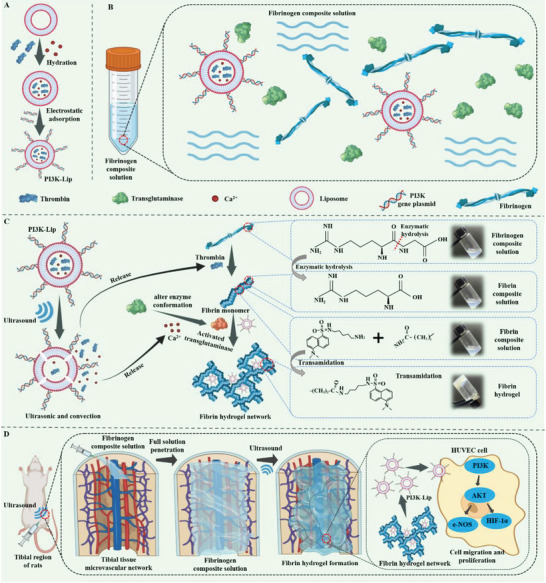
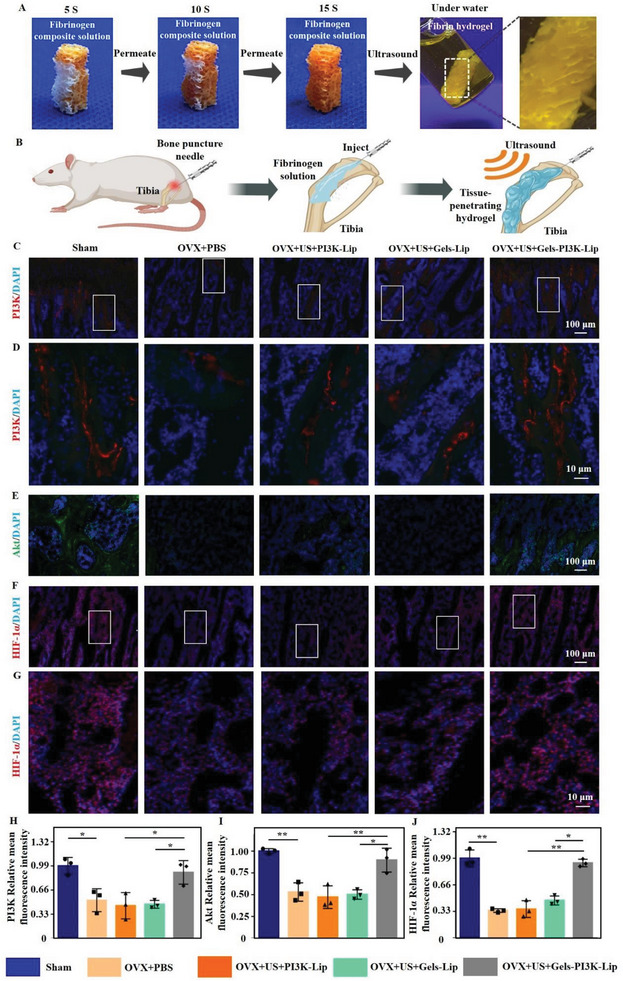
The microvascular network plays an important role in providing nutrients to the injured tissue and exchanging various metabolites. However, how to achieve efficient penetration of the injured tissue is an important bottleneck restricting the reconstruction of microvascular network. Herein, the hydrogel precursor solution can efficiently penetrate the damaged tissue area, and ultrasound triggers the release of thrombin from liposomes in the solution to hydrolyze fibrinogen, forming a fibrin solid hydrogel network in situ with calcium ions and transglutaminase as catalysts, effectively solving the penetration impedance bottleneck of damaged tissues and ultimately significantly promoting the formation of microvascular networks within tissues. First, the fibrinogen complex solution is effectively permeated into the injured tissue. Second, ultrasound triggered the release of calcium ions and thrombin, activates transglutaminase, and hydrolyzes fibrinogen. Third, fibrin monomers are catalyzed to form fibrin hydrogels in situ in the damaged tissue area. In vitro studies have shown that the fibrinogen complex solution effectively penetrated the artificial bone tissue within 15 s after ultrasonic triggering, and formed a hydrogel after continuous triggering for 30 s. Overall, this innovative strategy effectively solved the problem of penetration resistance of ultrasound-triggered hydrogels in the injured tissues, and finally activates in situ microvascular networks regeneration.
微血管网络在为损伤组织提供营养和交换各种代谢物方面发挥着重要作用。然而,如何实现对损伤组织的高效渗透是限制微血管网络重建的一个重要瓶颈。在此,水凝胶前体溶液能够高效地渗透进入损伤组织区域,超声触发溶液中的脂质体释放凝血酶,使纤维蛋白原水解,在钙离子和转谷氨酰胺酶的作用下形成纤维蛋白固态水凝胶网络,有效地解决了损伤组织的渗透阻抗瓶颈,最终显著促进了组织内微血管网络的形成。首先,纤维蛋白原复合溶液有效地渗透进入损伤组织。其次,超声触发释放钙离子和凝血酶,激活转谷氨酰胺酶,水解纤维蛋白原。第三,纤维蛋白单体在损伤组织区域原位被催化形成纤维蛋白水凝胶。体外研究表明,纤维蛋白原复合溶液在超声触发后 15 s 内有效地渗透进入人工骨组织,并在连续触发 30 s 后形成水凝胶。总的来说,这项创新策略有效地解决了超声触发水凝胶在损伤组织中渗透阻力的问题,最终激活了原位微血管网络的再生。