Rabin Erik E, Huang Jonathan, Kim Miri, Mozny Andreas, Lauing Kristen L, Penco-Campillo Manon, Zhai Lijie, Bommi Prashant, Mi Xinlei, Power Erica A, Prabhu Vikram C, Anderson Douglas E, Barton Kevin P, Walunas Theresa L, Schiltz Gary E, Amidei Christina, Sanchez-Gomez Pilar, Thakkar Jigisha P, Lukas Rimas V, Wainwright Derek A
Department of Neurological Surgery at Northwestern University Feinberg School of Medicine, Chicago, IL, USA.
Department of Neurological Surgery at Loyola University Chicago Stritch School of Medicine, Maywood, IL, USA.
Brain Behav Immun Health. 2024 Mar 15;38:100753. doi: 10.1016/j.bbih.2024.100753. eCollection 2024 Jul.
Increased age is a strong and unfavorable prognostic factor for patients with glioblastoma (GBM). However, the relationships between stratified patient age, comorbidities, and medications have yet to be explored in GBM patient survival analyses.
To evaluate co-morbid conditions, tumor-related symptoms, medication prescriptions, and subject age for patients with GBM and to establish potential targets for prospective studies.
Electronic health records for 565 patients with IDHwt GBM were evaluated at a single center between January 1, 2000 and August 9, 2021 were retrospectively assessed. Data were stratified by MGMT promoter methylation status when available and were used to construct multivariable time-dependent cox models and intra-cohort hazards.
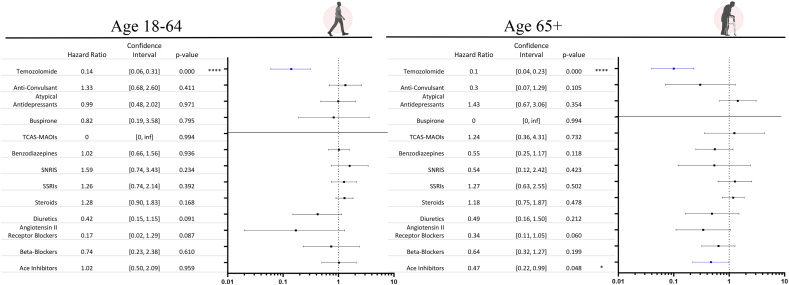
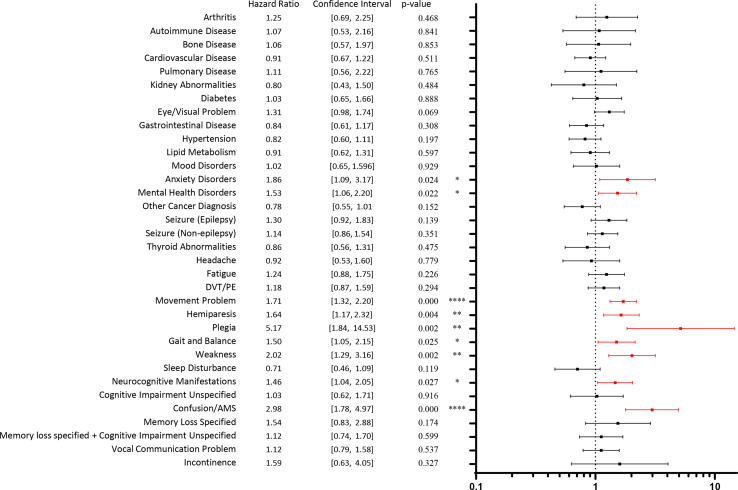
Younger (<65 years of age) but not older (≥65 years) GBM patients demonstrated a worse prognosis with movement related disabilities (P < 0.0001), gait/balance difficulty (P = 0.04) and weakness (P = 0.007), as well as psychiatric conditions, mental health disorders (P = 0.002) and anxiety (P = 0.001). In contrast, older but not younger GBM patients demonstrated a worse prognosis with epilepsy (P = 0.039). Both groups had worse survival with confusion/altered mental status (P = 0.023 vs < 0.000) and an improved survival with a Temozolomide prescription. Older but not younger GBM patients experienced an improved hazard with a prescription of ace-inhibitor medications (P = 0.048).
Age-dependent novel associations between clinical symptoms and medications prescribed for co-morbid conditions were demonstrated in patients with GBM. The results of the current work support future mechanistic studies that investigate the negative relationship(s) between increased age, comorbidities, and drug therapies for differential clinical decision-making across the lifespan of patients with GBM.
年龄增长是胶质母细胞瘤(GBM)患者的一个强烈且不利的预后因素。然而,在GBM患者生存分析中,分层患者年龄、合并症和药物之间的关系尚未得到探索。
评估GBM患者的合并症、肿瘤相关症状、药物处方和受试者年龄,并为前瞻性研究确定潜在靶点。
回顾性评估了2000年1月1日至2021年8月9日期间在单一中心的565例异柠檬酸脱氢酶野生型(IDHwt)GBM患者的电子健康记录。数据在可行时按O6-甲基鸟嘌呤-DNA甲基转移酶(MGMT)启动子甲基化状态分层,并用于构建多变量时间依赖性Cox模型和队列内风险。
年龄较小(<65岁)而非年龄较大(≥65岁)的GBM患者在运动相关残疾(P<0.0001)、步态/平衡困难(P=0.04)和虚弱(P=0.007)以及精神疾病、心理健康障碍(P=0.002)和焦虑(P=0.001)方面预后较差。相比之下,年龄较大而非年龄较小的GBM患者在癫痫方面预后较差(P=0.039)。两组在意识模糊/精神状态改变方面生存率均较差(P=0.023对<0.000),而接受替莫唑胺处方的患者生存率有所提高。年龄较大而非年龄较小的GBM患者在使用血管紧张素转换酶抑制剂药物处方时风险有所改善(P=0.048)。
GBM患者存在临床症状与合并症所开药物之间的年龄依赖性新关联。当前工作的结果支持未来的机制研究,该研究调查年龄增长、合并症和药物治疗之间的负相关关系,以便在GBM患者的整个生命周期内进行差异化临床决策。