
基于监测、流行病学和最终结果数据库及单中心数据的可切除非小细胞肺癌伴淋巴结转移(N1或N2)患者生存列线图模型
A survival nomogram model for patients with resectable non-small cell lung cancer and lymph node metastasis (N1 or N2) based on the Surveillance, Epidemiology, and End Results Database and single-center data.
作者信息
He Cheng, Ni Miaoqi, Liu Jiacong, Teng Xiao, Ke Lei, Matsuura Yosuke, Okuda Katsuhiro, Sakairi Yuichi, Cheng Jun, Yu Li, Lv Wang, Hu Jian
机构信息
Department of Thoracic Surgery, the First Affiliated Hospital, Zhejiang University School of Medicine, Hangzhou, China.
Echocardiography and Vascular Ultrasound Center, the First Affiliated Hospital, Zhejiang University School of Medicine, Hangzhou, China.
出版信息
Transl Lung Cancer Res. 2024 Mar 29;13(3):573-586. doi: 10.21037/tlcr-24-119. Epub 2024 Mar 27.
BACKGROUND
The ability to predict survival in patients with lymph node metastasis has long been elusive. After surgery, the basis for decision-making on the combination treatment of patients is not clear. The purpose of this study was thus to build a survival nomogram model to effectively predict the overall survival (OS) of patients with non-small cell lung cancer (NSCLC) and lymph node metastasis. The number of dissected lymph nodes (NDLN), number of positive lymph nodes (NPLN), lymph node ratio (LNR), and log odds of positive lymph nodes (LODDS) were included in this study to determine the risk factors in patients with advanced NSCLC.
METHODS
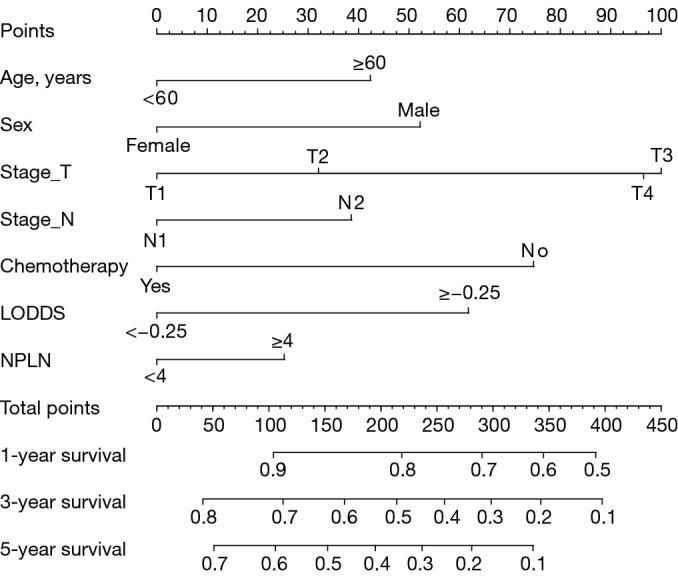
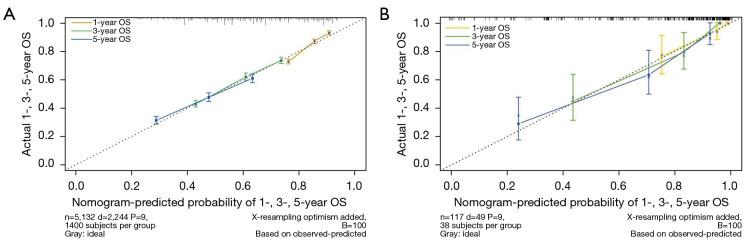
The data of 5,132 patients with NSCLC and lymph node metastasis (N1 or N2) were extracted from the Surveillance, Epidemiology, and End Results (SEER) database according to inclusion and exclusion criteria and used as the training cohort. We enrolled 117 patients from the First Affiliated Hospital, Zhejiang University School of Medicine as the external validation cohort. Receiver operating characteristic (ROC) analyses were performed to determine the best cutoff values for predicting the prognosis of patients with NSCLC. Based on the risk factors affecting prognosis, a nomogram was constructed using univariate and multivariate Cox proportional hazard regression models. The discrimination ability of the nomogram was evaluated with the concordance index (C-index) and calibration curves. For the independent risk factors, survival curves were drawn using Kaplan-Meier analysis.
RESULTS
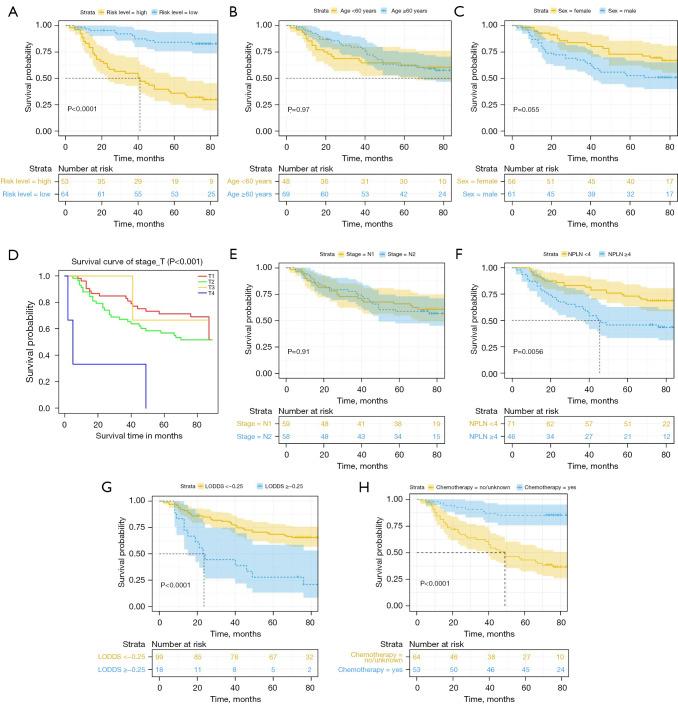
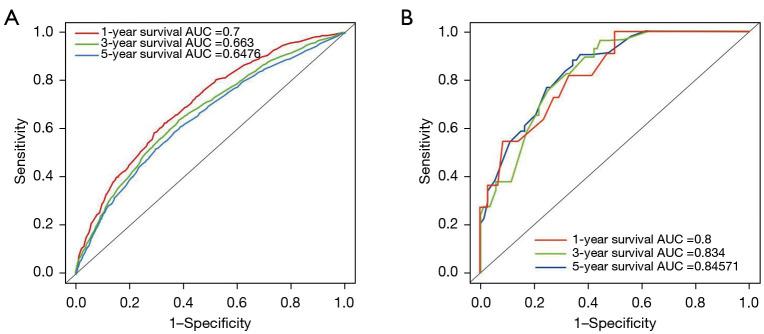
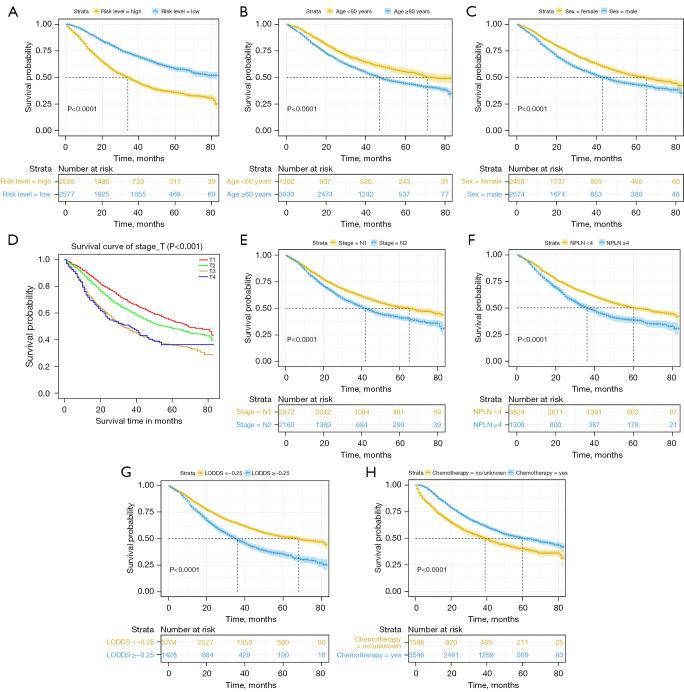
ROC curve analysis showed that the optimal NPLN cut-off value was 4, LNR was 0.26, and LODDS was -0.25, respectively. However, LNR was nonsignificant in multivariate analysis, with a P value of 0.274. The novel survival nomogram model included seven independent risk factors, among which were NPLN, LODDS, and chemotherapy. Model 4, which included N stage, NPLN, and LODDS, had a higher likelihood ratio (LR) and C-index than did the other models. The C-index was 0.648 [95% confidence interval (CI): 0.636-0.659] in the training cohort and 0.807 (95% CI: 0.751-0.863) in the external validation cohort, showing good prognostic accuracy and discrimination ability. According to the median risk score, the patients in the training cohort and external validation cohort were divided into high-risk and low-risk groups, between which significant differences in OS were found. In the training cohort, age, sex, T stage, N stage, NPLN, LODDS, and chemotherapy were significantly associated with OS (P<0.001). In the external validation cohort, T stage, NPLN, LODDS, and chemotherapy were found to be correlated with OS.
CONCLUSIONS
The NPLN and LODDS nomogram is an accurate survival prediction tool for patients with N1 or N2 NSCLC. Patients with lymph node metastasis can benefit from chemotherapy, but no evidence shows that radiotherapy is necessary for patients with resectable NSCLC.
背景
长期以来,预测淋巴结转移患者的生存情况一直难以实现。手术后,患者联合治疗决策的依据尚不清楚。因此,本研究旨在构建一个生存列线图模型,以有效预测非小细胞肺癌(NSCLC)伴淋巴结转移患者的总生存期(OS)。本研究纳入了解剖淋巴结数量(NDLN)、阳性淋巴结数量(NPLN)、淋巴结比率(LNR)和阳性淋巴结对数优势比(LODDS),以确定晚期NSCLC患者的危险因素。
方法
根据纳入和排除标准,从监测、流行病学和最终结果(SEER)数据库中提取5132例NSCLC伴淋巴结转移(N1或N2)患者的数据作为训练队列。我们纳入了浙江大学医学院附属第一医院的117例患者作为外部验证队列。进行受试者操作特征(ROC)分析,以确定预测NSCLC患者预后的最佳截断值。基于影响预后的危险因素,使用单因素和多因素Cox比例风险回归模型构建列线图。用一致性指数(C指数)和校准曲线评估列线图的辨别能力。对于独立危险因素,采用Kaplan-Meier分析绘制生存曲线。
结果
ROC曲线分析显示,最佳NPLN截断值分别为4,LNR为0.26,LODDS为-0.25。然而,LNR在多因素分析中无统计学意义,P值为0.274。新的生存列线图模型包括七个独立危险因素,其中有NPLN、LODDS和化疗。包含N分期、NPLN和LODDS的模型4比其他模型具有更高的似然比(LR)和C指数。训练队列中的C指数为0.648[95%置信区间(CI):0.636-0.659],外部验证队列中的C指数为0.807(95%CI:0.751-0.863),显示出良好的预后准确性和辨别能力。根据中位风险评分,将训练队列和外部验证队列中的患者分为高风险和低风险组,两组之间的OS存在显著差异。在训练队列中,年龄、性别、T分期、N分期、NPLN、LODDS和化疗与OS显著相关(P<0.001)。在外部验证队列中,发现T分期、NPLN、LODDS和化疗与OS相关。
结论
NPLN和LODDS列线图是N1或N2期NSCLC患者准确的生存预测工具。有淋巴结转移的患者可从化疗中获益,但没有证据表明可切除的NSCLC患者需要放疗。
 Zotero 插件