Department of Gynaecology, The First Affiliated Hospital of Jinan University, 613 Whampoa Avenue, Tianhe District, Guangzhou, 510632, China.
Department of Clinical Research, The First Affiliated Hospital of Jinan University, 613 Whampoa Avenue, Tianhe District, Guangzhou, China.
BMC Cancer. 2021 Oct 27;21(1):1149. doi: 10.1186/s12885-021-08888-0.
Aims to compare the prognostic performance of the number of positive lymph nodes (PLNN), lymph node ratio (LNR) and log odds of metastatic lymph nodes (LODDS) and establish a prognostic nomogram to predict overall survival (OS) rate for patients with endometrial carcinosarcoma (ECS).
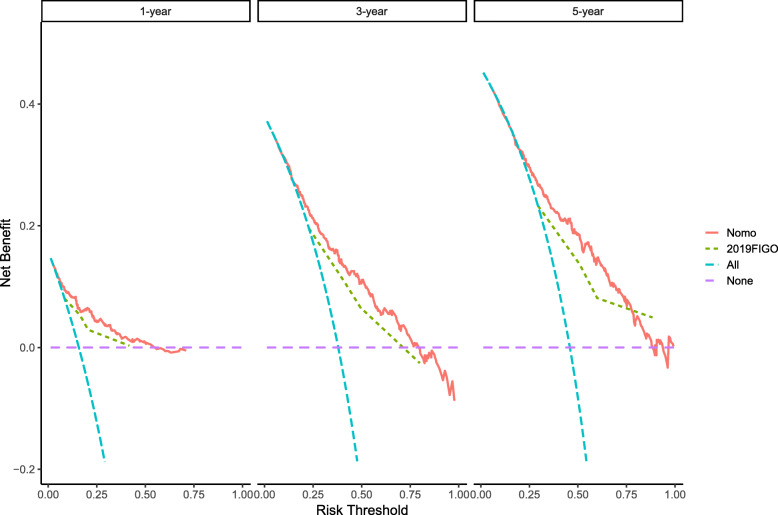
Patients were retrospectively obtained from Surveillance, Epidemiology and End Results (SEER) database from 2004 to 2015. The prognostic value of PLNN, LNR and LODDS were assessed. A prediction model for OS was established based on univariate and multivariate analysis of clinical and demographic characteristics of ECS patients. The clinical practical usefulness of the prediction model was valued by decision curve analysis (DCA) through quantifying its net benefits.
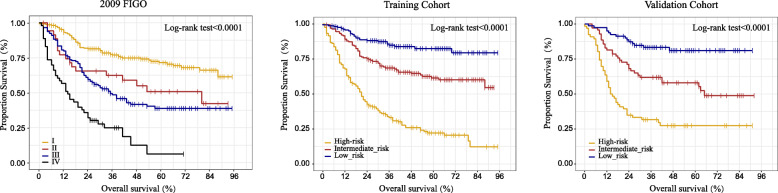
The OS prediction accuracy of LODDS for ECS is better than that of PLNN and LNR. Five factors, age, tumor size, 2009 FIGO, LODDS and peritoneal cytology, were independent prognostic factors of OS. The C-index of the nomogram was 0.743 in the training cohort. The AUCs were 0.740, 0.682 and 0.660 for predicting 1-, 3- and 5-year OS, respectively. The calibration plots and DCA showed good clinical applicability of the nomogram, which is better than 2009 FIGO staging system. These results were verified in the validation cohort. A risk classification system was built that could classify ECS patients into three risk groups. The Kaplan-Meier curves showed that OS in the different groups was accurately differentiated by the risk classification system and performed much better than FIGO 2009.
Our results indicated that LODDS was an independent prognostic indicator for ECS patients, with better predictive efficiency than PLNN and LNR. A novel prognostic nomogram for predicting the OS rate of ECS patients was established based on the population in the SEER database. Our nomogram based on LODDS has a more accurate and convenient value for predicting the OS of ECS patients than the FIGO staging system alone.
旨在比较阳性淋巴结数量(PLNN)、淋巴结比率(LNR)和转移淋巴结对数优势(LODDS)的预后性能,并建立一个预测列线图来预测子宫内膜癌肉瘤(ECS)患者的总生存率(OS)。
从 2004 年至 2015 年,从监测、流行病学和最终结果(SEER)数据库中回顾性地获取患者。评估 PLNN、LNR 和 LODDS 的预后价值。根据 ECS 患者的临床和人口统计学特征的单因素和多因素分析,建立 OS 预测模型。通过量化净效益,通过决策曲线分析(DCA)来评估预测模型的临床实用性。
LODDS 对 ECS 的 OS 预测准确性优于 PLNN 和 LNR。年龄、肿瘤大小、2009FIGO、LODDS 和腹膜细胞学五个因素是 OS 的独立预后因素。该列线图在训练队列中的 C 指数为 0.743。预测 1 年、3 年和 5 年 OS 的 AUC 分别为 0.740、0.682 和 0.660。校准图和 DCA 显示列线图具有良好的临床适用性,优于 2009FIGO 分期系统。这些结果在验证队列中得到了验证。建立了一个风险分类系统,可以将 ECS 患者分为三个风险组。Kaplan-Meier 曲线表明,该风险分类系统可以准确地区分不同组别的 OS,并且比 2009FIGO 表现更好。
我们的结果表明,LODDS 是 ECS 患者的独立预后指标,预测效率优于 PLNN 和 LNR。根据 SEER 数据库中的人群,建立了一种预测 ECS 患者 OS 率的新预后列线图。与单独的 FIGO 分期系统相比,我们基于 LODDS 的列线图在预测 ECS 患者 OS 方面具有更准确和方便的价值。