• 文献检索
  • 文档翻译
  • 深度研究
  • 学术资讯
  • Suppr Zotero 插件Zotero 插件
  • 邀请有礼
  • 套餐&价格
  • 历史记录
应用&插件
Suppr Zotero 插件Zotero 插件浏览器插件Mac 客户端Windows 客户端微信小程序
定价
高级版会员购买积分包购买API积分包
服务
文献检索文档翻译深度研究API 文档MCP 服务
关于我们
关于 Suppr公司介绍联系我们用户协议隐私条款
关注我们

Suppr 超能文献

核心技术专利:CN118964589B侵权必究
粤ICP备2023148730 号-1Suppr @ 2026

文献检索

告别复杂PubMed语法,用中文像聊天一样搜索,搜遍4000万医学文献。AI智能推荐,让科研检索更轻松。

立即免费搜索

文件翻译

保留排版,准确专业,支持PDF/Word/PPT等文件格式,支持 12+语言互译。

免费翻译文档

深度研究

AI帮你快速写综述,25分钟生成高质量综述,智能提取关键信息,辅助科研写作。

立即免费体验

涉及适应他人波动意图的神经计算机制。

Neurocomputational mechanisms involved in adaptation to fluctuating intentions of others.

机构信息

CNRS-Institut des Sciences Cognitives Marc Jeannerod, UMR5229, Neuroeconomics, reward, and decision making laboratory, Lyon, France.

Université Claude Bernard Lyon 1, Lyon, France.

出版信息

Nat Commun. 2024 Apr 12;15(1):3189. doi: 10.1038/s41467-024-47491-2.

DOI:10.1038/s41467-024-47491-2
PMID:38609372
原文链接:https://pmc.ncbi.nlm.nih.gov/articles/PMC11014977/
Abstract

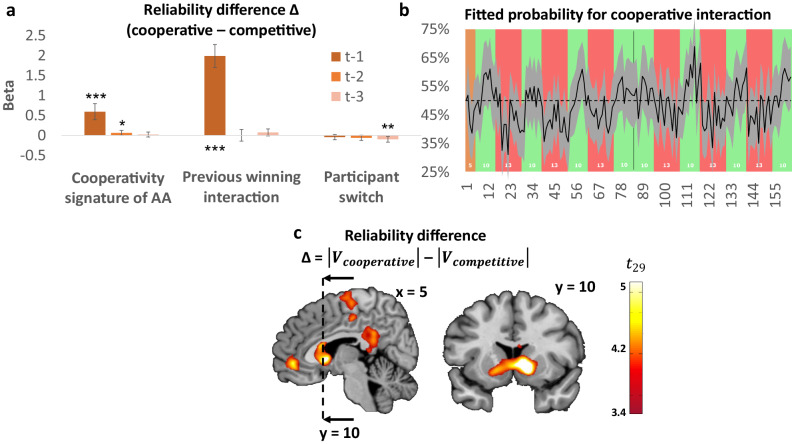
Humans frequently interact with agents whose intentions can fluctuate between competition and cooperation over time. It is unclear how the brain adapts to fluctuating intentions of others when the nature of the interactions (to cooperate or compete) is not explicitly and truthfully signaled. Here, we use model-based fMRI and a task in which participants thought they were playing with another player. In fact, they played with an algorithm that alternated without signaling between cooperative and competitive strategies. We show that a neurocomputational mechanism with arbitration between competitive and cooperative experts outperforms other learning models in predicting choice behavior. At the brain level, the fMRI results show that the ventral striatum and ventromedial prefrontal cortex track the difference of reliability between these experts. When attributing competitive intentions, we find increased coupling between these regions and a network that distinguishes prediction errors related to competition and cooperation. These findings provide a neurocomputational account of how the brain arbitrates dynamically between cooperative and competitive intentions when making adaptive social decisions.

摘要

人类经常与那些意图随时间在竞争和合作之间波动的主体进行交互。当交互的性质(合作或竞争)没有明确和真实地发出信号时,大脑如何适应他人意图的波动尚不清楚。在这里,我们使用基于模型的 fMRI 和一个任务,参与者认为他们正在与另一个玩家一起玩。事实上,他们与一个算法一起玩,该算法在没有信号的情况下交替使用合作和竞争策略。我们表明,在预测选择行为方面,竞争和合作专家之间具有仲裁功能的神经计算机制优于其他学习模型。在大脑水平上,fMRI 结果表明,腹侧纹状体和腹内侧前额叶皮层跟踪这些专家之间可靠性的差异。当归因于竞争意图时,我们发现这些区域与一个网络之间的耦合增加,该网络区分与竞争和合作相关的预测误差。这些发现提供了一个神经计算解释,说明大脑在做出适应性社会决策时如何在合作和竞争意图之间进行动态仲裁。

https://cdn.ncbi.nlm.nih.gov/pmc/blobs/9bda/11014977/416ef1d8650e/41467_2024_47491_Fig6_HTML.jpg
https://cdn.ncbi.nlm.nih.gov/pmc/blobs/9bda/11014977/189887d74e58/41467_2024_47491_Fig1_HTML.jpg
https://cdn.ncbi.nlm.nih.gov/pmc/blobs/9bda/11014977/08c5bcc522c7/41467_2024_47491_Fig2_HTML.jpg
https://cdn.ncbi.nlm.nih.gov/pmc/blobs/9bda/11014977/defdb54a2e38/41467_2024_47491_Fig3_HTML.jpg
https://cdn.ncbi.nlm.nih.gov/pmc/blobs/9bda/11014977/aa2a3fafb159/41467_2024_47491_Fig4_HTML.jpg
https://cdn.ncbi.nlm.nih.gov/pmc/blobs/9bda/11014977/d29685610941/41467_2024_47491_Fig5_HTML.jpg
https://cdn.ncbi.nlm.nih.gov/pmc/blobs/9bda/11014977/416ef1d8650e/41467_2024_47491_Fig6_HTML.jpg
https://cdn.ncbi.nlm.nih.gov/pmc/blobs/9bda/11014977/189887d74e58/41467_2024_47491_Fig1_HTML.jpg
https://cdn.ncbi.nlm.nih.gov/pmc/blobs/9bda/11014977/08c5bcc522c7/41467_2024_47491_Fig2_HTML.jpg
https://cdn.ncbi.nlm.nih.gov/pmc/blobs/9bda/11014977/defdb54a2e38/41467_2024_47491_Fig3_HTML.jpg
https://cdn.ncbi.nlm.nih.gov/pmc/blobs/9bda/11014977/aa2a3fafb159/41467_2024_47491_Fig4_HTML.jpg
https://cdn.ncbi.nlm.nih.gov/pmc/blobs/9bda/11014977/d29685610941/41467_2024_47491_Fig5_HTML.jpg
https://cdn.ncbi.nlm.nih.gov/pmc/blobs/9bda/11014977/416ef1d8650e/41467_2024_47491_Fig6_HTML.jpg

相似文献

1
Neurocomputational mechanisms involved in adaptation to fluctuating intentions of others.涉及适应他人波动意图的神经计算机制。
Nat Commun. 2024 Apr 12;15(1):3189. doi: 10.1038/s41467-024-47491-2.
2
Learning whom to cooperate with: neurocomputational mechanisms for choosing cooperative partners.学习与谁合作:选择合作伙伴的神经计算机制。
Cereb Cortex. 2023 Apr 4;33(8):4612-4625. doi: 10.1093/cercor/bhac365.
3
Neural computations underlying strategic social decision-making in groups.群体策略性社会决策的神经计算基础。
Nat Commun. 2019 Nov 21;10(1):5287. doi: 10.1038/s41467-019-12937-5.
4
Neural implementation of computational mechanisms underlying the continuous trade-off between cooperation and competition.合作与竞争之间持续权衡背后计算机制的神经实现
Nat Commun. 2022 Nov 11;13(1):6873. doi: 10.1038/s41467-022-34509-w.
5
A Neuro-computational Account of Arbitration between Choice Imitation and Goal Emulation during Human Observational Learning.人类观察学习中选择模仿与目标模拟之间的仲裁的神经计算解释。
Neuron. 2020 May 20;106(4):687-699.e7. doi: 10.1016/j.neuron.2020.02.028. Epub 2020 Mar 17.
6
Cooperation or competition? Discriminating between social intentions by observing prehensile movements.合作还是竞争?通过观察抓取动作来区分社会意图。
Exp Brain Res. 2011 Jun;211(3-4):547-56. doi: 10.1007/s00221-011-2649-4. Epub 2011 Apr 5.
7
MDMA Increases Cooperation and Recruitment of Social Brain Areas When Playing Trustworthy Players in an Iterated Prisoner's Dilemma.MDMA 增加了在迭代囚徒困境中与可信赖玩家一起玩时的合作和社交脑区的招募。
J Neurosci. 2019 Jan 9;39(2):307-320. doi: 10.1523/JNEUROSCI.1276-18.2018. Epub 2018 Nov 19.
8
Cooperative and Competitive Contextual Effects on Social Cognitive and Empathic Neural Responses.合作与竞争情境对社会认知和共情神经反应的影响。
Front Hum Neurosci. 2018 Jun 11;12:218. doi: 10.3389/fnhum.2018.00218. eCollection 2018.
9
Neurocomputational mechanisms of adaptive learning in social exchanges.社会交往中适应性学习的神经计算机制。
Cogn Affect Behav Neurosci. 2019 Aug;19(4):985-997. doi: 10.3758/s13415-019-00697-0.
10
Neural correlates of observing joint actions with shared intentions.观察具有共同意图的联合行动的神经关联。
Cortex. 2015 Sep;70:90-100. doi: 10.1016/j.cortex.2015.05.027. Epub 2015 Jun 5.

引用本文的文献

1
Heterogeneity in strategy use during arbitration between experiential and observational learning.在经验学习和观察学习之间的仲裁中策略使用的异质性。
Nat Commun. 2024 May 24;15(1):4436. doi: 10.1038/s41467-024-48548-y.

本文引用的文献

1
Formalising social representation to explain psychiatric symptoms.形式化社会表征以解释精神症状。
Trends Cogn Sci. 2023 Mar;27(3):317-332. doi: 10.1016/j.tics.2022.12.004. Epub 2023 Jan 4.
2
Explicit knowledge of task structure is a primary determinant of human model-based action.任务结构的明确知识是人类基于模型行为的主要决定因素。
Nat Hum Behav. 2022 Aug;6(8):1126-1141. doi: 10.1038/s41562-022-01346-2. Epub 2022 May 19.
3
Bayesian inference with incomplete knowledge explains perceptual confidence and its deviations from accuracy.
贝叶斯推断与不完全知识解释了感知信心及其与准确性的偏差。
Nat Commun. 2021 Sep 29;12(1):5704. doi: 10.1038/s41467-021-25419-4.
4
Reading between the lines: Listener's vmPFC simulates speaker cooperative choices in communication games.字里行间的解读:听众的腹内侧前额叶皮层在交流游戏中模拟说话者的合作选择。
Sci Adv. 2021 Mar 3;7(10). doi: 10.1126/sciadv.abe6276. Print 2021 Mar.
5
Why and how the brain weights contributions from a mixture of experts.大脑为何以及如何权衡来自多个专家的贡献。
Neurosci Biobehav Rev. 2021 Apr;123:14-23. doi: 10.1016/j.neubiorev.2020.10.022. Epub 2021 Jan 11.
6
Entorhinal and ventromedial prefrontal cortices abstract and generalize the structure of reinforcement learning problems.内嗅皮层和腹内侧前额叶皮层抽象和概括了强化学习问题的结构。
Neuron. 2021 Feb 17;109(4):713-723.e7. doi: 10.1016/j.neuron.2020.11.024. Epub 2020 Dec 22.
7
Neural mechanisms resolving exploitation-exploration dilemmas in the medial prefrontal cortex.内侧前额叶皮层中解决利用-探索困境的神经机制。
Science. 2020 Aug 28;369(6507). doi: 10.1126/science.abb0184.
8
Is There a 'Social' Brain? Implementations and Algorithms.是否存在“社交”大脑?实现与算法。
Trends Cogn Sci. 2020 Oct;24(10):802-813. doi: 10.1016/j.tics.2020.06.011. Epub 2020 Jul 28.
9
Prefrontal Cortex Predicts State Switches during Reversal Learning.前额皮质预测反转学习过程中的状态转换。
Neuron. 2020 Jun 17;106(6):1044-1054.e4. doi: 10.1016/j.neuron.2020.03.024. Epub 2020 Apr 20.
10
A Neuro-computational Account of Arbitration between Choice Imitation and Goal Emulation during Human Observational Learning.人类观察学习中选择模仿与目标模拟之间的仲裁的神经计算解释。
Neuron. 2020 May 20;106(4):687-699.e7. doi: 10.1016/j.neuron.2020.02.028. Epub 2020 Mar 17.