Department of Psychology, University of Marburg, Gutenbergstr. 18, 35032, Marburg, Germany.
Heidelberg University, Heidelberg, Germany.
Behav Res Methods. 2024 Apr;56(4):3469-3486. doi: 10.3758/s13428-024-02394-4. Epub 2024 Apr 12.
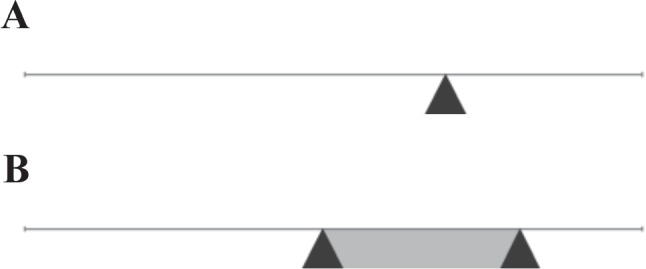
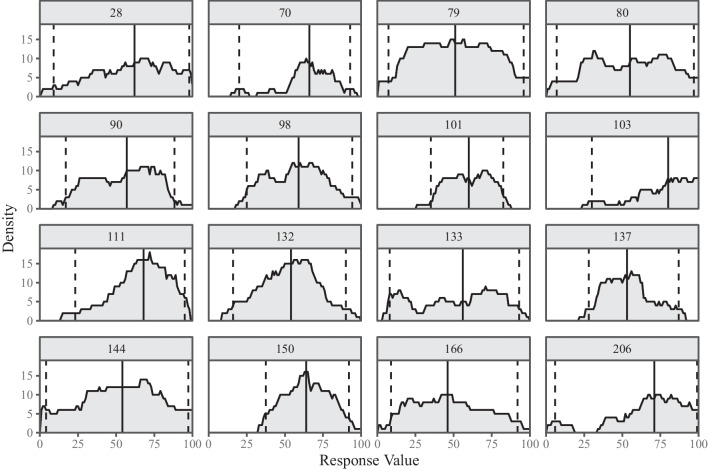
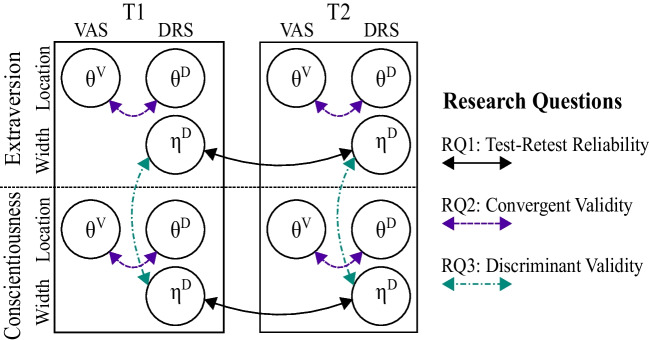
Measuring the variability in persons' behaviors and experiences using ecological momentary assessment is time-consuming and costly. We investigate whether interval responses provided through a dual-range slider (DRS) response format can be used as a simple and efficient alternative: Respondents indicate variability in their behavior in a retrospective rating by choosing a lower and an upper bound on a continuous, bounded scale. We investigate the psychometric properties of this response format as a prerequisite for further validation. First, we assess the test-retest reliability of factor-score estimates for the width of DRS intervals. Second, we test whether factor-score estimates of the visual analog scale (VAS) and the location of DRS intervals show convergent validity. Third, we investigate whether factor-score estimates for the DRS are uncorrelated between different personality scales. We present a longitudinal multitrait-multimethod study using two personality scales (Extraversion, Conscientiousness) and two response formats (VAS, DRS) at two measurement occasions (6-8 weeks apart) for which we estimate factor-score correlations in a joint item response theory model. The test-retest reliability of the width of DRS intervals was high ( ). Also, convergent validity between location scores of VAS and DRS was high ( ). Conversely, discriminant validity of the width of DRS intervals between Extraversion and Conscientiousness was poor ( ). In conclusion, the DRS seems to be a reliable response format that could be used to measure the central tendency of a trait equivalently to the VAS. However, it might not be well suited for measuring intra-individual variability in personality traits.
使用生态瞬时评估来衡量个体行为和体验的变异性既耗时又昂贵。我们研究了通过双范围滑块 (DRS) 响应格式提供的间隔响应是否可以作为一种简单而高效的替代方法:受访者通过在连续的有界量表上选择下限和上限来对其行为的变异性进行回顾性评分。作为进一步验证的前提,我们研究了这种响应格式的心理测量特性。首先,我们评估 DRS 间隔宽度的因子评分估计值的重测信度。其次,我们测试视觉模拟量表 (VAS) 的因子评分估计值和 DRS 间隔的位置是否表现出收敛效度。第三,我们研究 DRS 的因子评分估计值在不同人格量表之间是否不相关。我们提出了一项纵向多特质-多方法研究,使用两种人格量表(外向性、尽责性)和两种响应格式(VAS、DRS),在两个测量时间点(相隔 6-8 周)进行,我们在联合项目反应理论模型中估计因子评分相关性。DRS 间隔宽度的重测信度很高( )。此外,VAS 和 DRS 的位置得分之间的收敛效度也很高( )。相反,DRS 间隔宽度在外向性和尽责性之间的区分效度较差( )。总之,DRS 似乎是一种可靠的响应格式,可用于与 VAS 等效地测量特质的中心趋势。然而,它可能不太适合测量人格特质的个体内变异性。