Famili Alireza, Stavrou Angelos, Wang Haining, Park Jung-Min Jerry, Gerdes Ryan
Department of Electrical and Computer Engineering, Virginia Tech, Arlington, VA 22203, USA.
Sensors (Basel). 2024 Mar 22;24(7):2028. doi: 10.3390/s24072028.
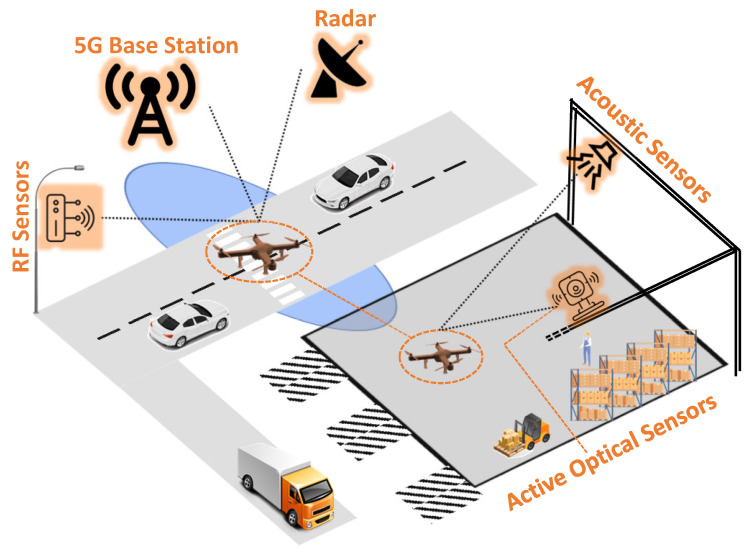
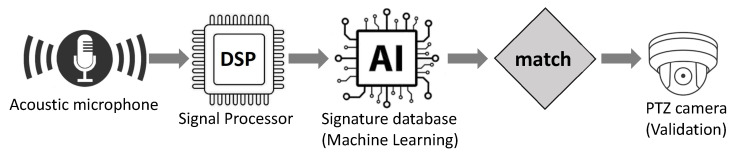
Unmanned Aerial Vehicle (UAV) deployment has risen rapidly in recent years. They are now used in a wide range of applications, from critical safety-of-life scenarios like nuclear power plant surveillance to entertainment and hobby applications. While the popularity of drones has grown lately, the associated intentional and unintentional security threats require adequate consideration. Thus, there is an urgent need for real-time accurate detection and classification of drones. This article provides an overview of drone detection approaches, highlighting their benefits and limitations. We analyze detection techniques that employ radars, acoustic and optical sensors, and emitted radio frequency (RF) signals. We compare their performance, accuracy, and cost under different operating conditions. We conclude that multi-sensor detection systems offer more compelling results, but further research is required.
近年来,无人机(UAV)的部署迅速增加。它们现在被广泛应用于各种领域,从核电站监测等关键的生命安全场景到娱乐和爱好应用。虽然无人机最近越来越受欢迎,但相关的有意和无意安全威胁需要充分考虑。因此,迫切需要对无人机进行实时准确的检测和分类。本文概述了无人机检测方法,突出了它们的优点和局限性。我们分析了采用雷达、声学和光学传感器以及发射射频(RF)信号的检测技术。我们比较了它们在不同操作条件下的性能、准确性和成本。我们得出结论,多传感器检测系统能提供更有说服力的结果,但仍需要进一步研究。