Chen Tianxiao, Niu Yanan, Yang Changdeng, Liang Yan, Xu Jianlong
State Key Laboratory of Rice Biology, China National Center for Rice Improvement, China National Rice Research Institute, Hangzhou 310006, China.
State Key Laboratory of Crop Gene Resources and Breeding, Institute of Crop Sciences, Chinese Academy of Agricultural Sciences, Beijing 100081, China.
Plants (Basel). 2024 Apr 6;13(7):1036. doi: 10.3390/plants13071036.
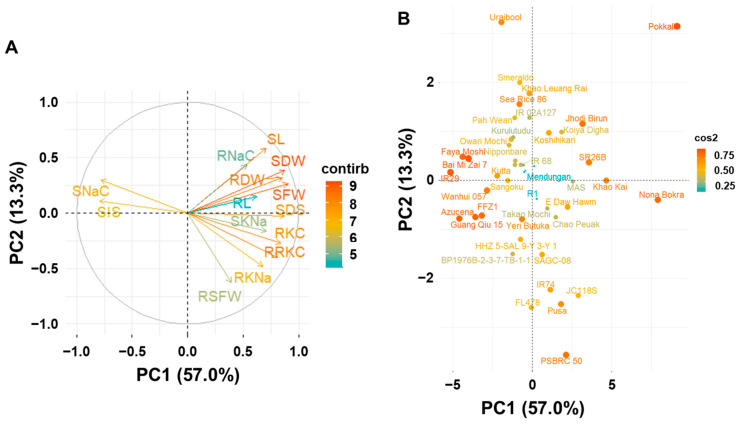
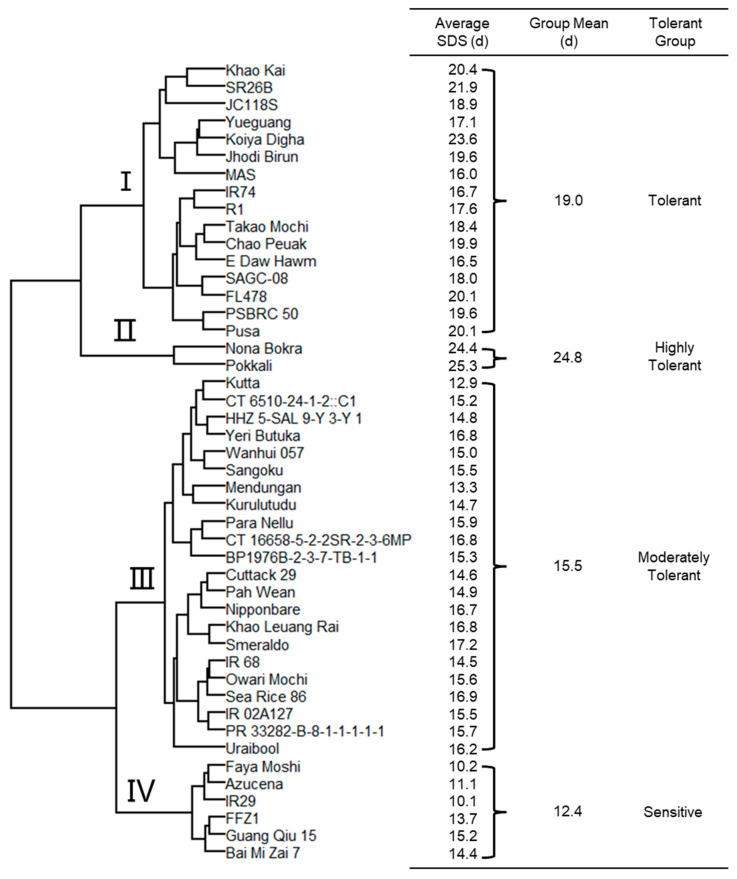
Soil salinity imposes osmotic, ionic, and oxidative stresses on plants, resulting in growth inhibition, developmental changes, metabolic adaptations, and ion sequestration or exclusion. Identifying salinity-tolerant resources and understanding physiological and molecular mechanisms of salinity tolerance could lay a foundation for the improvement of salinity tolerance in rice. In this study, a series of salinity-tolerance-related morphological and physiological traits were investigated in 46 rice genotypes, including Sea Rice 86, to reveal the main strategies of rice in responding to salinity stress at the seedling stage. No genotypes showed the same tolerance level as the two landraces Pokkali and Nona Bokra, which remain the donors for improving the salinity tolerance of rice. However, due to undesirable agronomic traits of these donors, alternative cultivars such as JC118S and R1 are recommended as novel source of salinity tolerance. Correlation and principal component analyses revealed that the salinity tolerance of rice seedlings is not only controlled by growth vigor but also regulated by ion transport pathways such as long-distance Na transport, root Na sequestration, and root K retention. Therefore, such key traits should be targeted in future breeding programs as the strategy of obtaining better Na exclusion is still the bottleneck for improving salinity tolerance in rice.
土壤盐度对植物施加渗透、离子和氧化胁迫,导致生长抑制、发育变化、代谢适应以及离子螯合或排斥。鉴定耐盐资源并了解耐盐的生理和分子机制可为提高水稻耐盐性奠定基础。在本研究中,对包括海稻86在内的46个水稻基因型的一系列耐盐相关形态和生理性状进行了研究,以揭示水稻在幼苗期应对盐胁迫的主要策略。没有基因型表现出与两个地方品种Pokkali和Nona Bokra相同的耐受水平,这两个品种仍是提高水稻耐盐性的供体。然而,由于这些供体存在不良农艺性状,推荐JC118S和R1等替代品种作为新的耐盐来源。相关性和主成分分析表明,水稻幼苗的耐盐性不仅受生长活力控制,还受长距离钠运输、根系钠螯合和根系钾保留等离子运输途径调节。因此,在未来的育种计划中应针对这些关键性状,因为获得更好的钠排斥策略仍然是提高水稻耐盐性的瓶颈。