Maciag Karolina, Plumlee Courtney, Cohen Sara, Gern Benjamin, Urdahl Kevin
Seattle Children's Research Institute.
Division of Allergy and Infectious Diseases, University of Washington.
bioRxiv. 2024 Apr 5:2024.04.04.588086. doi: 10.1101/2024.04.04.588086.
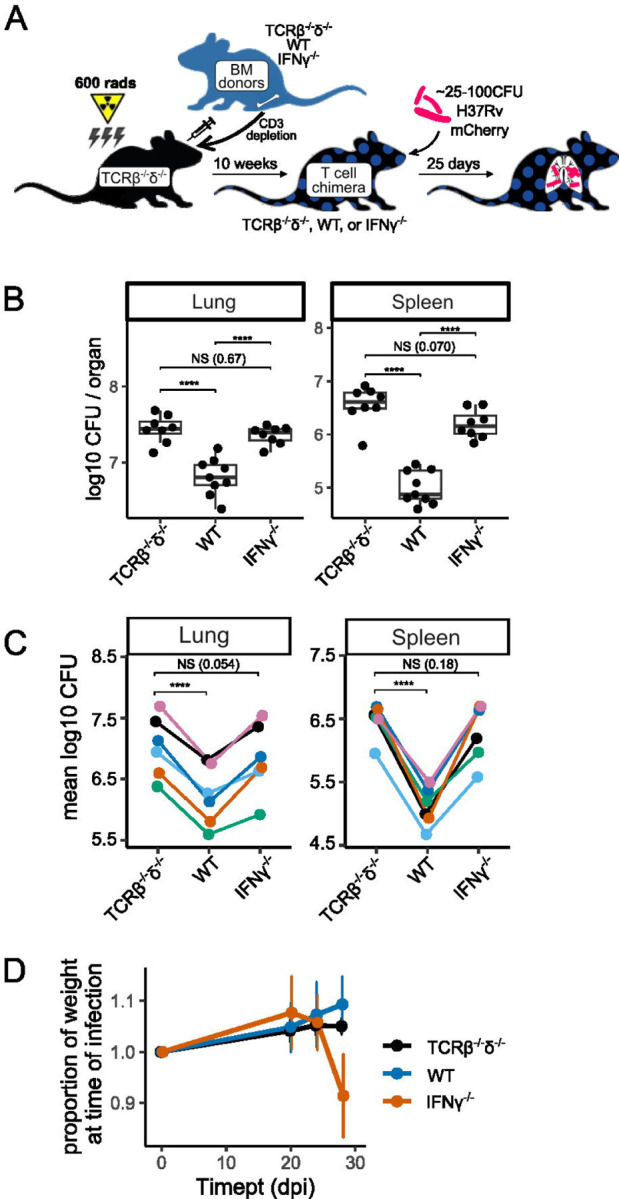
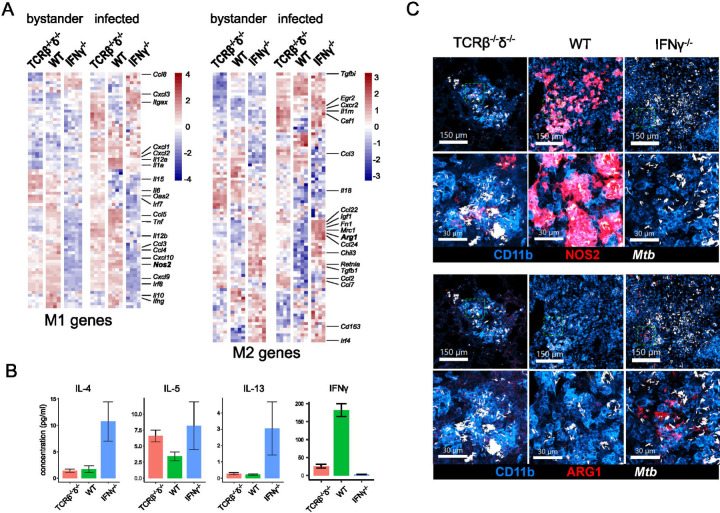
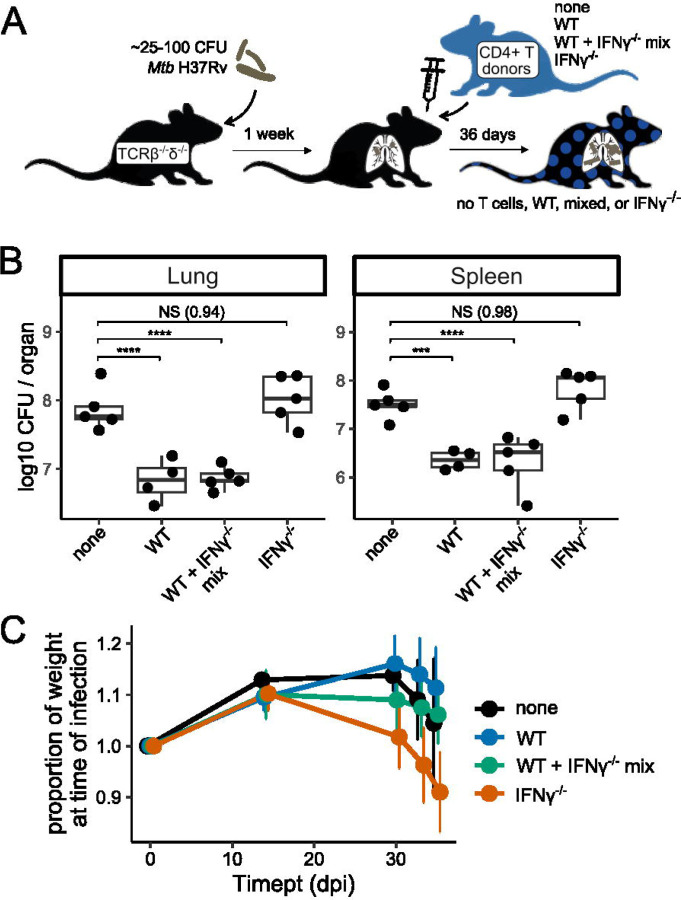
T cells producing interferon gamma (IFNγ) have long been considered a stalwart for immune protection against (), but their relative importance to pulmonary immunity has been challenged by murine studies which achieved protection by adoptively transferred -specific IFNγ T cells. Using IFNγ T cell chimeric mice and adoptive transfer of IFNγ T cells into TCRβδ mice, we demonstrate that control of lung burden is in fact dependent on T cell-derived IFNγ, and furthermore, mice selectively deficient in T cell-derived IFNγ develop exacerbated disease compared to T cell-deficient controls despite equivalent lung bacterial burdens. Deficiency in T cell-derived IFNγ skews infected and bystander monocyte-derived macrophages (MDMs) to an alternative M2 phenotype, and promotes neutrophil and eosinophil influx. Our studies support an important role for T cell-derived IFNγ in pulmonary immunity against TB.
长期以来,产生干扰素γ(IFNγ)的T细胞一直被视为抵抗()免疫保护的中坚力量,但它们对肺部免疫的相对重要性受到了小鼠研究的挑战,这些研究通过过继转移特异性IFNγ T细胞实现了保护。使用IFNγ T细胞嵌合小鼠并将IFNγ T细胞过继转移到TCRβδ小鼠中,我们证明肺部()负担的控制实际上依赖于T细胞衍生的IFNγ,此外,尽管肺部细菌负担相当,但与T细胞缺陷对照相比,选择性缺乏T细胞衍生IFNγ的小鼠会出现病情加重。T细胞衍生的IFNγ缺乏会使受感染和旁观的单核细胞衍生巨噬细胞(MDM)偏向替代的M2表型,并促进中性粒细胞和嗜酸性粒细胞的流入。我们的研究支持T细胞衍生的IFNγ在抗结核肺部免疫中发挥重要作用。