• 文献检索
  • 文档翻译
  • 深度研究
  • 学术资讯
  • Suppr Zotero 插件Zotero 插件
  • 邀请有礼
  • 套餐&价格
  • 历史记录
应用&插件
Suppr Zotero 插件Zotero 插件浏览器插件Mac 客户端Windows 客户端微信小程序
定价
高级版会员购买积分包购买API积分包
服务
文献检索文档翻译深度研究API 文档MCP 服务
关于我们
关于 Suppr公司介绍联系我们用户协议隐私条款
关注我们

Suppr 超能文献

核心技术专利:CN118964589B侵权必究
粤ICP备2023148730 号-1Suppr @ 2026

文献检索

告别复杂PubMed语法,用中文像聊天一样搜索,搜遍4000万医学文献。AI智能推荐,让科研检索更轻松。

立即免费搜索

文件翻译

保留排版,准确专业,支持PDF/Word/PPT等文件格式,支持 12+语言互译。

免费翻译文档

深度研究

AI帮你快速写综述,25分钟生成高质量综述,智能提取关键信息,辅助科研写作。

立即免费体验

灼口综合征的临床特征与唾液生物标志物

Clinical characteristics and salivary biomarkers of burning mouth syndrome.

作者信息

Kong Mi-Sun, Kim Moon-Jong, Kim Yoon-Young, Chang Ji-Youn, Kho Hong-Seop

机构信息

Department of Oral Medicine and Oral Diagnosis, School of Dentistry and Dental Research Institute, Seoul National University, Seoul, South Korea.

Department of Oral Medicine, Gwanak Seoul National University Dental Hospital, Seoul, South Korea.

出版信息

Oral Dis. 2024 Nov;30(8):5360-5369. doi: 10.1111/odi.14959. Epub 2024 Apr 15.

DOI:10.1111/odi.14959
PMID:38622964
原文链接:https://pmc.ncbi.nlm.nih.gov/articles/PMC11610668/
Abstract

OBJECTIVES

To investigate the clinical characteristics and salivary biomarkers in each type of burning mouth syndrome (BMS) patients.

MATERIALS AND METHODS

Ninety-eight postmenopausal female patients with BMS were included. Fifty and 21 patients were assigned to the primary and secondary groups, respectively. Twenty-seven patients with both primary and secondary characteristics were assigned to the intermediate group. Comprehensive clinical characteristics and salivary biomarkers were analyzed.

RESULTS

Significant differences in age, proportion of hyposalivator patients based on unstimulated whole saliva (UWS), symptom distribution, severties of burning sensation and effect of oral complaints in daily life (Eff-life), and positive symptom distress index (PSDI) were observed among the three groups. The primary group had significant higher UWS flow rate, fewer UWS hyposalivator proportions, and lesser severity of Eff-life than the secondary group. The intermediate group had significantly greater intensities of burning sensation and Eff-life and higher PSDI score than did the primary group. The primary group had significantly higher cortisol and dehydroepiandrosterone (DHEA) levels in stimulated whole saliva than did the secondary group.

CONCLUSIONS

This study's findings show that clinical characteristics differentiate each BMS type. Cortisol and DHEA levels are potential salivary biomarkers for discriminating between the primary and secondary types of BMS.

摘要

目的

研究各类型灼口综合征(BMS)患者的临床特征及唾液生物标志物。

材料与方法

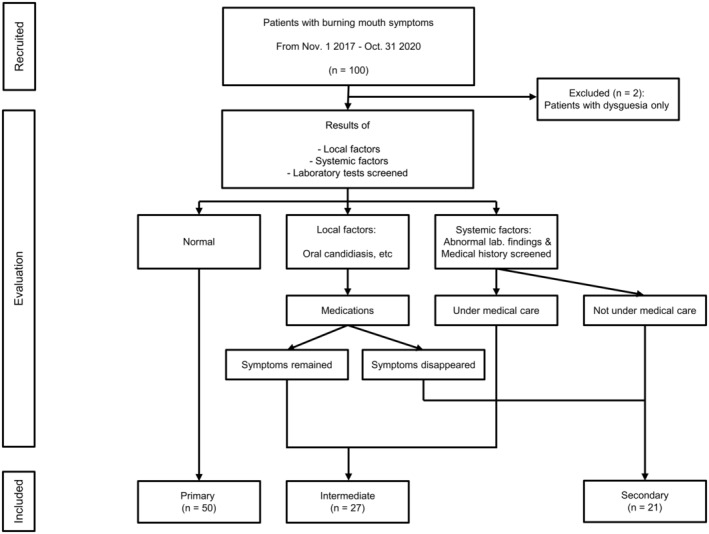
纳入98例绝经后女性BMS患者。分别将50例和21例患者分配至原发性组和继发性组。27例兼具原发性和继发性特征的患者被分配至中间组。分析综合临床特征和唾液生物标志物。

结果

三组患者在年龄、基于非刺激性全唾液(UWS)的唾液分泌减少患者比例、症状分布、灼痛严重程度及口腔不适对日常生活的影响(Eff-life)以及阳性症状困扰指数(PSDI)方面存在显著差异。原发性组的UWS流速显著高于继发性组,UWS唾液分泌减少患者比例更低,Eff-life严重程度更低。中间组的灼痛强度和Eff-life显著高于原发性组,PSDI评分更高。原发性组刺激全唾液中的皮质醇和脱氢表雄酮(DHEA)水平显著高于继发性组。

结论

本研究结果表明,临床特征可区分各类型BMS。皮质醇和DHEA水平是区分原发性和继发性BMS的潜在唾液生物标志物。
https://cdn.ncbi.nlm.nih.gov/pmc/blobs/1031/11610668/ed2fe3aba57d/ODI-30-5360-g001.jpg
https://cdn.ncbi.nlm.nih.gov/pmc/blobs/1031/11610668/b14ff3d2a4e0/ODI-30-5360-g002.jpg
https://cdn.ncbi.nlm.nih.gov/pmc/blobs/1031/11610668/ed2fe3aba57d/ODI-30-5360-g001.jpg
https://cdn.ncbi.nlm.nih.gov/pmc/blobs/1031/11610668/b14ff3d2a4e0/ODI-30-5360-g002.jpg
https://cdn.ncbi.nlm.nih.gov/pmc/blobs/1031/11610668/ed2fe3aba57d/ODI-30-5360-g001.jpg

相似文献

1
Clinical characteristics and salivary biomarkers of burning mouth syndrome.灼口综合征的临床特征与唾液生物标志物
Oral Dis. 2024 Nov;30(8):5360-5369. doi: 10.1111/odi.14959. Epub 2024 Apr 15.
2
Relationships between oral MUC1 expression and salivary hormones in burning mouth syndrome.口腔 MUC1 表达与灼口综合征唾液激素的关系。
Arch Oral Biol. 2017 Jun;78:58-64. doi: 10.1016/j.archoralbio.2017.01.022. Epub 2017 Feb 4.
3
Salivary cortisol, 17β-estradiol, progesterone, dehydroepiandrosterone, and α-amylase in patients with burning mouth syndrome.灼口综合征患者的唾液皮质醇、17β-雌二醇、孕酮、脱氢表雄酮和α-淀粉酶。
Oral Dis. 2012 Sep;18(6):613-20. doi: 10.1111/j.1601-0825.2012.01937.x. Epub 2012 Apr 26.
4
Salivary biomarkers in burning mouth syndrome: A systematic review and meta-analysis.口腔灼口综合征的唾液生物标志物:系统评价和荟萃分析。
Oral Dis. 2023 Oct;29(7):2600-2613. doi: 10.1111/odi.14390. Epub 2022 Oct 4.
5
Taste Perception and Saliva Composition Are Not Altered in Burning Mouth Syndrome.灼口综合征患者的味觉感知和唾液成分未发生改变。
Oral Dis. 2025 Apr;31(4):1317-1332. doi: 10.1111/odi.15201. Epub 2024 Dec 3.
6
Opiorphin in burning mouth syndrome patients: a case-control study.灼口综合征患者中的脑啡肽:一项病例对照研究。
Clin Oral Investig. 2017 Sep;21(7):2363-2370. doi: 10.1007/s00784-016-2031-9. Epub 2016 Dec 24.
7
Changes in salivary biomarkers of burning mouth syndrome patients after clonazepam treatment.氯硝西泮治疗后灼口综合征患者唾液生物标志物的变化。
J Oral Facial Pain Headache. 2024 Jun;38(2):111-118. doi: 10.22514/jofph.2024.019. Epub 2024 Jun 12.
8
Anxiety and salivary cortisol levels in patients with burning mouth syndrome: case-control study.灼口综合征患者的焦虑情绪与唾液皮质醇水平:病例对照研究
Oral Surg Oral Med Oral Pathol Oral Radiol Endod. 2008 Apr;105(4):460-5. doi: 10.1016/j.tripleo.2007.10.002.
9
Comparison of Salivary Opiorphin in Burning Mouth Syndrome and Healthy Subjects and Its Correlation With Psychiatric Disorders.比较灼口综合征患者和健康受试者的唾液中阿片肽的含量及其与精神障碍的相关性。
Clin Exp Dent Res. 2024 Dec;10(6):e934. doi: 10.1002/cre2.934.
10
Reduction in unstimulated salivary flow rate in burning mouth syndrome.灼口综合征患者非刺激性唾液流速降低。
Br Dent J. 2014 Oct;217(7):E14. doi: 10.1038/sj.bdj.2014.884.

引用本文的文献

1
Salivary Biomarkers for Oral Frailty in Patients With Burning Mouth Symptoms.灼口症状患者口腔衰弱的唾液生物标志物
Int Dent J. 2025 Aug 23;75(5):103868. doi: 10.1016/j.identj.2025.103868.
2
A scientometric study on research trends and characteristics of burning mouth syndrome.一项关于灼口综合征研究趋势与特征的科学计量学研究。
J Dent Sci. 2025 Apr;20(2):1252-1256. doi: 10.1016/j.jds.2025.01.009. Epub 2025 Jan 17.
3
Efficacy and safety of photobiomodulation combined with oral cryotherapy on oral mucosa pain in patients with burning mouth syndrome: a multi-institutional, randomized, controlled trial.

本文引用的文献

1
Efficacy of rikkosan for primary burning mouth syndrome: a retrospective study.立消散治疗原发性灼口综合征的疗效:一项回顾性研究。
Biopsychosoc Med. 2021 Oct 30;15(1):19. doi: 10.1186/s13030-021-00221-2.
2
Evaluation of serum neuron specific enolase levels among patients with primary and secondary burning mouth syndrome.原发性和继发性灼口综合征患者血清神经元特异性烯醇化酶水平的评估
Cephalalgia. 2022 Feb;42(2):119-127. doi: 10.1177/03331024211046613. Epub 2021 Oct 13.
3
Clinical Characteristics, Treatment Effectiveness, and Predictors of Response to Pharmacotherapeutic Interventions in Burning Mouth Syndrome: A Retrospective Analysis.
光生物调节联合口服冷冻疗法治疗灼口综合征患者口腔黏膜疼痛的疗效与安全性:一项多机构、随机、对照试验
BMC Med. 2025 Apr 7;23(1):196. doi: 10.1186/s12916-025-04015-z.
4
Studies on Burning Mouth Syndrome in the Past 20 Years: A Bibliometric and Visualised Analysis.过去20年灼口综合征的研究:文献计量与可视化分析
Int Dent J. 2025 Apr;75(2):426-438. doi: 10.1016/j.identj.2024.09.034. Epub 2024 Nov 23.
烧口综合征的临床特征、治疗效果及药物干预反应的预测因素:回顾性分析。
J Oral Facial Pain Headache. 2020;34(2):157-166. doi: 10.11607/ofph.2180.
4
Comparison of clinical characteristics between burning mouth syndrome patients with bilateral and unilateral symptoms.比较双侧和单侧灼口综合征患者的临床特征。
Int J Oral Maxillofac Surg. 2020 Jan;49(1):38-43. doi: 10.1016/j.ijom.2019.06.013. Epub 2019 Jun 21.
5
World Workshop on Oral Medicine VII: Burning mouth syndrome: A systematic review of disease definitions and diagnostic criteria utilized in randomized clinical trials.世界口腔医学研讨会 VII:灼口综合征:随机临床试验中使用的疾病定义和诊断标准的系统评价。
Oral Dis. 2019 Jun;25 Suppl 1:141-156. doi: 10.1111/odi.13067.
6
Blood contamination in salivary diagnostics: current methods and their limitations.唾液诊断中的血液污染:当前方法及其局限性。
Clin Chem Lab Med. 2019 Jul 26;57(8):1115-1124. doi: 10.1515/cclm-2018-0739.
7
Salivary biomarkers of inflammation and oxidative stress in healthy adults.健康成年人的炎症和氧化应激的唾液生物标志物。
Arch Oral Biol. 2019 Jan;97:215-222. doi: 10.1016/j.archoralbio.2018.10.026. Epub 2018 Oct 24.
8
Clinical factors affecting salivary transferrin level, a marker of blood contamination in salivary analysis.影响唾液转铁蛋白水平的临床因素,唾液分析中血液污染的一个标志物。
BMC Oral Health. 2018 Mar 21;18(1):49. doi: 10.1186/s12903-018-0510-x.
9
Comparison between burning mouth syndrome patients with and without psychological problems.伴有和不伴有心理问题的灼口综合征患者之间的比较。
Int J Oral Maxillofac Surg. 2018 Jul;47(7):879-887. doi: 10.1016/j.ijom.2018.02.001. Epub 2018 Mar 2.
10
Is burning mouth syndrome a neuropathic pain condition?灼口综合征是一种神经性疼痛疾病吗?
Pain. 2018 Mar;159(3):610-613. doi: 10.1097/j.pain.0000000000001090.