Kassis Wassilis, Aksoy Dilan, Favre Céline Anne, Arnold Julia, Gaugler Stefan, Grafinger Katharina Elisabeth, Artz Sibylle, Magnuson Doug
School of Education, University of Applied Sciences, Windisch, Switzerland.
School of Life Sciences, University of Applied Sciences, Muttenz, Switzerland.
Front Psychiatry. 2024 Apr 2;15:1345844. doi: 10.3389/fpsyt.2024.1345844. eCollection 2024.
To understand the family's role in adolescents' mental health development and the connection to neurodevelopmental disorders related to experienced parental physical abuse, we first explored resilience pathways longitudinally and secondly, connected the identified patterns to adolescents' hair cortisol levels that are rooted in the hypothalamic-pituitary-adrenal axis as the main stress response system and connected brain structure alterations.
We analyzed longitudinal online questionnaire data for three consecutive high school years (from seventh to ninth grade) and four survey waves from a representative sample of = 1609 high school students in Switzerland on violence-resilience pathways. Furthermore, we collected students' hair samples from a subsample of = 229 at survey wave 4. About 30% of the participating adolescents had been physically abused by their parents. Out of the overall sample, we drew a subsample of adolescents with parental abuse experiences (survey wave 1 = 509; survey wave 2 = 506; survey wave 3 = 561; survey wave 4 = 560).
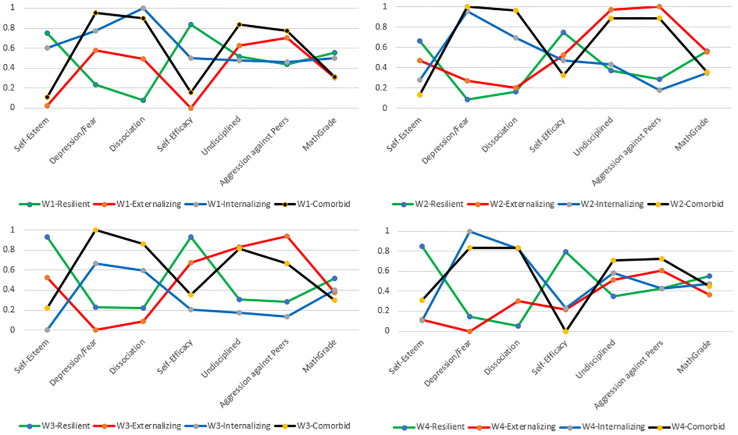
Despite the odds, about 20-30% of adolescents who have experienced parental physical abuse escaped the family violence cycle and can be called resilient. By applying a person-oriented analytical approach via latent class and transition analysis, we longitudinally identified and compared four distinct violence-resilience patterns. We identified violence resilience as a multidimensional latent construct, which includes hedonic and eudaimonic protective and risk indicators. Because resilience should not solely be operationalized based on the lack of psychopathology, our latent construct included both feeling good (hedonic indicators such as high levels of self-esteem and low levels of depression/anxiety and dissociation) and doing well (eudaimonic indicators such as high levels of self-determination and self-efficacy as well as low levels of aggression toward peers).
The present study confirmed that higher cortisol levels significantly relate to the comorbid pattern (internalizing and externalizing symptoms), and further confirmed the presence of lasting alterations in brain structures. In this way, we corroborated the insight that when studying the resilience pathways and trajectories of abused adolescents, biological markers such as hair cortisol significantly enhance and deepen the understanding of the longitudinal mechanisms of psychological markers (e.g., self-determination, self-esteem, self-efficacy) that are commonly applied in questionnaires.
为了解家庭在青少年心理健康发展中的作用以及与因遭受父母身体虐待而导致的神经发育障碍之间的联系,我们首先纵向探索了复原力途径,其次,将所识别的模式与青少年的头发皮质醇水平联系起来,头发皮质醇水平源于作为主要应激反应系统的下丘脑 - 垂体 - 肾上腺轴,并与脑结构改变相关。
我们分析了瑞士1609名高中生的代表性样本连续三个高中年级(从七年级到九年级)的纵向在线问卷数据以及关于暴力 - 复原力途径的四次调查数据。此外,我们在第四次调查时从229名子样本中收集了学生的头发样本。约30%的参与青少年曾遭受父母身体虐待。在整个样本中,我们抽取了有父母虐待经历的青少年子样本(第一次调查 = 509人;第二次调查 = 506人;第三次调查 = 561人;第四次调查 = 560人)。
尽管困难重重,但约20 - 30%遭受父母身体虐待的青少年摆脱了家庭暴力循环,可被称为具有复原力。通过运用基于潜在类别和转变分析的以人为本的分析方法,我们纵向识别并比较了四种不同的暴力 - 复原力模式。我们将暴力复原力确定为一个多维潜在结构,其中包括享乐主义和幸福主义的保护及风险指标。由于复原力不应仅基于缺乏精神病理学来衡量,我们的潜在结构既包括感觉良好(享乐主义指标,如高自尊水平、低抑郁/焦虑和解离水平),也包括表现良好(幸福主义指标,如高自我决定水平、高自我效能水平以及对同伴低攻击水平)。
本研究证实较高的皮质醇水平与共病模式(内化和外化症状)显著相关,并进一步证实了脑结构存在持久改变。通过这种方式,我们证实了这样一种观点,即在研究受虐待青少年的复原力途径和轨迹时,头发皮质醇等生物学标志物显著增强并深化了对问卷中常用心理标志物(如自我决定、自尊、自我效能)纵向机制的理解。