Chen Hsiao-Jou Cortina, Spiers Jereme G, Lerskiatiphanich Titaya, Parker Sandra E, Lavidis Nickolas A, Fung Jenny N, Woodruff Trent M, Lee John D
School of Biomedical Sciences, the University of Queensland, St. Lucia, Brisbane, Queensland, Australia.
Metabolic Research Laboratories, Wellcome Trust MRC Institute of Metabolic Science, University of Cambridge, Addenbrooke's Hospital, Cambridge, United Kingdom.
Biol Psychiatry Glob Open Sci. 2024 Mar 7;4(3):100306. doi: 10.1016/j.bpsgos.2024.100306. eCollection 2024 May.
Accumulating evidence underscores the pivotal role of heightened inflammation in the pathophysiology of stress-related diseases, but the underlying mechanisms remain elusive. The complement system, a key effector of the innate immune system, produces the C5-cleaved activation product C5a upon activation, initiating inflammatory responses through the canonical C5a receptor 1 (C5aR1). While C5aR1 is expressed in stress-responsive brain regions, its role in stress responsiveness remains unknown.
To investigate C5a-C5aR1 signaling in stress responses, mice underwent acute and chronic stress paradigms. Circulating C5a levels and messenger RNA expression of C5aR1 in the hippocampus and adrenal gland were measured. C5aR1-deficient mice were used to elucidate the effects of disrupted C5a-C5aR1 signaling across behavioral, hormonal, metabolic, and inflammation parameters.
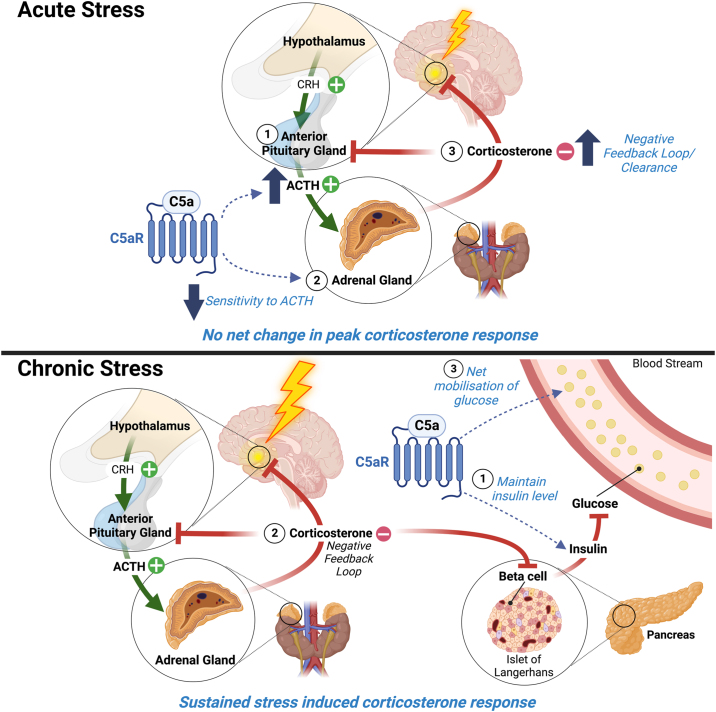
Chronic restraint stress elevated circulating C5a levels while reducing C5aR1 messenger RNA expression in the hippocampus and adrenal gland. Notably, the absence of C5aR1 signaling enhanced adrenal sensitivity to adrenocorticotropic hormone, concurrently reducing pituitary adrenocorticotropic hormone production and enhancing the response to acute stress. C5aR1-deficient mice exhibited attenuated reductions in locomotor activity and body weight under chronic stress. Additionally, these mice displayed increased glucocorticoid receptor sensitivity and disrupted glucose and insulin homeostasis. Chronic stress induced an increase in C5aR1-expressing microglia in the hippocampus, a response mitigated in C5aR1-deficient mice.
C5a-C5aR1 signaling emerges as a key metabolic regulator during stress, suggesting that complement activation and dysfunctional C5aR1 signaling may contribute to neuroinflammatory phenotypes in stress-related disorders. The results advocate for further exploration of complement C5aR1 as a potential therapeutic target for stress-related conditions.
越来越多的证据强调了炎症加剧在应激相关疾病病理生理学中的关键作用,但其潜在机制仍不清楚。补体系统是固有免疫系统的关键效应器,激活后会产生C5裂解激活产物C5a,通过经典的C5a受体1(C5aR1)引发炎症反应。虽然C5aR1在应激反应性脑区表达,但其在应激反应中的作用仍不清楚。
为了研究C5a - C5aR1信号在应激反应中的作用,对小鼠进行急性和慢性应激范式实验。测量循环C5a水平以及海马体和肾上腺中C5aR1的信使核糖核酸表达。使用C5aR1缺陷小鼠来阐明C5a - C5aR1信号中断对行为、激素、代谢和炎症参数的影响。
慢性束缚应激会提高循环C5a水平,同时降低海马体和肾上腺中C5aR1信使核糖核酸的表达。值得注意的是,缺乏C5aR1信号会增强肾上腺对促肾上腺皮质激素的敏感性,同时减少垂体促肾上腺皮质激素的产生,并增强对急性应激的反应。C5aR1缺陷小鼠在慢性应激下运动活动和体重的减轻减弱。此外,这些小鼠表现出糖皮质激素受体敏感性增加以及葡萄糖和胰岛素稳态紊乱。慢性应激会导致海马体中表达C5aR1的小胶质细胞增加,而在C5aR1缺陷小鼠中这种反应会减轻。
C5a - C5aR1信号在应激过程中成为关键的代谢调节因子,这表明补体激活和功能失调的C5aR1信号可能导致应激相关疾病中的神经炎症表型。这些结果主张进一步探索补体C5aR1作为应激相关病症的潜在治疗靶点。