Fan Xing, Song Jin-Wen, Wang Si-Yu, Cao Wen-Jing, Wang Xiu-Wen, Zhou Ming-Ju, Yang Tao, Zhou Chun-Bao, Hou Jun, Zhang Ji-Yuan, Meng Fan-Ping, Shi Ming, Wang Fu-Sheng, Zhang Chao
Department of Infectious Diseases, Fifth Medical Center of Chinese PLA General Hospital, National Clinical Research Center for Infectious Diseases, Beijing 100039, China.
Medical School of Chinese PLA, Beijing 100853, China.
Infect Dis Immun. 2021 Apr 20;1(1):20-27. doi: 10.1097/01.ID9.0000733572.40970.6c. eCollection 2021 Apr.
The development of severe coronavirus disease 2019 (COVID-19) is associated with systemic hyperinflammation, which drives multi-organ failure and death. Disease deterioration tends to occur when the virus is receding; however, whether other factors besides viral products are involved in the inflammatory cascade remains unclear.
Twenty-eight COVID-19 patients with laboratory-confirmed SARS-CoV-2 infection hospitalized at the Fifth Medical Center of Chinese PLA General Hospital from January 23 to February 20, 2020 and nine healthy donors during the same period were recruited in the study. COVID-19 patients were grouped as mild, moderate, severe based on disease severity. Plasma damage-associated molecular patterns (DAMPs), including high mobility group box 1 (HMGB1), calprotectin (S100A8/A9), surfactant protein A (SP-A), cold-inducible RNA-binding protein (CIRBP), and Histone H4 were detected by ELISA assay, and analyzed in combination with clinical data. Plasma cytokines, chemokines and lymphocytes were determined by flow cytometry.
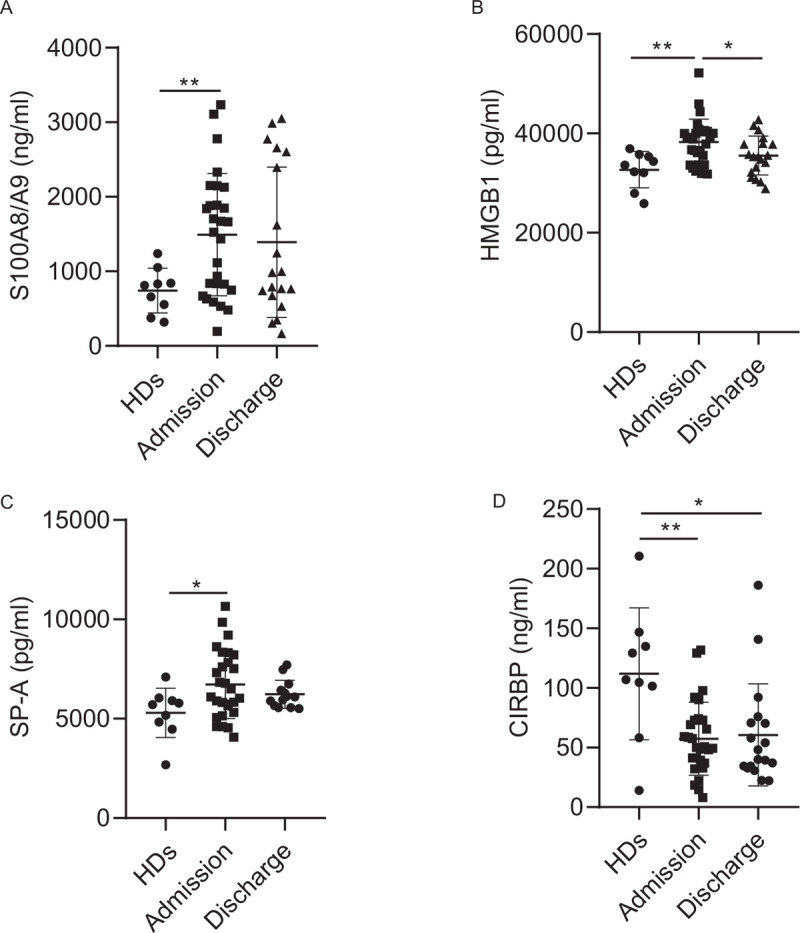
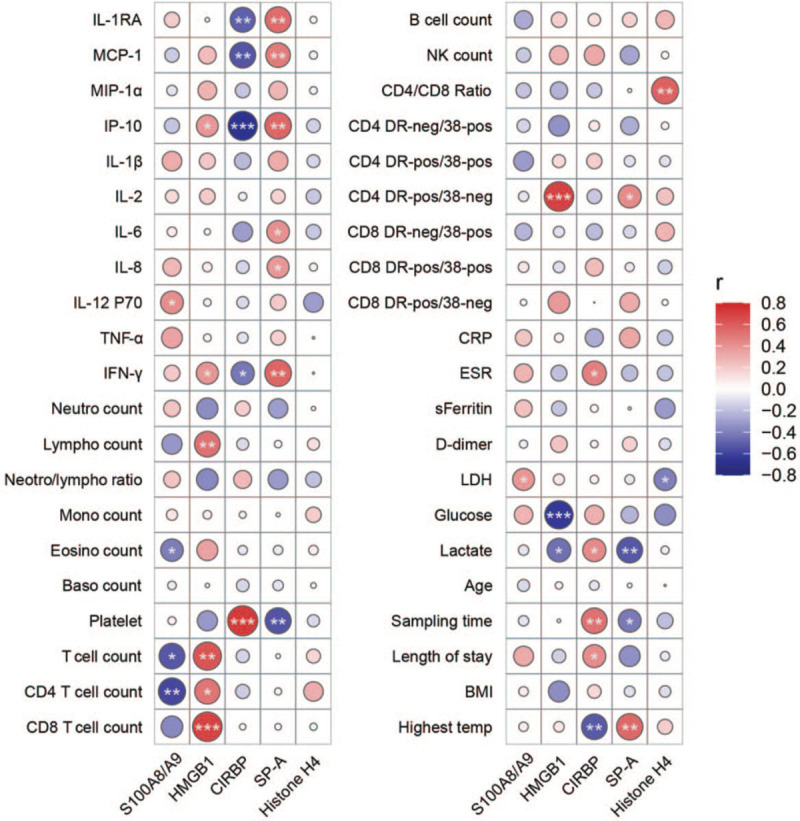
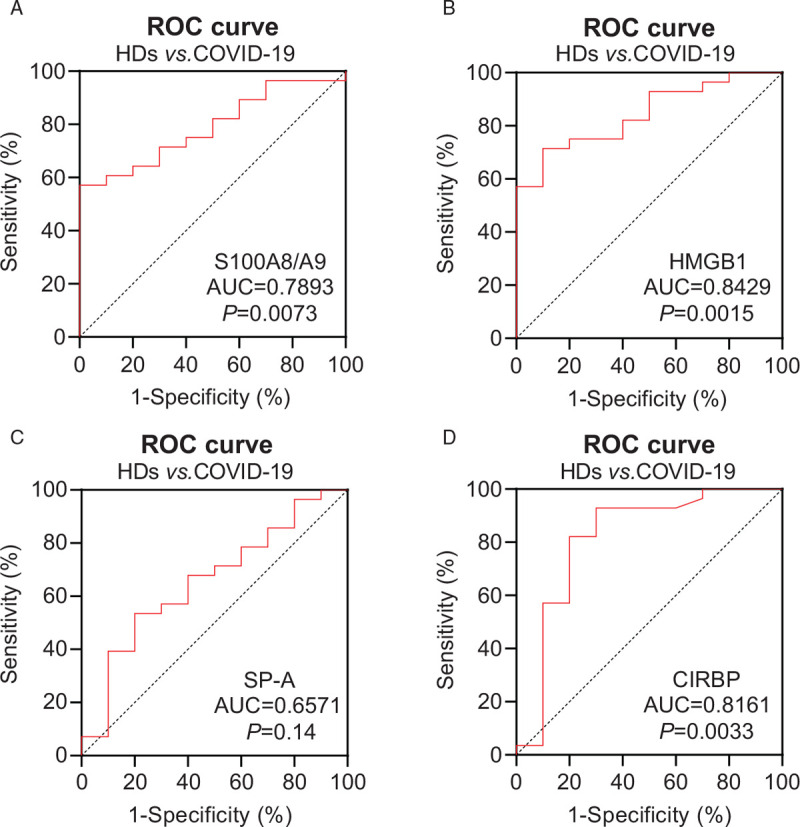
Plasma levels of HMGB1 (38292.3 ± 4564.4 32686.3 ± 3678.1, = 0.002), S100A8/A9 (1490.8 ± 819.3 742.2 ± 300.8, = 0.015), and SP-A (6713.6 ± 1708.7 5296.3 ± 1240.4, = 0.048) were increased in COVID-19 patients compared to healthy donors, while CIRBP (57.4 ± 30.7 111.9 ± 55.2, = 0.004) levels decreased. Five DAMPs did not vary among mild, moderate, and severe patients. Moreover, SP-A levels correlated positively with inflammatory cytokines and negatively with time elapsed after symptom onset, whereas CIRBP showed an opposite pattern.
These findings suggest SP-A may involve in the inflammation of COVID-19, while CIRBP likely plays a protective role. Therefore, DAMPs represent a potential target in the prevention or treatment of COVID-19.
2019年冠状病毒病(COVID-19)重症的发展与全身炎症反应增强有关,后者可导致多器官功能衰竭和死亡。疾病恶化往往发生在病毒消退时;然而,除病毒产物外,是否有其他因素参与炎症级联反应仍不清楚。
选取2020年1月23日至2月20日在中国人民解放军总医院第五医学中心住院的28例实验室确诊的严重急性呼吸综合征冠状病毒2型(SARS-CoV-2)感染的COVID-19患者以及同期9名健康供者纳入研究。根据疾病严重程度将COVID-19患者分为轻症、中症、重症组。采用酶联免疫吸附测定法检测血浆中损伤相关分子模式(DAMP),包括高迁移率族蛋白B1(HMGB1)、钙卫蛋白(S100A8/A9)、表面活性蛋白A(SP-A)、冷诱导RNA结合蛋白(CIRBP)和组蛋白H4,并结合临床资料进行分析。采用流式细胞术检测血浆细胞因子、趋化因子和淋巴细胞。
与健康供者相比,COVID-19患者血浆中HMGB1(38292.3±4564.4对32686.3±3678.1,P=0.002)、S100A8/A9(1490.8±819.3对742.2±300.8,P=0.015)和SP-A(6713.6±1708.7对5296.3±1240.4,P=0.048)水平升高,而CIRBP(57.4±30.7对111.9±55.2,P=0.004)水平降低。5种DAMP在轻症、中症和重症患者中无差异。此外,SP-A水平与炎症细胞因子呈正相关,与症状出现后的时间呈负相关,而CIRBP表现出相反的模式。
这些发现提示SP-A可能参与COVID-19的炎症反应,而CIRBP可能起保护作用。因此,DAMP是COVID-19预防或治疗的潜在靶点。