Department of Women's and Children's Health, Karolinska Institutet at Karolinska University Hospital, Tomtebodavägen 18A, 171 77, Stockholm, Sweden.
Air Ambulance department, Oslo University Hospital, Oslo, Norway.
Mol Med. 2020 May 7;26(1):42. doi: 10.1186/s10020-020-00172-4.
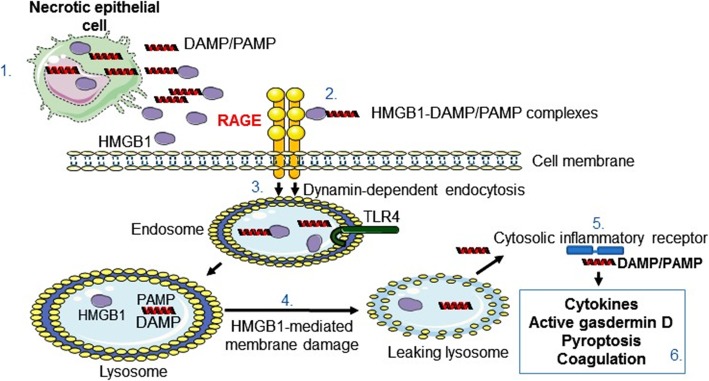
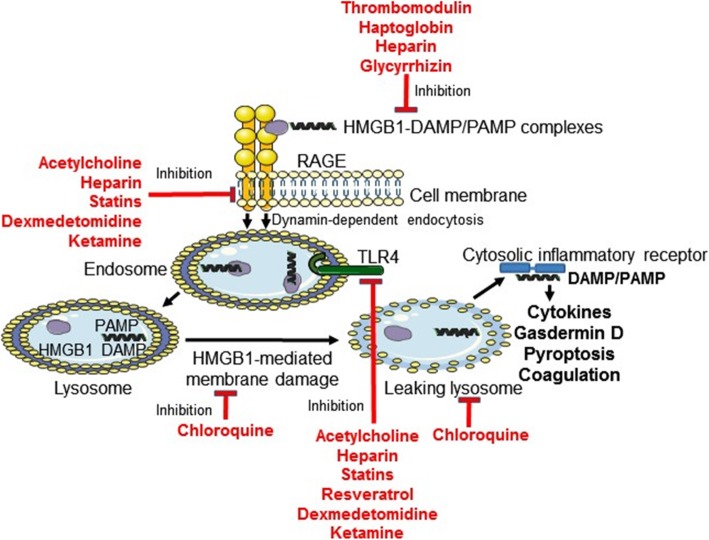
The 2019 novel coronavirus disease (COVID-19) causes for unresolved reasons acute respiratory distress syndrome in vulnerable individuals. There is a need to identify key pathogenic molecules in COVID-19-associated inflammation attainable to target with existing therapeutic compounds. The endogenous damage-associated molecular pattern (DAMP) molecule HMGB1 initiates inflammation via two separate pathways. Disulfide-HMGB1 triggers TLR4 receptors generating pro-inflammatory cytokine release. Extracellular HMGB1, released from dying cells or secreted by activated innate immunity cells, forms complexes with extracellular DNA, RNA and other DAMP or pathogen-associated molecular (DAMP) molecules released after lytic cell death. These complexes are endocytosed via RAGE, constitutively expressed at high levels in the lungs only, and transported to the endolysosomal system, which is disrupted by HMGB1 at high concentrations. Danger molecules thus get access to cytosolic proinflammatory receptors instigating inflammasome activation. It is conceivable that extracellular SARS-CoV-2 RNA may reach the cellular cytosol via HMGB1-assisted transfer combined with lysosome leakage. Extracellular HMGB1 generally exists in vivo bound to other molecules, including PAMPs and DAMPs. It is plausible that these complexes are specifically removed in the lungs revealed by a 40% reduction of HMGB1 plasma levels in arterial versus venous blood. Abundant pulmonary RAGE expression enables endocytosis of danger molecules to be destroyed in the lysosomes at physiological HMGB1 levels, but causing detrimental inflammasome activation at high levels. Stress induces apoptosis in pulmonary endothelial cells from females but necrosis in cells from males.
Based on these observations we propose extracellular HMGB1 to be considered as a therapeutic target for COVID-19.
2019 年新型冠状病毒病(COVID-19)导致易感染个体出现原因不明的急性呼吸窘迫综合征。需要确定 COVID-19 相关炎症中的关键致病分子,以便用现有治疗化合物作为靶点。内源性损伤相关分子模式(DAMP)分子 HMGB1 通过两条独立的途径引发炎症。二硫键 HMGB1 触发 TLR4 受体,产生促炎细胞因子释放。细胞外 HMGB1 从死亡细胞释放或由激活的固有免疫细胞分泌,与细胞外 DNA、RNA 和其他 DAMP 或病原体相关分子(DAMP)分子形成复合物,这些复合物在高浓度 HMGB1 作用下通过 RAGE 内吞,RAGE 仅在肺部高表达。这些复合物被内体溶酶体系统摄取,该系统在高浓度 HMGB1 作用下被破坏。危险分子因此进入细胞质中的促炎受体,引发炎症小体激活。可以想象,细胞外 SARS-CoV-2 RNA 可能通过 HMGB1 辅助转移与溶酶体泄漏一起到达细胞细胞质。细胞外 HMGB1 通常与其他分子(包括 PAMP 和 DAMPs)结合存在于体内。这些复合物很可能在肺部被特异性清除,这可以从动脉血与静脉血相比 HMGB1 血浆水平降低 40%中得到证实。丰富的肺部 RAGE 表达使危险分子能够在生理 HMGB1 水平下在溶酶体中被内吞,但在高水平下会导致有害的炎症小体激活。应激诱导雌性肺内皮细胞凋亡,但诱导雄性细胞坏死。
基于这些观察结果,我们提出将细胞外 HMGB1 视为 COVID-19 的治疗靶点。