Médecine Intensive Réanimation, APHP.Nord, Hôpital Bichat Claude Bernard, Paris, France
INSERM UMR 1137, IAME, Université Paris Cité, Paris, France.
BMJ Open. 2024 Apr 17;14(4):e083414. doi: 10.1136/bmjopen-2023-083414.
Physical restraint (PR) is prescribed in patients receiving invasive mechanical ventilation in the intensive care unit (ICU) to avoid unplanned removal of medical devices. However, it is associated with an increased risk of delirium. We hypothesise that a restrictive use of PR, as compared with a systematic use, could reduce the duration of delirium in ICU patients receiving invasive mechanical ventilation.
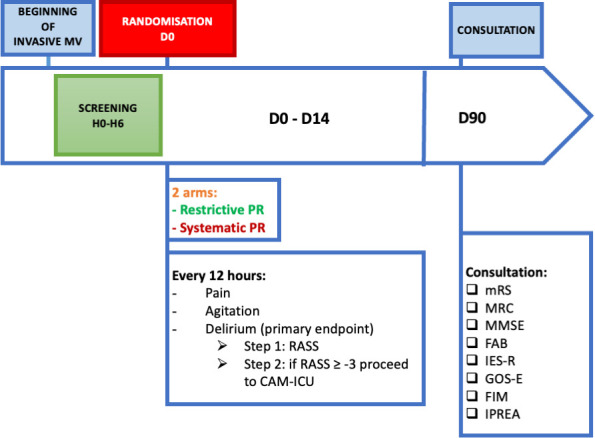
The Restrictive use of Restraints and Delirium Duration in ICU (R2D2-ICU) study is a national multicentric, parallel-group, randomised (1:1) open-label, controlled, superiority trial, which will be conducted in 10 ICUs. A total of 422 adult patients requiring invasive mechanical ventilation for an expected duration of at least 48 hours and eligible for prescription of PR will be randomly allocated within 6 hours from intubation to either the restrictive PR use group or the systematic PR use group, until day 14, ICU discharge or death, whichever comes first. In both groups, PR will consist of the use of wrist straps. The primary endpoint will be delirium or coma-free days, defined as the number of days spent alive in the ICU without coma or delirium within the first 14 days after randomisation. Delirium will be assessed using the Confusion Assessment Method-ICU twice daily. Key secondary endpoints will encompass agitation episodes, opioid, propofol, benzodiazepine and antipsychotic drug exposure during the 14-day intervention period, along with a core outcome set of measures evaluated 90 days postrandomisation.
The R2D2-ICU study has been approved by the Comité de Protection des Personnes (CPP) ILE DE FRANCE III-PARIS (CPP19.09.06.37521) on June 10th, 2019). Participant recruitment started on 25 January 2021. Results will be published in international peer-reviewed medical journals and presented at conferences.
NCT04273360.
在重症监护病房(ICU)接受有创机械通气的患者中,通常会使用身体约束(PR)来避免医疗设备被意外移除。但它与谵妄风险增加有关。我们假设与系统使用相比,限制使用 PR 可以减少 ICU 接受有创机械通气的患者谵妄的持续时间。
“限制使用约束和 ICU 谵妄持续时间(R2D2-ICU)”研究是一项全国性、多中心、平行组、随机(1:1)、开放性、对照、优效性试验,将在 10 个 ICU 中进行。共有 422 名预计需要接受有创机械通气至少 48 小时且有资格开具 PR 处方的成年患者,将在插管后 6 小时内随机分配到限制 PR 使用组或系统 PR 使用组,直至第 14 天、ICU 出院或死亡,以先发生者为准。在两组中,PR 将包括使用腕带。主要终点是无谵妄或昏迷天数,定义为随机分组后前 14 天内无昏迷或谵妄的 ICU 存活天数。谵妄将使用 ICU 意识模糊评估方法(CAM-ICU)每天评估两次。次要终点包括 14 天干预期间的激越发作、阿片类药物、丙泊酚、苯二氮䓬类药物和抗精神病药物暴露,以及 90 天随机分组后评估的核心结局集测量。
R2D2-ICU 研究已于 2019 年 6 月 10 日获得法兰西岛 III-巴黎保护委员会(CPP19.09.06.37521)的批准。患者招募于 2021 年 1 月 25 日开始。研究结果将发表在国际同行评议的医学期刊上,并在会议上展示。
NCT04273360。