Institute for Integrative Systems Biology (I2SysBio), CSIC - University of Valencia, 46980, Paterna, Spain.
Department of Plant Biology, Uppsala BioCenter, Swedish University of Agricultural Sciences and Linnean Center for Plant Biology, Uppsala, Sweden.
NPJ Syst Biol Appl. 2024 Apr 17;10(1):41. doi: 10.1038/s41540-024-00367-z.
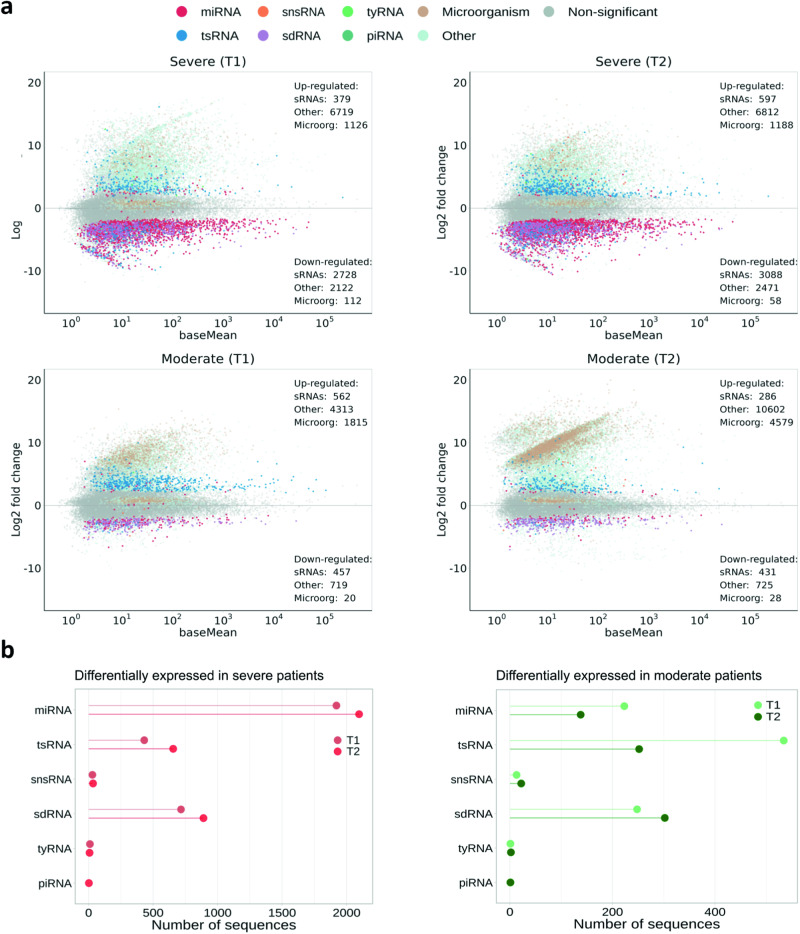
The COVID-19 pandemic caused by the coronavirus SARS-CoV-2 has significantly impacted global health, stressing the necessity of basic understanding of the host response to this viral infection. In this study, we investigated how SARS-CoV-2 remodels the landscape of small non-coding RNAs (sncRNA) from a large collection of nasopharyngeal swab samples taken at various time points from patients with distinct symptom severity. High-throughput RNA sequencing analysis revealed a global alteration of the sncRNA landscape, with abundance peaks related to species of 21-23 and 32-33 nucleotides. Host-derived sncRNAs, including microRNAs (miRNAs), transfer RNA-derived small RNAs (tsRNAs), and small nucleolar RNA-derived small RNAs (sdRNAs) exhibited significant differential expression in infected patients compared to controls. Importantly, miRNA expression was predominantly down-regulated in response to SARS-CoV-2 infection, especially in patients with severe symptoms. Furthermore, we identified specific tsRNAs derived from Glu- and Gly-tRNAs as major altered elements upon infection, with 5' tRNA halves being the most abundant species and suggesting their potential as biomarkers for viral presence and disease severity prediction. Additionally, down-regulation of C/D-box sdRNAs and altered expression of tinyRNAs (tyRNAs) were observed in infected patients. These findings provide valuable insights into the host sncRNA response to SARS-CoV-2 infection and may contribute to the development of further diagnostic and therapeutic strategies in the clinic.
由冠状病毒 SARS-CoV-2 引起的 COVID-19 大流行对全球健康造成了重大影响,强调了人们有必要基本了解宿主对这种病毒感染的反应。在这项研究中,我们调查了 SARS-CoV-2 如何从不同症状严重程度的患者在不同时间点采集的大量鼻咽拭子样本中重塑小非编码 RNA(sncRNA)的图谱。高通量 RNA 测序分析揭示了 sncRNA 图谱的全局改变,丰度峰值与 21-23 个和 32-33 个核苷酸的物种有关。与对照相比,感染患者中宿主来源的 sncRNA,包括 microRNAs(miRNAs)、转移 RNA 衍生的小 RNA(tsRNAs)和小核仁 RNA 衍生的小 RNA(sdRNAs)的表达水平有显著差异。重要的是,miRNA 的表达在 SARS-CoV-2 感染后主要下调,尤其是在症状严重的患者中。此外,我们发现感染后特定的 Glu- 和 Gly-tRNAs 衍生的 tsRNAs 是主要改变的元素,5' tRNA 一半是最丰富的物种,这表明它们可能成为病毒存在和疾病严重程度预测的生物标志物。此外,在感染患者中还观察到 C/D-box sdRNAs 的下调和 tinyRNAs(tyRNAs)的表达改变。这些发现为宿主对 SARS-CoV-2 感染的 sncRNA 反应提供了有价值的见解,并可能有助于进一步开发临床诊断和治疗策略。