Kostova Polina, Petrova Guergana, Shahid Martin, Papochieva Vera, Miteva Dimitrinka, Yordanova Ivelina, Drenovska Kossara, Bradinova Irena, Janniger Camila K, Schwartz Robert A, Vassileva Snejina
Pediatric Department Medical University Sofia Bulgaria.
Pediatric Clinic, UMHAT Alexandrovska Sofia Bulgaria.
Clin Case Rep. 2024 Apr 16;12(4):e8770. doi: 10.1002/ccr3.8770. eCollection 2024 Apr.
High-dose intravenous immunoglobulin exhibits great potential in the treatment of Netherton syndrome.
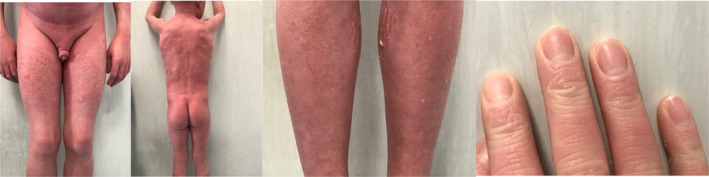
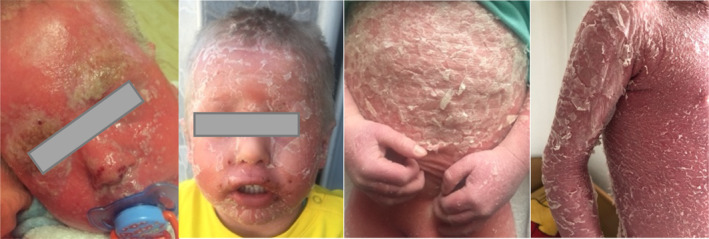
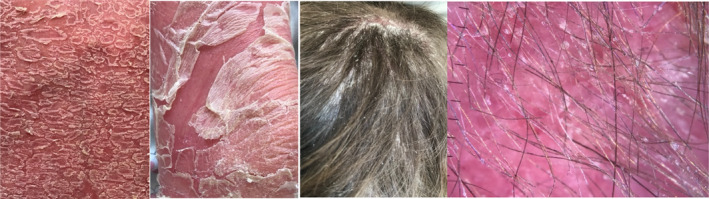
Netherton syndrome (NS) is a rare autosomal recessive genodermatosis (OMIM #256500) characterized by superficial scaling, atopic manifestations, and multisystemic complications. It is caused by loss-of-function mutations in the SPINK5 gene, which encode a key kallikrein protease inhibitor. There are two subtypes of the syndrome that differ in clinical presentation and immune profile: ichthyosiform erythroderma and ichthyosis linearis circumflexa. NS is a multisystemic disease with numerous extracutaneous manifestations. Current therapy for patients with NS is mainly supportive, as there is no curative or specific treatment, especially for children with NS, but targeted therapies are being developed. We describe an 8-year-old boy with genetically proven NS treated with intravenous immunoglobulin for recurrent skin and systemic infections from infancy, growth retardation, and associated erythroderma. Under this therapy, his skin status, infectious exacerbations, and quality of life all improved. Knowledge of the cytokine-mediated pathogenesis of NS and the development of new biologic drugs open new possibilities for NS patients. However, the different therapeutic options have been applied in a limited number of cases, and variable responses have been shown. Randomized controlled trials with a sufficient number of patients stratified and treated according to their specific immune profile and clinical phenotype are needed to evaluate the safety and efficacy of treatment options for patients with NS.
大剂量静脉注射免疫球蛋白在Netherton综合征的治疗中显示出巨大潜力。
Netherton综合征(NS)是一种罕见的常染色体隐性遗传性皮肤病(OMIM #256500),其特征为浅表脱屑、特应性表现和多系统并发症。它由SPINK5基因的功能丧失突变引起,该基因编码一种关键的激肽释放酶蛋白酶抑制剂。该综合征有两种亚型,临床表现和免疫特征不同:鱼鳞癣样红皮病和回旋状线状鱼鳞病。NS是一种具有多种皮肤外表现的多系统疾病。目前NS患者的治疗主要是支持性的,因为没有治愈性或特异性治疗方法,尤其是对于NS患儿,但靶向治疗正在研发中。我们描述了一名8岁男孩,经基因证实患有NS,自婴儿期起因反复皮肤和全身感染、生长发育迟缓及相关红皮病接受静脉注射免疫球蛋白治疗。在这种治疗下,他的皮肤状况、感染加重情况和生活质量均有所改善。了解NS的细胞因子介导发病机制以及新型生物药物的研发为NS患者开辟了新的可能性。然而,不同的治疗方案应用的病例数量有限,且显示出不同的反应。需要进行随机对照试验,纳入足够数量的患者,并根据其特定的免疫特征和临床表型进行分层和治疗,以评估NS患者治疗方案的安全性和有效性。