Kramer Emily B, Pietri Evava S, Bryan Angela D
Department of Psychology and Neuroscience, University of Colorado Boulder, Muenzinger D244, 345 UCB, Boulder, CO, 80309-0345, USA.
J Eat Disord. 2024 Apr 18;12(1):46. doi: 10.1186/s40337-024-00994-1.
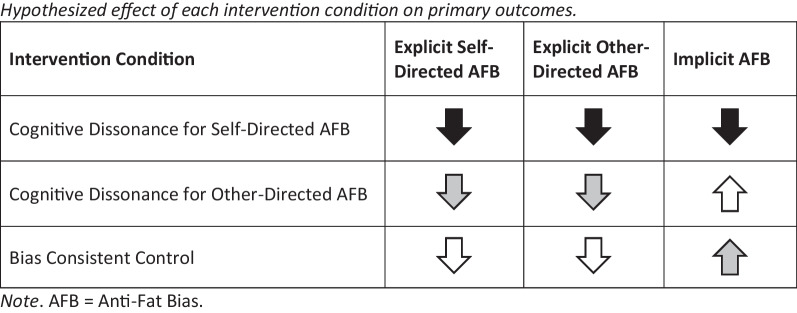
Despite strong evidence linking anti-fat bias directed toward others with markers of self-directed anti-fat bias, there is a dearth of theory-based research examining the cognitive pathways underlying this relationship, and existing bias-reduction intervention efforts have thus far been conducted with exclusive focus on one domain or the other. Cognitive dissonance (CD)-based interventions have been identified as viable for reducing anti-fat bias directed toward the self and others. However, no study has yet examined whether the effects of these domain-specific interventions (e.g., anti-fat bias towards the self) extend to anti-fat bias in the non-targeted domain (e.g., anti-fat bias towards others). The present study aimed to address these gaps in the literature by comparing effects of brief CD-based interventions targeting anti-fat bias directed toward either the self or others on measures of anti-fat bias. Participants (N = 197, female-identifying undergraduates) were randomized to a writing activity prompting cognitive dissonance about either self-directed or other-directed anti-fat bias, or a bias-consistent control condition. Results indicated that participants in the CD intervention conditions showed significantly greater reductions in both explicit self- and other-directed anti-fat biases than those in the control condition, but results did not significantly differ across CD conditions. This supports the potential utility of interventions simultaneously targeting anti-fat bias in both domains and provides insight into the cognitive pathways underlying these related forms of bias.
尽管有强有力的证据表明,针对他人的反胖偏见与自我导向的反胖偏见相关,但缺乏基于理论的研究来探究这种关系背后的认知途径,而且迄今为止,现有的减少偏见干预措施都只专注于其中一个领域。基于认知失调(CD)的干预措施已被认为是减少针对自我和他人的反胖偏见的可行方法。然而,尚无研究考察这些特定领域干预措施(例如,针对自我的反胖偏见)的效果是否会扩展到非目标领域的反胖偏见(例如,针对他人的反胖偏见)。本研究旨在通过比较针对自我或他人的反胖偏见的简短CD干预措施对反胖偏见测量的影响,来填补文献中的这些空白。参与者(N = 197,自我认同为女性的本科生)被随机分配到一个写作活动中,该活动引发对自我导向或他人导向的反胖偏见的认知失调,或一个与偏见一致的对照条件。结果表明,与对照条件下的参与者相比,CD干预条件下的参与者在明确的自我导向和他人导向的反胖偏见方面都有显著更大程度的降低,但CD条件之间的结果没有显著差异。这支持了同时针对两个领域的反胖偏见的干预措施的潜在效用,并为这些相关形式的偏见背后的认知途径提供了见解。