Department of Cardiology, University Hospital Ramón y Cajal, Madrid, Spain.
Instituto Ramón y Cajal de Investigación Sanitaria (IRYCIS), Madrid, Spain.
ESC Heart Fail. 2024 Aug;11(4):2272-2286. doi: 10.1002/ehf2.14765. Epub 2024 Apr 18.
Severe functional tricuspid regurgitation (FTR) is associated with high risk of cardiovascular events, particularly heart failure (HF) and mortality. MicroRNAs (miRNAs) have been recently identified as novel biomarkers in different cardiovascular conditions, but no studies have focused on FTR. We sought to (1) to identify and validate circulating miRNAs as regulators of FTR and (2) to test association of miRNA with heart failure and mortality in FTR.
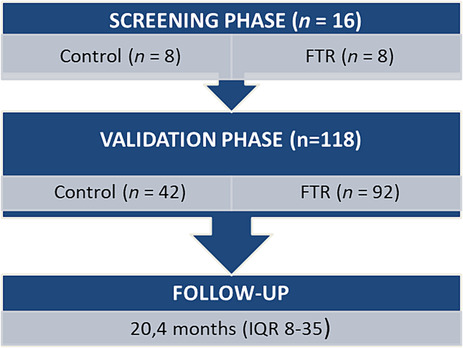
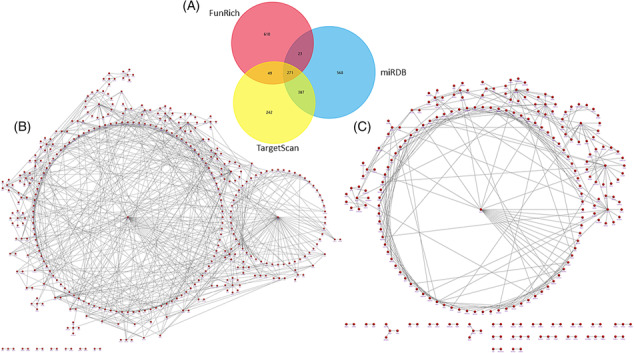
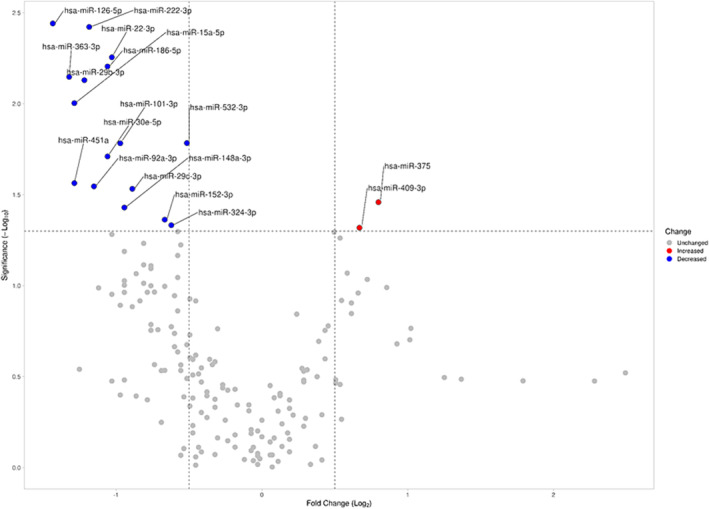
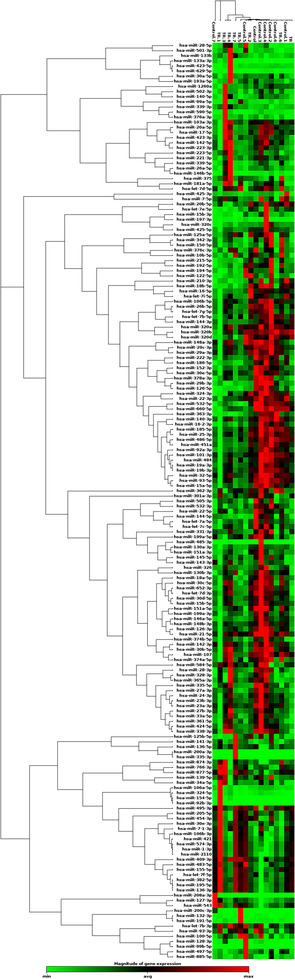
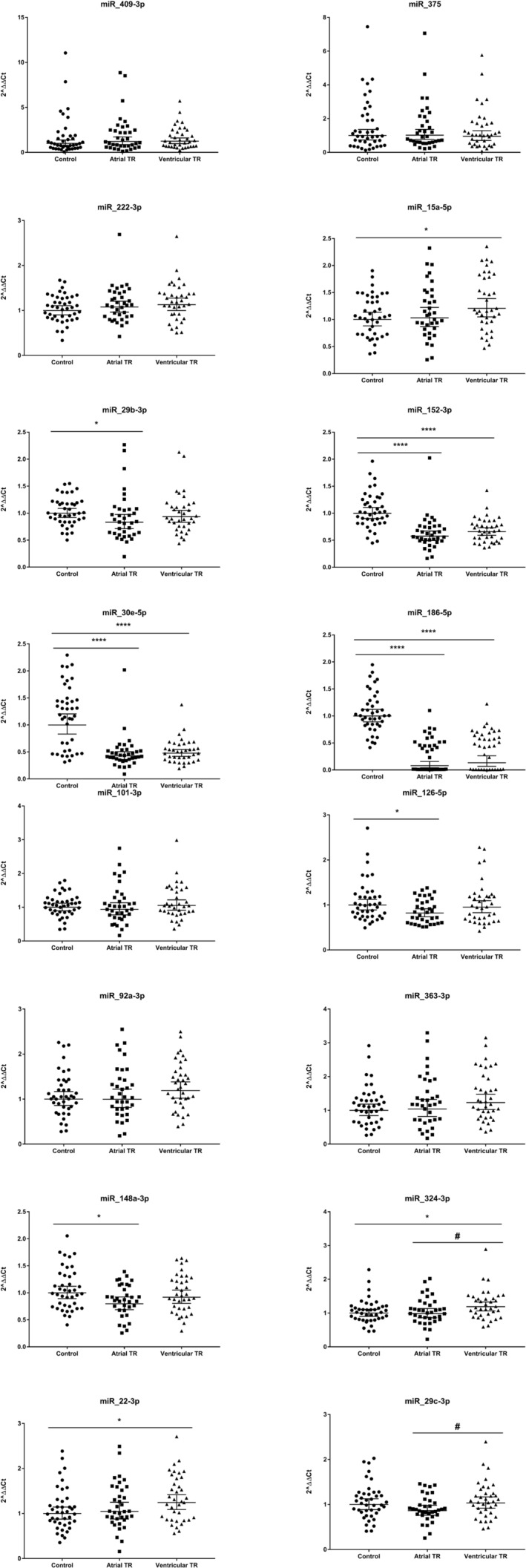
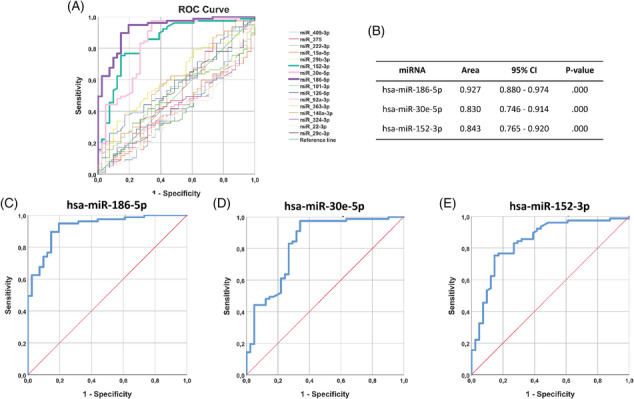
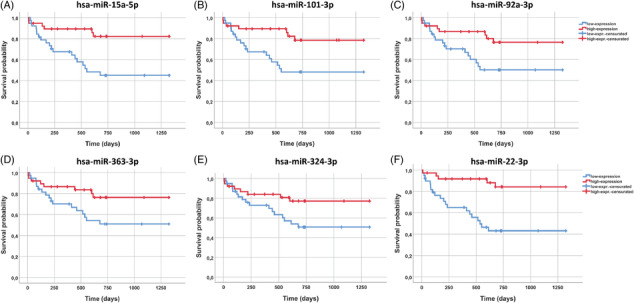
Consecutive patients with isolated severe FTR (n = 100) evaluated in the outpatient Heart Valve Clinic and age- and gender-matched subjects with no TR (controls, n = 50) were prospectively recruited. The experimental design included (1) a screening phase to identify candidate miRNA differentially expressed in FTR (n = 8) compared with controls (n = 8) through miRNA array profiling of 192 miRNAs using quantitative reverse transcription PCR arrays [qRT-PCR]) and (2) a validation phase in which candidate miRNAs identified in the initial screening were selected for further validation by qRT-PCR in a prospectively recruited cohort of FTR (n = 92) and controls (n = 42). Bioinformatics analysis was used to predict their potential target genes and functional pathways elicited. A combined endpoint of hospital admission due to heart failure (HF) and all-cause mortality was defined. Initial screening identified 16 differentially expressed miRNAs in FTR compared with controls, subsequently confirmed in the validation phase (n = 16 were excluded due to significant haemolysis). miR-186-5p, miR-30e-5p, and miR-152-3p identified FTR with high predictive value [AUC of 0.93 (0.88-0.97), 0.83 (0.75-0.91) and 0.84 (0.76-0.92), respectively]. During a median follow-up of 20.4 months (IQR 8-35 months), 32% of FTR patients reached the combined endpoint. Patients with low relative expression of miR-15a-5p, miR-92a-3p, miR101-3p, and miR-363-3p, miR-324-3p, and miR-22-3p showed significantly higher rates of events (log-rank test for all P < 0.01). Both miR-15a-5p [hazard ratio: 0.21 (0.06-0.649, P = 0.007) and miR-92a-3p (0.27 (0.09-0.76), P = 0.01] were associated with outcomes after adjusting for age, gender, and New York Heart Association functional class.
Circulating miRNAs are novel diagnostic and prognostic biomarkers in severe FTR. The quantification of miR-186-5p, miR-30e-5p, and miR-152-3p held strong diagnostic value, and the quantification of miR-15a-5p and miR-92a-3p are independently associated with outcomes. The recognition of specific miRNAs offers a novel perspective for TR evaluation.
严重功能性三尖瓣反流(FTR)与心血管事件风险增加相关,尤其是心力衰竭(HF)和死亡率。微小 RNA(miRNA)最近被确定为不同心血管疾病的新型生物标志物,但尚无研究关注 FTR。我们旨在(1)鉴定和验证循环 miRNA 作为 FTR 的调节因子,以及(2)检测 miRNA 与 FTR 心力衰竭和死亡率的相关性。
连续入选在门诊心脏瓣膜诊所评估的孤立性严重 FTR(n=100)患者和年龄及性别匹配的无 TR 患者(对照组,n=50)前瞻性入选。实验设计包括(1)通过使用定量逆转录 PCR 阵列(qRT-PCR)对 192 个 miRNA 进行 miRNA 微阵列分析,对 FTR(n=8)与对照组(n=8)进行比较,以鉴定候选 miRNA 来进行筛选阶段,以鉴定差异表达的 miRNA;(2)验证阶段,在一个前瞻性招募的 FTR 队列(n=92)和对照组(n=42)中,进一步通过 qRT-PCR 验证候选 miRNA。生物信息学分析用于预测其潜在的靶基因和功能途径。定义因心力衰竭(HF)和全因死亡率入院的综合终点。在 FTR 中与对照组相比,初步筛选确定了 16 个差异表达的 miRNA,随后在验证阶段得到了确认(由于显著溶血,排除了 16 个)。miR-186-5p、miR-30e-5p 和 miR-152-3p 对 FTR 具有较高的预测价值[AUC 分别为 0.93(0.88-0.97)、0.83(0.75-0.91)和 0.84(0.76-0.92)]。在中位数为 20.4 个月(IQR 8-35 个月)的中位随访期间,32%的 FTR 患者达到了综合终点。miR-15a-5p、miR-92a-3p、miR101-3p 和 miR-363-3p、miR-324-3p 和 miR-22-3p 相对表达水平较低的患者事件发生率明显更高(所有 P<0.01 的对数秩检验)。miR-15a-5p [风险比:0.21(0.06-0.649,P=0.007)和 miR-92a-3p(0.27(0.09-0.76),P=0.01]与年龄、性别和纽约心脏协会功能分类调整后的结局相关。
循环 miRNA 是严重 FTR 的新型诊断和预后生物标志物。miR-186-5p、miR-30e-5p 和 miR-152-3p 的定量具有很强的诊断价值,miR-15a-5p 和 miR-92a-3p 的定量与结局独立相关。特定 miRNA 的识别为 TR 评估提供了新的视角。