Zhejiang Provincial People's Hospital, People's Hospital of Hangzhou Medical College, Hangzhou, China.
Medical Education Department, Zhejiang Provincial People's Hospital, People's Hospital of Hangzhou Medical College, Hangzhou, China.
J Glob Health. 2024 Apr 19;14:04088. doi: 10.7189/jogh.14.04088.
Cognitive impairment is a highly heterogeneous disorder that necessitates further investigation into the distinct characteristics of populations at varying risk levels of cognitive impairment. Using a large-scale registry cohort of elderly individuals, we applied a data-driven approach to identify novel clusters based on diverse sociodemographic features.
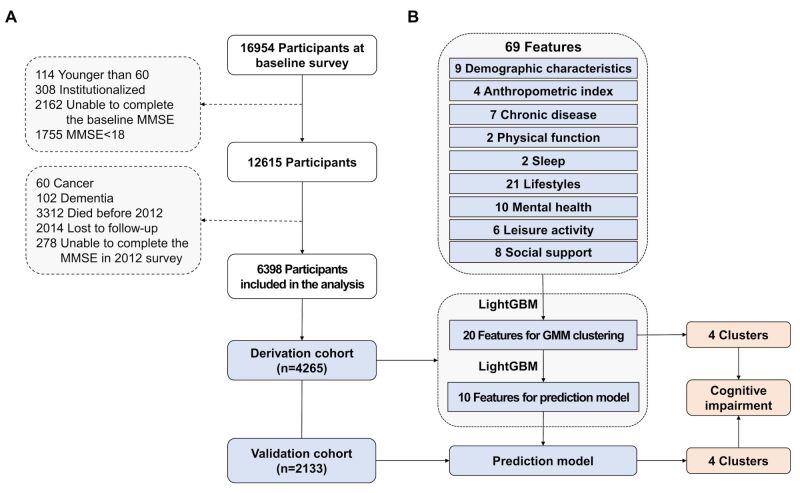
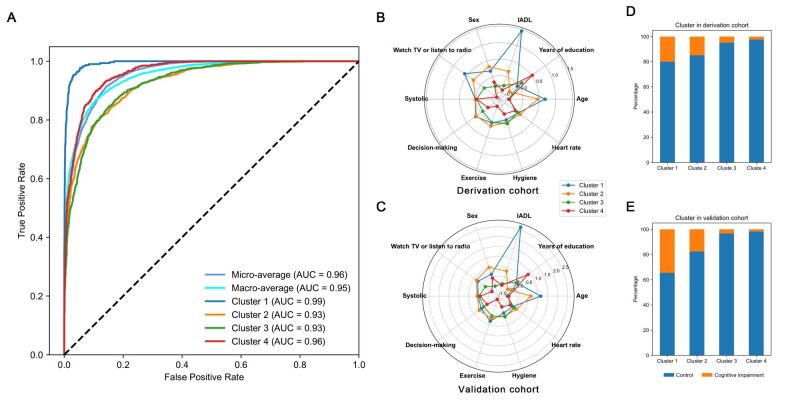
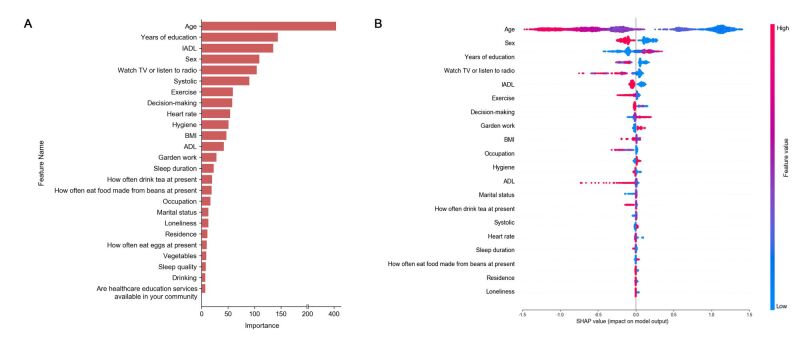
A prospective cohort of 6398 elderly people from the Chinese Longitudinal Healthy Longevity Survey, followed between 2008-14, was used to develop and validate the model. Participants were aged ≥60 years, community-dwelling, and the Chinese version of the Mini-Mental State Examination (MMSE) score ≥18 were included. Sixty-nine sociodemographic features were included in the analysis. The total population was divided into two-thirds for the derivation cohort (n = 4265) and one-third for the validation cohort (n = 2133). In the derivation cohort, an unsupervised Gaussian mixture model was applied to categorise participants into distinct clusters. A classifier was developed based on the most important 10 factors and was applied to categorise participants into their corresponding clusters in a validation cohort. The difference in the three-year risk of cognitive impairment was compared across the clusters.
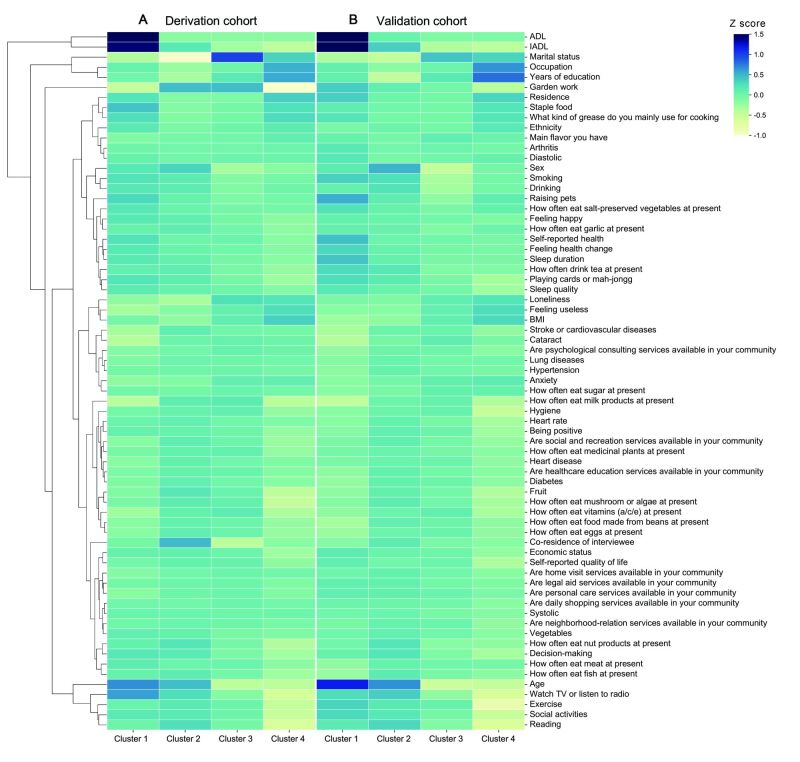
We identified four clusters with distinct features in the derivation cohort. Cluster 1 was associated with the worst life independence, longest sleep duration, and the oldest age. Cluster 2 demonstrated the highest loneliness, characterised by non-marital status and living alone. Cluster 3 was characterised by the lowest sense of loneliness and the highest proportions in marital status and family co-residence. Cluster 4 demonstrated heightened engagement in exercise and leisure activity, along with independent decision-making, hygiene, and a diverse diet. In comparison to Cluster 4, Cluster 1 exhibited the highest three-year cognitive impairment risk (adjusted odds ratio (aOR) = 3.31; 95% confidence interval (CI) = 1.81-6.05), followed by Cluster 2 and Cluster 3 after adjustment for baseline MMSE, residence, sex, age, years of education, drinking, smoking, hypertension, diabetes, heart disease and stroke or cardiovascular diseases.
A data-driven approach can be instrumental in identifying individuals at high risk of cognitive impairment among cognitively normal elderly populations. Based on various sociodemographic features, these clusters can suggest individualised intervention plans.
认知障碍是一种高度异质的疾病,需要进一步研究不同认知障碍风险水平人群的特征。本研究使用大规模老年人群队列,采用数据驱动的方法,基于多种社会人口学特征识别新的亚组。
采用中国长寿队列研究的前瞻性队列,纳入 2008 年至 2014 年期间年龄≥60 岁、居住在社区、中文版简易精神状态检查(MMSE)评分≥18 的 6398 名老年人进行模型的建立和验证。分析中纳入了 69 项社会人口学特征。总人群分为三分之二的推导队列(n=4265)和三分之一的验证队列(n=2133)。在推导队列中,应用无监督高斯混合模型将参与者分为不同的亚组。基于最重要的 10 个因素建立分类器,并应用于验证队列中对参与者进行分类。比较不同亚组间认知障碍 3 年的风险差异。
在推导队列中,我们确定了具有不同特征的 4 个亚组。亚组 1 的生活独立性最差,睡眠时间最长,年龄最大。亚组 2 孤独感最高,表现为非婚姻状况和独居。亚组 3 的孤独感最低,婚姻状况和家庭共同居住的比例最高。亚组 4 表现为更积极地进行运动和休闲活动,以及独立决策、卫生和多样化的饮食。与亚组 4 相比,亚组 1 的认知障碍 3 年风险最高(调整后的优势比[aOR]=3.31;95%置信区间[CI]=1.81-6.05),其次是亚组 2 和亚组 3,调整基线 MMSE、居住地、性别、年龄、受教育年限、饮酒、吸烟、高血压、糖尿病、心脏病和中风或心血管疾病后。
数据驱动的方法可用于识别认知正常的老年人群中认知障碍风险较高的个体。根据不同的社会人口学特征,这些亚组可以提示个体化的干预计划。