• 文献检索
  • 文档翻译
  • 深度研究
  • 学术资讯
  • Suppr Zotero 插件Zotero 插件
  • 邀请有礼
  • 套餐&价格
  • 历史记录
应用&插件
Suppr Zotero 插件Zotero 插件浏览器插件Mac 客户端Windows 客户端微信小程序
定价
高级版会员购买积分包购买API积分包
服务
文献检索文档翻译深度研究API 文档MCP 服务
关于我们
关于 Suppr公司介绍联系我们用户协议隐私条款
关注我们

Suppr 超能文献

核心技术专利:CN118964589B侵权必究
粤ICP备2023148730 号-1Suppr @ 2026

文献检索

告别复杂PubMed语法,用中文像聊天一样搜索,搜遍4000万医学文献。AI智能推荐,让科研检索更轻松。

立即免费搜索

文件翻译

保留排版,准确专业,支持PDF/Word/PPT等文件格式,支持 12+语言互译。

免费翻译文档

深度研究

AI帮你快速写综述,25分钟生成高质量综述,智能提取关键信息,辅助科研写作。

立即免费体验

探讨 COVID-19 危机期间青少年心理健康:优势与困难。

Exploring adolescent mental health during the COVID-19 crisis - strengths and difficulties.

机构信息

Department of Child and Adolescent Psychiatry, Psychosomatics and Psychotherapy, Faculty of Medicine and University Hospital Cologne, University of Cologne, Cologne, Germany.

Department of Pediatric and Adolescent Medicine, Faculty of Medicine and University Hospital Cologne, University of Cologne, Cologne, Germany.

出版信息

Front Public Health. 2024 Apr 4;12:1357766. doi: 10.3389/fpubh.2024.1357766. eCollection 2024.

DOI:10.3389/fpubh.2024.1357766
PMID:38638467
原文链接:https://pmc.ncbi.nlm.nih.gov/articles/PMC11024382/
Abstract

INTRODUCTION

The SARS-CoV-2 pandemic has significantly impacted children and adolescents, leading to mental health challenges. Knowledge on their resources and difficulties is crucial and there is a need for valid instruments to assess their psychosocial condition especially in this exceptional situation. We assessed psychopathological symptoms using the SDQ during the pandemic, comparing to pre-pandemic data. Our study aims to understand adolescents' strengths and difficulties amidst COVID-19, evaluating the SDQ's utility in crisis settings.

METHODS

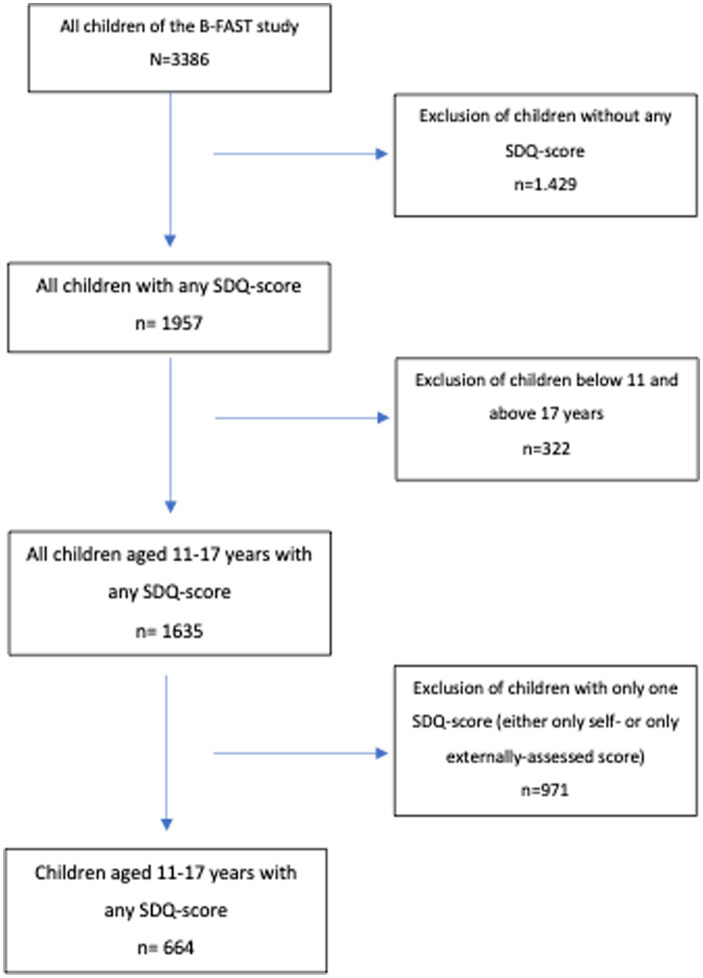
Within the German school-based surveillance study ("B-Fast"), we assessed behavioral strengths and difficulties in 664 adolescents aged 11-17 years during the peak of the German COVID-19 pandemic using the validated Strengths and Difficulties Questionnaire (SDQ) for both external and self-assessed data collection. Data were collected between November 2020 and April 2021. We compared self-assessed SDQ-scores to pre-pandemic data from a comparable sample and examined adolescent classification as "normal" or "borderline/abnormal" based on both external and self-assessed SDQ subscale scores using established cut-off values. Additionally, we conducted sex and rater-based score comparisons.

RESULTS

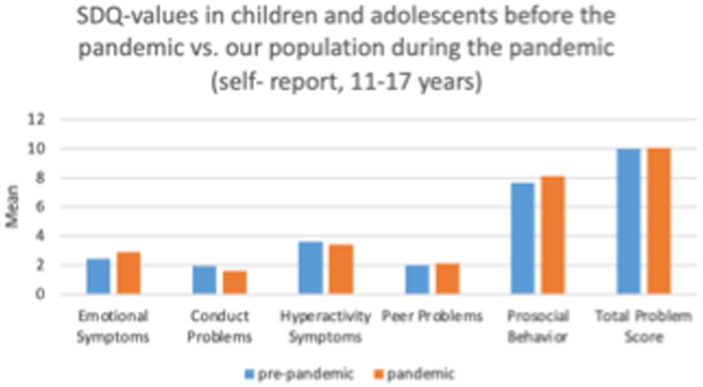
In our study, we observed a significant worsening of "Emotional Symptoms" compared to pre-pandemic levels, while "Conduct Problems" and "Prosocial Behavior" showed improvement. Variations in classification to "normal" and "abnormal" emerged when applying German versus British cut-off values. Females scored higher on "Emotional Symptoms" while males scored higher on "Hyperactivity Symptoms." Correlations between external and self-assessed SDQ ratings ranged from 0.43 ( < 0.001) for "Prosocial Behavior" among girls to 0.62 ( < 0.001) for "Peer Problems" among boys, indicating moderate to high consistency.

DISCUSSION/CONCLUSION: Our study contributes to understanding the psychosocial impact of the COVID-19 pandemic on German adolescents. Compared to other symptoms, we observed a particular worsening in "Emotional Symptoms" based on our data. Despite the moderate correlation between parental and self-reported evaluations, there appears to be a certain discrepancy in the perception of adolescent quality of life. Therefore, it seems prudent to assess both the external and self-reported evaluations and amalgamate the results from both parties to obtain a comprehensive problem profile of the individual. These findings underscore the importance of using country-specific cutoff values and reaffirm the utility of the SDQ as a valuable assessment tool, even within the unique circumstances posed by a pandemic.
https://cdn.ncbi.nlm.nih.gov/pmc/blobs/d314/11024382/d9d16ce7172c/fpubh-12-1357766-g002.jpg
https://cdn.ncbi.nlm.nih.gov/pmc/blobs/d314/11024382/8036f37eb0f7/fpubh-12-1357766-g001.jpg
https://cdn.ncbi.nlm.nih.gov/pmc/blobs/d314/11024382/d9d16ce7172c/fpubh-12-1357766-g002.jpg
https://cdn.ncbi.nlm.nih.gov/pmc/blobs/d314/11024382/8036f37eb0f7/fpubh-12-1357766-g001.jpg
https://cdn.ncbi.nlm.nih.gov/pmc/blobs/d314/11024382/d9d16ce7172c/fpubh-12-1357766-g002.jpg
摘要

简介

SARS-CoV-2 大流行对儿童和青少年产生了重大影响,导致他们面临心理健康挑战。了解他们的资源和困难至关重要,因此需要有效的工具来评估他们的社会心理状况,尤其是在这种特殊情况下。我们使用 SDQ 在大流行期间评估了心理病理学症状,并与大流行前的数据进行了比较。我们的研究旨在了解青少年在 COVID-19 大流行期间的优势和困难,评估 SDQ 在危机环境中的效用。

方法

在德国基于学校的监测研究(“B-Fast”)中,我们使用经过验证的优势和困难问卷(SDQ)评估了 664 名 11-17 岁青少年在德国 COVID-19 大流行高峰期的行为优势和困难,同时进行了外部和自我评估的数据收集。数据收集于 2020 年 11 月至 2021 年 4 月之间。我们将自我评估的 SDQ 评分与来自可比样本的大流行前数据进行了比较,并根据外部和自我评估的 SDQ 分量表评分使用既定的截断值检查了青少年的分类为“正常”或“边缘/异常”。此外,我们还进行了性别和评估者评分比较。

结果

在我们的研究中,我们观察到与大流行前水平相比,“情绪症状”明显恶化,而“行为问题”和“亲社会行为”有所改善。当应用德国与英国的截断值时,出现了向“正常”和“异常”分类的变化。女性在“情绪症状”上的得分较高,而男性在“多动症状”上的得分较高。女孩的外部和自我评估的 SDQ 评分之间的相关性从“亲社会行为”的 0.43( < 0.001)到男孩的“同伴问题”的 0.62( < 0.001),表明存在中度到高度一致性。

讨论/结论:我们的研究有助于了解 COVID-19 大流行对德国青少年的社会心理影响。与其他症状相比,我们根据数据观察到“情绪症状”的特别恶化。尽管父母和自我报告评估之间存在中度相关性,但在青少年生活质量的感知方面似乎存在一定差异。因此,评估外部和自我报告的评估并合并双方的结果以获得个人的综合问题概况似乎是谨慎的。这些发现强调了使用特定国家的截断值的重要性,并再次确认了 SDQ 作为一种有价值的评估工具的效用,即使在大流行带来的独特情况下也是如此。

相似文献

1
Exploring adolescent mental health during the COVID-19 crisis - strengths and difficulties.探讨 COVID-19 危机期间青少年心理健康:优势与困难。
Front Public Health. 2024 Apr 4;12:1357766. doi: 10.3389/fpubh.2024.1357766. eCollection 2024.
2
Normative Data of the Self-Report Version of the German Strengths and Difficulties Questionnaire in an Epidemiological Setting.德国优势与困难问卷自陈版在流行病学背景下的常模数据。
Z Kinder Jugendpsychiatr Psychother. 2018 Nov;46(6):523-533. doi: 10.1024/1422-4917/a000589. Epub 2018 May 30.
3
Measuring adolescent mental health around the globe: psychometric properties of the self-report Strengths and Difficulties Questionnaire in South Africa, and comparison with UK, Australian and Chinese data.全球青少年心理健康测量:南非自我报告《长处与困难问卷》的心理测量特性,以及与英国、澳大利亚和中国数据的比较。
Epidemiol Psychiatr Sci. 2018 Aug;27(4):369-380. doi: 10.1017/S2045796016001207. Epub 2017 Jan 23.
4
Revising the self-report strengths and difficulties questionnaire for cross-country comparisons of adolescent mental health problems: the SDQ-R.修订自陈式长处与困难问卷以进行青少年心理健康问题的跨国比较:SDQ-R。
Epidemiol Psychiatr Sci. 2019 May 3;29:e35. doi: 10.1017/S2045796019000246.
5
Six years ahead: a longitudinal analysis regarding course and predictive value of the Strengths and Difficulties Questionnaire (SDQ) in children and adolescents.六年展望:儿童和青少年长处和困难问卷(SDQ)的过程和预测价值的纵向分析。
Eur Child Adolesc Psychiatry. 2015 Jun;24(6):715-25. doi: 10.1007/s00787-014-0640-x. Epub 2014 Dec 2.
6
Mental Health of Children With Special Educational Needs and the Return to In-Person Learning After the COVID-19 Pandemic.有特殊教育需求儿童的心理健康与新冠疫情后重返线下学习
JAMA Netw Open. 2023 Dec 1;6(12):e2346106. doi: 10.1001/jamanetworkopen.2023.46106.
7
Parental Mental Health, Gender, and Lifestyle Effects on Post-Pandemic Child and Adolescent Psychosocial Problems: A Cross-Sectional Survey in Northern Italy.父母心理健康、性别和生活方式对疫情后儿童和青少年心理社会问题的影响:意大利北部的一项横断面调查。
Int J Environ Res Public Health. 2024 Jul 17;21(7):933. doi: 10.3390/ijerph21070933.
8
Internal consistency of the Strengths and Difficulties Questionnaire in Amazonian children.《亚马逊儿童长处与困难问卷的内部一致性》
Rev Saude Publica. 2024 Feb 26;57Suppl 2(Suppl 2):4s. doi: 10.11606/s1518-8787.2023057005562. eCollection 2024.
9
[Towards a better assessment of child and adolescent mental health status. Polish version of strengths and difficulties questionnaire. Experiences from two population studies].[迈向对儿童和青少年心理健康状况的更好评估。优势与困难问卷波兰语版。两项人群研究的经验]
Med Wieku Rozwoj. 2007 Jan-Mar;11(1):13-24.
10
Emotional and behavioural difficulties among children and adolescents attending "ART teen clubs" in Mzuzu City in northern Malawi: a cross-sectional study.马拉维北部姆祖祖市“ART 青少年俱乐部”中儿童和青少年的情绪和行为困难:一项横断面研究。
BMC Pediatr. 2024 Jan 13;24(1):41. doi: 10.1186/s12887-023-04504-1.

引用本文的文献

1
Screening mental health risks for adolescents in South Korea.韩国青少年心理健康风险筛查
Front Psychol. 2025 Jul 16;16:1589136. doi: 10.3389/fpsyg.2025.1589136. eCollection 2025.
2
Parental Mental Health, Gender, and Lifestyle Effects on Post-Pandemic Child and Adolescent Psychosocial Problems: A Cross-Sectional Survey in Northern Italy.父母心理健康、性别和生活方式对疫情后儿童和青少年心理社会问题的影响:意大利北部的一项横断面调查。
Int J Environ Res Public Health. 2024 Jul 17;21(7):933. doi: 10.3390/ijerph21070933.

本文引用的文献

1
Sex Differences in ADHD: Review and Priorities for Future Research.注意缺陷多动障碍的性别差异:综述及未来研究重点。
Curr Psychiatry Rep. 2024 Apr;26(4):151-156. doi: 10.1007/s11920-024-01492-6. Epub 2024 Feb 7.
2
Sex and gender role differences on stress, depression, and anxiety symptoms in response to the COVID-19 pandemic over time.随着时间推移,新冠疫情期间压力、抑郁和焦虑症状方面的性别及性别角色差异。
Front Psychol. 2023 May 3;14:1166154. doi: 10.3389/fpsyg.2023.1166154. eCollection 2023.
3
Impact of the COVID-19 pandemic on the psychological status of undergraduate medical students in Saudi Arabia: A cross-sectional double-scale study.
COVID-19 大流行对沙特阿拉伯本科医学生心理健康的影响:一项横断面双尺度研究。
Medicine (Baltimore). 2023 Apr 7;102(14):e33487. doi: 10.1097/MD.0000000000033487.
4
Risks and Resources for Depressive Symptoms and Anxiety in Children and Adolescents During the COVID-19 Pandemic - Results of the Longitudinal COPSY Study.新冠疫情期间儿童和青少年抑郁症状与焦虑的风险及相关因素——纵向COPSY研究结果
Front Psychiatry. 2022 Jul 7;13:901783. doi: 10.3389/fpsyt.2022.901783. eCollection 2022.
5
The Italian COVID-19 Anxiety Syndrome Scale: Investigation of the COVID-19 anxiety syndrome and its association with psychological symptoms in an Italian population.意大利 COVID-19 焦虑综合征量表:在意大利人群中调查 COVID-19 焦虑综合征及其与心理症状的关系。
Clin Psychol Psychother. 2022 Nov;29(6):1972-1990. doi: 10.1002/cpp.2767. Epub 2022 Jul 9.
6
Anxiety in the Medically Ill: A Systematic Review of the Literature.内科疾病中的焦虑:文献系统综述
Front Psychiatry. 2022 Jun 3;13:873126. doi: 10.3389/fpsyt.2022.873126. eCollection 2022.
7
The Well-Being of the German Adult Population Measured with the WHO-5 over Different Phases of the COVID-19 Pandemic: An Analysis within the COVID-19 Snapshot Monitoring Study (COSMO).在新冠疫情不同阶段使用世界卫生组织-5福祉指数衡量德国成年人口的福祉:新冠疫情快照监测研究(COSMO)中的一项分析
Int J Environ Res Public Health. 2022 Mar 9;19(6):3236. doi: 10.3390/ijerph19063236.
8
Emotional Situation of Children and Adolescents during the COVID-19 Pandemic in Germany: Results from the COVID-19 Snapshot Monitoring Study (COSMO).德国 COVID-19 大流行期间儿童和青少年的情绪状况:COVID-19 快照监测研究(COSMO)的结果。
Int J Environ Res Public Health. 2022 Feb 25;19(5):2698. doi: 10.3390/ijerph19052698.
9
Establishing a Mental Health Surveillance in Germany: Development of a framework concept and indicator set.在德国建立心理健康监测:框架概念和指标集的制定。
J Health Monit. 2021 Dec 8;6(4):34-63. doi: 10.25646/8861. eCollection 2021 Dec.
10
The Impact of Migration Status on Adolescents' Mental Health during COVID-19.新冠疫情期间移民身份对青少年心理健康的影响
Healthcare (Basel). 2022 Jan 17;10(1):176. doi: 10.3390/healthcare10010176.