Almeida-Silva Diego, Servino Leonardo Matheus, Pontes-Nogueira Matheus, Sawaya Ricardo J
Centro de Ciências Naturais e Humanas, Universidade Federal do ABC, São Bernardo do Campo, São Paulo, Brazil.
Miguel Lillo, Unidad Ejecutora Lillo, San Miguel de Tucumán, Tucumán, Argentina.
PeerJ. 2024 Apr 16;12:e17232. doi: 10.7717/peerj.17232. eCollection 2024.
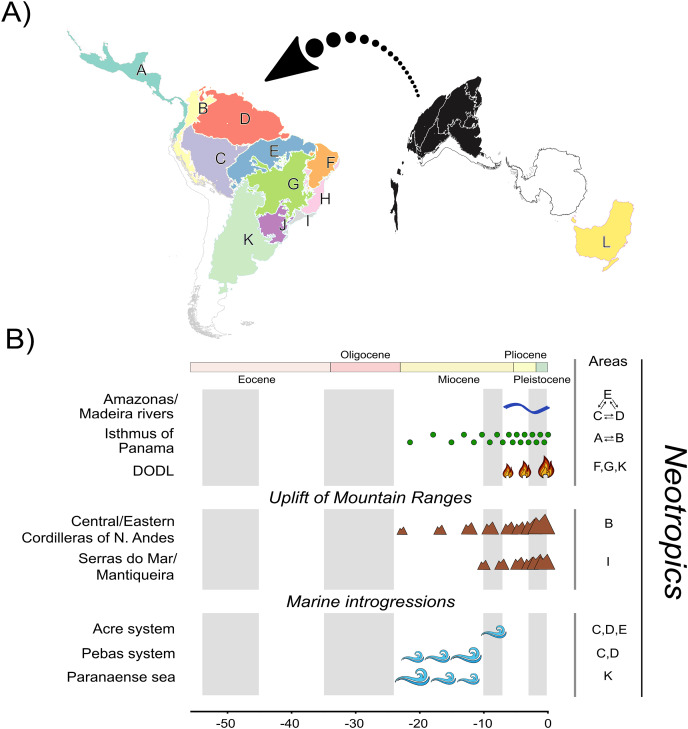
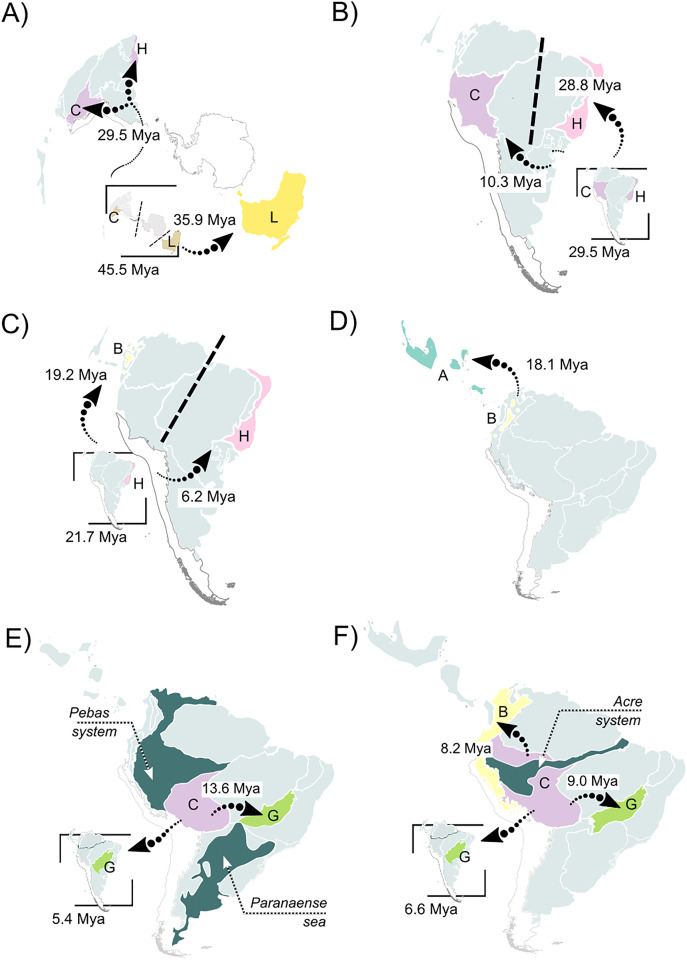
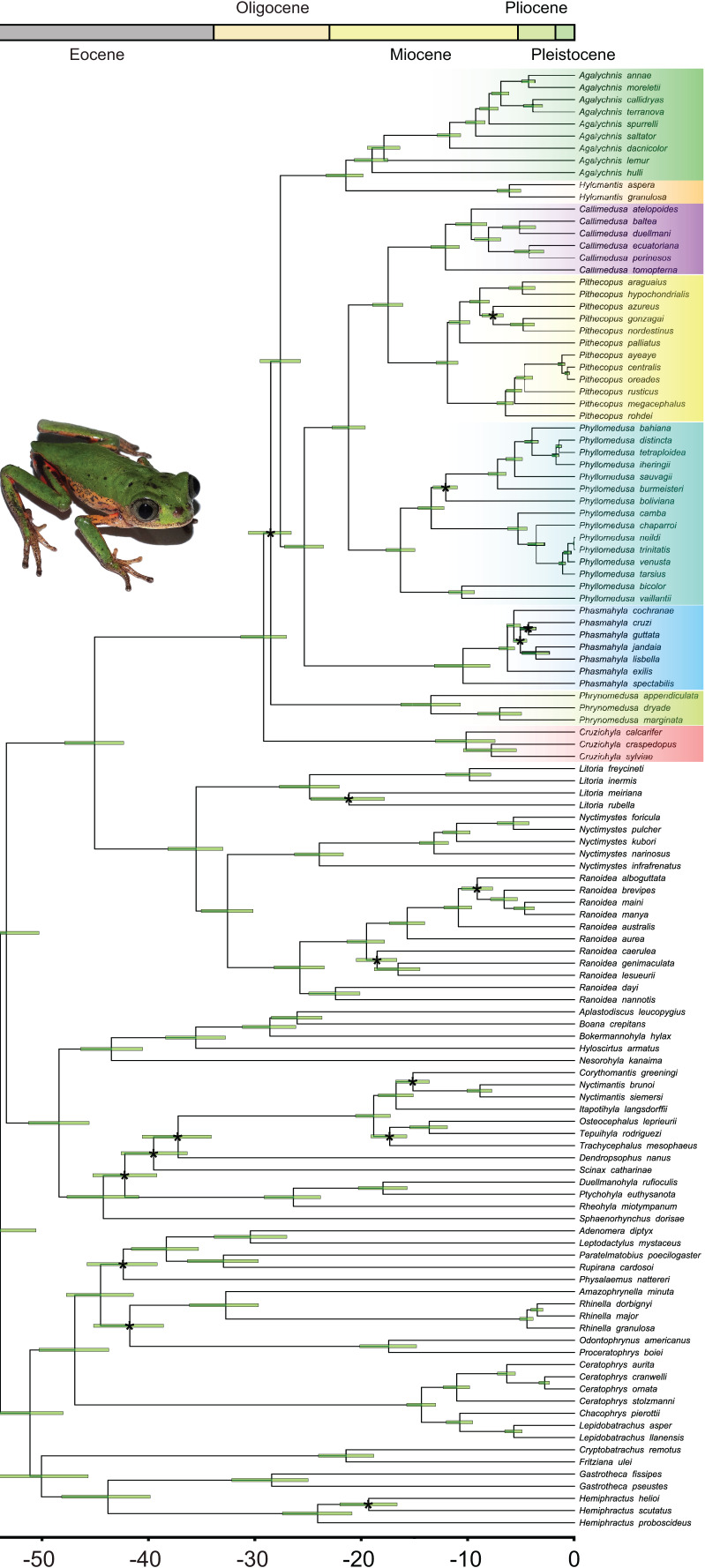
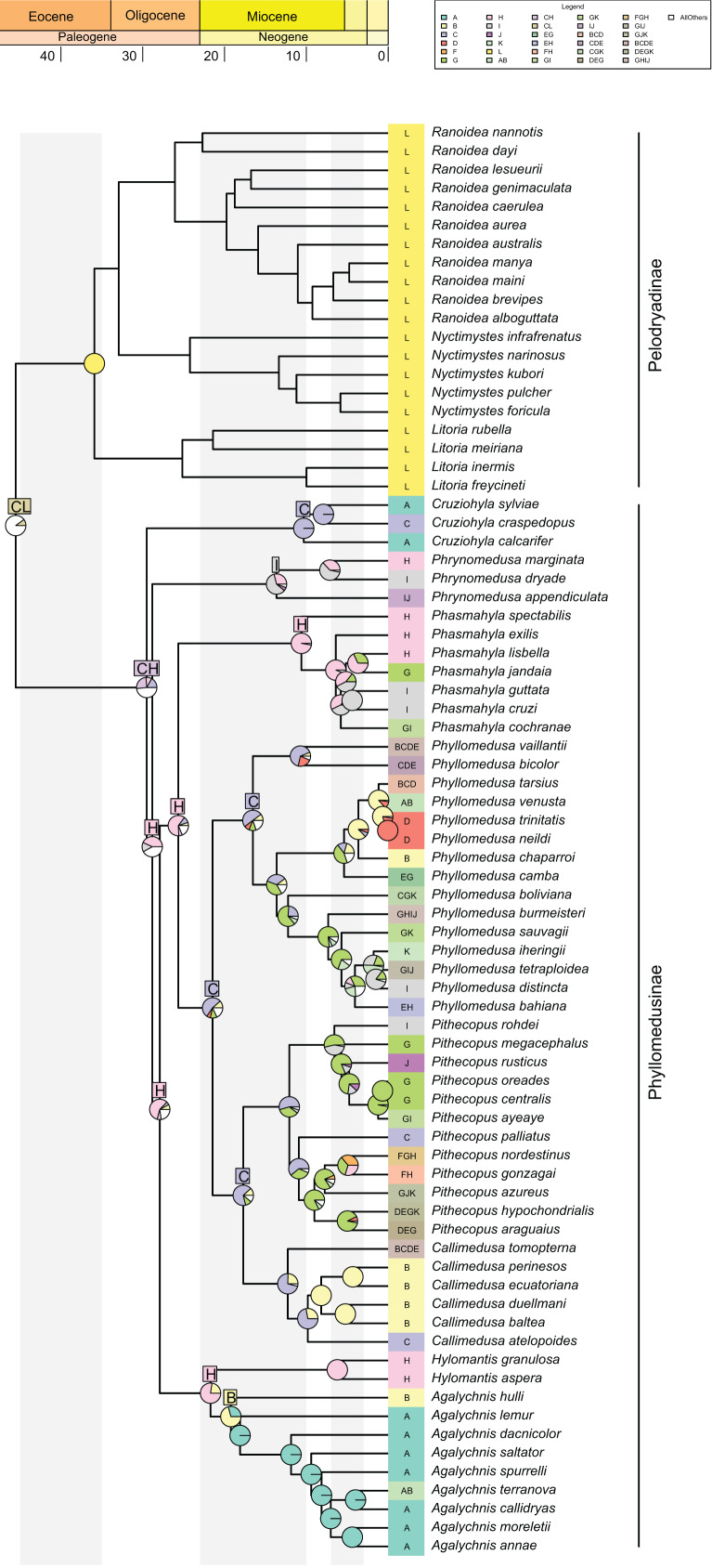
The species richness in the Neotropics has been linked to environmental heterogeneity and a complex geological history. We evaluated which biogeographic processes were associated with the diversification of Monkey tree frogs, an endemic clade from the Neotropics. We tested two competing hypotheses: the diversification of Phyllomedusinae occurred either in a "south-north" or a "north-south" direction in the Neotropics. We also hypothesized that marine introgressions and Andean uplift had a crucial role in promoting their diversification. We used 13 molecular markers in a Bayesian analysis to infer phylogenetic relationships among 57 species of Phyllomedusinae and to estimate their divergence times. We estimated ancestral ranges based on 12 biogeographic units considering the landscape modifications of the Neotropical region. We found that the Phyllomedusinae hypothetical ancestor range was probably widespread throughout South America, from Western Amazon to Southern Atlantic Forest, at 29.5 Mya. The Phyllomedusines' ancestor must have initially diverged through vicariance, generally followed by jump-dispersals and sympatric speciation. Dispersal among areas occurred mostly from Western Amazonia towards Northern Andes and the South American diagonal of dry landscapes, a divergent pattern from both "south-north" and "north-south" diversification hypotheses. Our results revealed a complex diversification process of Monkey tree frogs, occurring simultaneously with the orogeny of Northern Andes and the South American marine introgressions in the last 30 million years.
新热带界的物种丰富度与环境异质性和复杂的地质历史有关。我们评估了哪些生物地理过程与猴树蛙的多样化相关,猴树蛙是新热带界的一个特有分支。我们检验了两种相互竞争的假说:叶泡蛙亚科的多样化在新热带界是沿“南 - 北”方向还是“北 - 南”方向发生的。我们还假设海洋基因渗入和安第斯山脉隆升在促进它们的多样化过程中起到了关键作用。我们在贝叶斯分析中使用了13个分子标记,以推断57种叶泡蛙亚科物种之间的系统发育关系,并估计它们的分化时间。我们基于12个生物地理单元估计祖先分布范围,同时考虑新热带地区的景观变化。我们发现,叶泡蛙亚科的假设祖先分布范围可能在2950万年前广泛分布于南美洲,从西部亚马逊地区到南部大西洋森林。叶泡蛙的祖先最初一定是通过地理隔离分化的,随后通常伴随着跳跃扩散和同域物种形成。区域间的扩散主要发生在从西部亚马逊地区向安第斯山脉北部和南美洲干旱景观对角线方向,这与“南 - 北”和“北 - 南”多样化假说的模式都不同。我们的结果揭示了猴树蛙复杂的多样化过程,这一过程在过去3000万年中与安第斯山脉北部的造山运动和南美洲的海洋基因渗入同时发生。