Jones Morgan H, Gottreich Julia R, Jin Yuxuan, Kattan Michael W, Spindler Kurt P, Farrow Lutul D, Frangiamore Salvatore J, Gilot Gregory J, Hampton Robert J, Leo Brian M, Nickodem Robert J, Parker Richard D, Rosneck James T, Saluan Paul M, Scarcella Michael J, Serna Alfred, Stearns Kim L
Orthopaedic and Arthritis Center for Outcomes Research and Department of Orthopedic Surgery, Brigham and Women's Hospital, Boston, Massachusetts.
Orthopaedic and Arthritis Center for Outcomes Research, Brigham and Women's Hospital, Boston, Massachusetts.
Orthop J Sports Med. 2024 Apr 19;12(4):23259671231204014. doi: 10.1177/23259671231204014. eCollection 2024 Apr.
Surgeon performance has been investigated as a factor affecting patient outcomes after orthopaedic procedures to improve transparency between patients and providers.
PURPOSE/HYPOTHESIS: The purpose of this study was to identify whether surgeon performance influenced patient-reported outcomes (PROMs) 1 year after arthroscopic partial meniscectomy (APM). It was hypothesized that there would be no significant difference in PROMs between patients who underwent APM from various surgeons.
Case-control study; Level of evidence, 3.
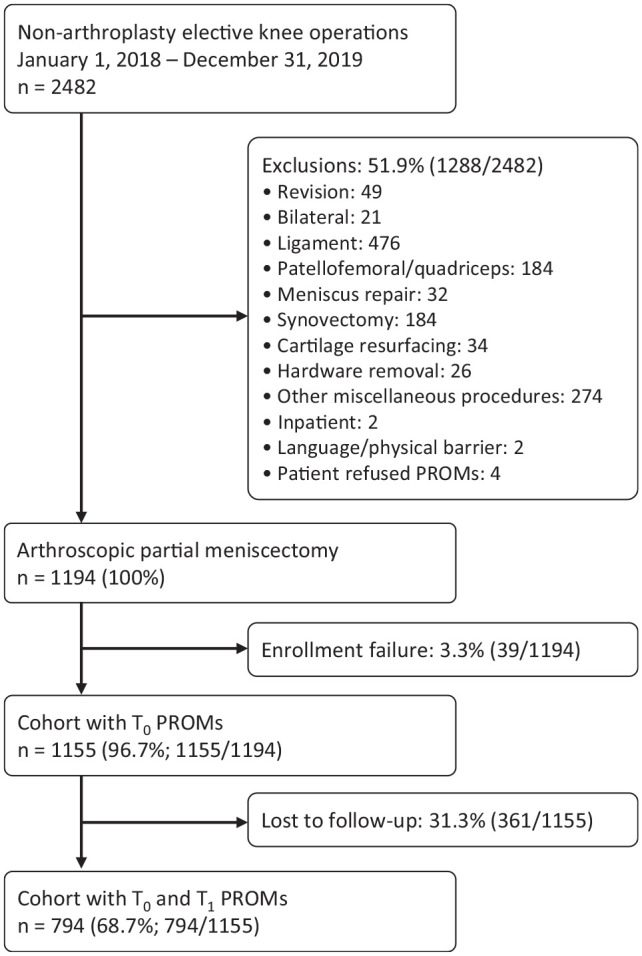
A prospective cohort of 794 patients who underwent APM between 2018 and 2019 were included in the analysis. A total of 34 surgeons from a large multicenter health care center were included. Three multivariable models were built to determine whether the surgeon-among demographic and meniscal pathology factors-was a significant variable for predicting the Knee injury and Osteoarthritis Outcome Score (KOOS)-Pain subscale, the Patient Acceptable Symptom State (PASS), and a 10-point improvement in the KOOS-Pain at 1 year after APM. Likelihood ratio (LR) tests were used to determine the significance of the surgeon variable in the models.
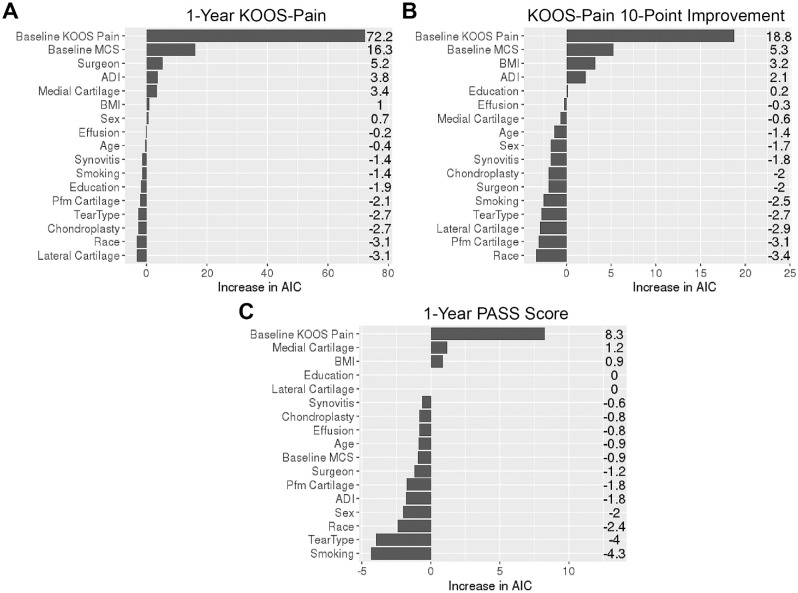
The 794 patients were identified from the multicenter hospital system. The baseline KOOS-Pain score was a significant predictor of outcome in the 1-year KOOS-Pain model (odds ratio [OR], 2.1 [95% CI, 1.77-2.48]; < .001), the KOOS-Pain 10-point improvement model (OR, 0.57 [95% CI, 0.44-0.73), and the 1-year PASS model (OR, 1.42 [95% CI, 1.15-1.76]; = .002) among articular cartilage pathology (bipolar medial cartilage) and patient-factor variables, including body mass index, Veterans RAND 12-Item Health Survey-Mental Component Score, and Area Deprivation Index. The individual surgeon significantly impacted outcomes in the 1-year KOOS-Pain mixed model in the LR test ( = .004).
Patient factors and characteristics are better predictors for patient outcomes 1 year after APM than surgeon characteristics, specifically baseline KOOS-Pain, although an individual surgeon influenced the 1-Year KOOS-Pain mixed model in the LR test. This finding has key clinical implications; surgeons who wish to improve patient outcomes after APM should focus on improving patient selection rather than improving the surgical technique. Future research is needed to determine whether surgeon variability has an impact on longer-term patient outcomes.
外科医生的表现已被作为影响骨科手术后患者预后的一个因素进行研究,以提高患者与医疗服务提供者之间的透明度。
目的/假设:本研究的目的是确定在关节镜下部分半月板切除术(APM)后1年,外科医生的表现是否会影响患者报告的结局(PROMs)。假设是,接受不同外科医生进行APM手术的患者之间,PROMs不会有显著差异。
病例对照研究;证据等级,3级。
对2018年至2019年间接受APM手术的794例患者的前瞻性队列进行分析。纳入了来自一个大型多中心医疗保健中心的34名外科医生。构建了三个多变量模型,以确定在人口统计学和半月板病理因素中,外科医生是否是预测膝关节损伤和骨关节炎结局评分(KOOS)-疼痛子量表、患者可接受症状状态(PASS)以及APM后1年KOOS-疼痛改善10分的显著变量。使用似然比(LR)检验来确定模型中外科医生变量的显著性。
从多中心医院系统中识别出794例患者。在1年KOOS-疼痛模型中,基线KOOS-疼痛评分是结局的显著预测因素(比值比[OR],2.1[95%可信区间,1.77 - 2.48];P <.001),在KOOS-疼痛改善10分模型中(OR,0.57[95%可信区间,0.44 - 0.73]),以及在1年PASS模型中(OR,1.42[95%可信区间,1.15 - 1.76];P =.002),在关节软骨病理(双极内侧软骨)和患者因素变量中,包括体重指数、退伍军人兰德12项健康调查-心理成分评分和地区贫困指数。在LR检验中,个体外科医生对1年KOOS-疼痛混合模型中的结局有显著影响(P =.004)。
患者因素和特征比外科医生特征更能预测APM后1年的患者结局,特别是基线KOOS-疼痛,尽管在LR检验中个体外科医生影响了1年KOOS-疼痛混合模型。这一发现具有关键的临床意义;希望改善APM后患者结局的外科医生应专注于改善患者选择,而不是改进手术技术。需要进一步的研究来确定外科医生的变异性是否对患者的长期结局有影响。