Ye Jing, Li Yunjie, Bai Yuqing, Zhang Ting, Jiang Wei, Shi Ting, Wu Zijian, Zhang Yi-Heng P Job
Tianjin Key Laboratory of Food Science and Biotechnology, College of Biotechnology and Food Science, Tianjin University of Commerce, Tianjin, China.
Tianjin Institute of Industrial Biotechnology, Chinese Academy of Sciences, 32 West 7th Avenue, Tianjin Airport Economic Area, Tianjin, 300308, China.
Bioresour Bioprocess. 2022 May 18;9(1):56. doi: 10.1186/s40643-022-00540-4.
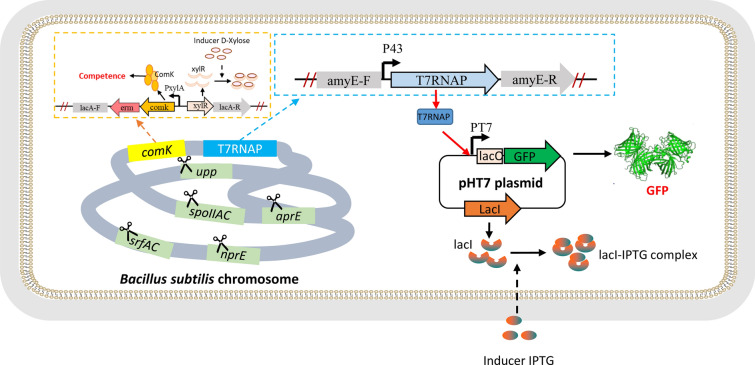
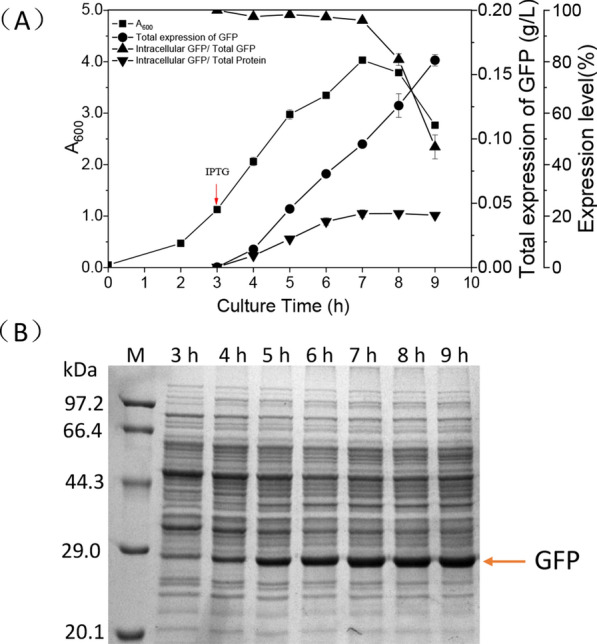
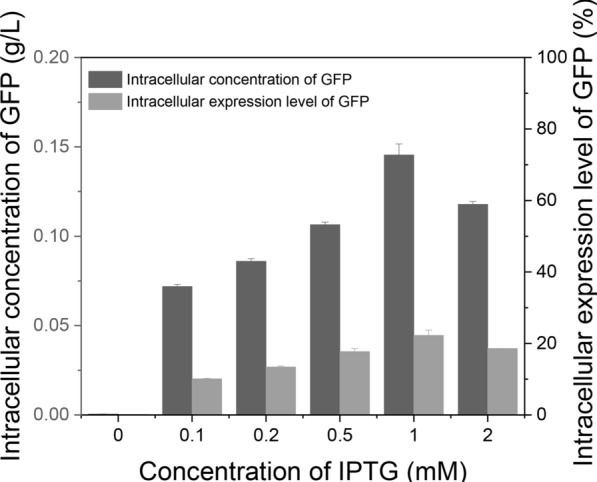
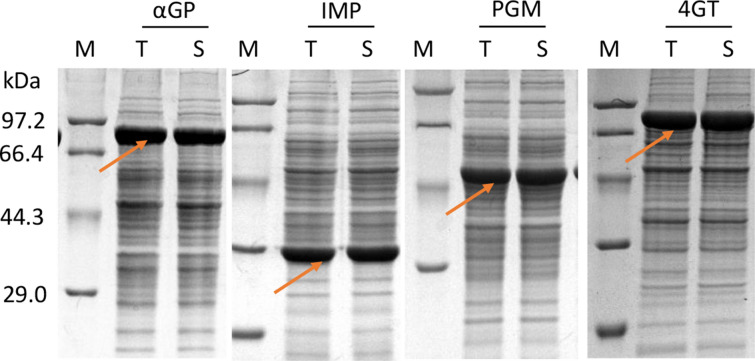
To mimic the Escherichia coli T7 protein expression system, we developed a facile T7 promoter-based protein expression system in an industrial microorganism Bacillus subtilis. This system has two parts: a new B. subtilis strain SCK22 and a plasmid pHT7. To construct strain SCK22, the T7 RNA polymerase gene was inserted into the chromosome, and several genes, such as two major protease genes, a spore generation-related gene, and a fermentation foam generation-related gene, were knocked out to facilitate good expression in high-density cell fermentation. The gene of a target protein can be subcloned into plasmid pHT7, where the gene of the target protein was under tight control of the T7 promoter with a ribosome binding site (RBS) sequence of B. subtilis (i.e., AAGGAGG). A few recombinant proteins (i.e., green fluorescent protein, α-glucan phosphorylase, inositol monophosphatase, phosphoglucomutase, and 4-α-glucanotransferase) were expressed with approximately 25-40% expression levels relative to the cellular total proteins estimated by SDS-PAGE by using B. subtilis SCK22/pHT7-derived plasmid. A fed-batch high-cell density fermentation was conducted in a 5-L fermenter, producing up to 4.78 g/L inositol monophosphatase. This expression system has a few advantageous features, such as, wide applicability for recombinant proteins, high protein expression level, easy genetic operation, high transformation efficiency, good genetic stability, and suitability for high-cell density fermentation.
为了模拟大肠杆菌T7蛋白表达系统,我们在工业微生物枯草芽孢杆菌中开发了一种基于T7启动子的简便蛋白表达系统。该系统有两个部分:新的枯草芽孢杆菌菌株SCK22和质粒pHT7。为构建菌株SCK22,将T7 RNA聚合酶基因插入染色体,并敲除了几个基因,如两个主要蛋白酶基因、一个与孢子生成相关的基因和一个与发酵泡沫生成相关的基因,以利于在高密度细胞发酵中实现良好表达。目标蛋白的基因可亚克隆到质粒pHT7中,其中目标蛋白的基因受T7启动子严格控制,并带有枯草芽孢杆菌的核糖体结合位点(RBS)序列(即AAGGAGG)。使用枯草芽孢杆菌SCK22/pHT7衍生质粒,通过SDS-PAGE估计,一些重组蛋白(即绿色荧光蛋白、α-葡聚糖磷酸化酶、肌醇单磷酸酶、磷酸葡萄糖变位酶和4-α-葡聚糖转移酶)的表达水平相对于细胞总蛋白约为25%-40%。在5-L发酵罐中进行了补料分批高细胞密度发酵,肌醇单磷酸酶产量高达4.78 g/L。该表达系统具有一些优势特性,如对重组蛋白适用性广、蛋白表达水平高、遗传操作简便、转化效率高、遗传稳定性好以及适合高细胞密度发酵。