School of Engineering and Applied Sciences, Harvard University, Cambridge, Massachusetts, USA.
INM - Leibniz Institute for New Materials, Saarbrücken, Germany.
J Extracell Vesicles. 2024 Apr;13(4):e12436. doi: 10.1002/jev2.12436.
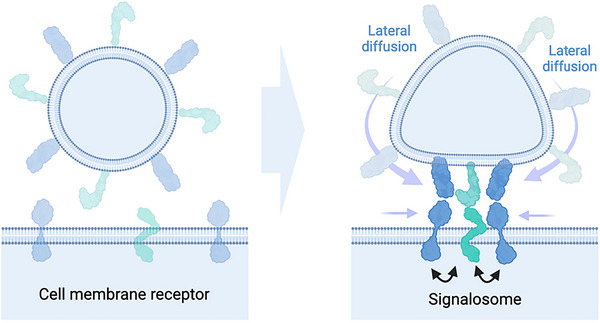
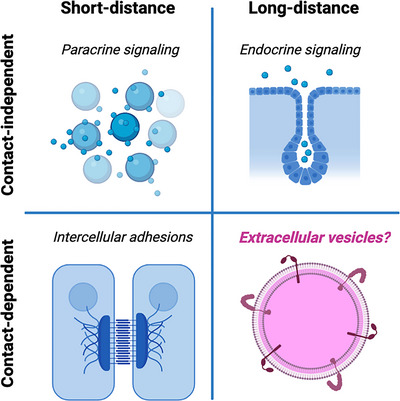
Extracellular vesicles (EVs), lipid-enclosed structures released by virtually all life forms, have gained significant attention due to their role in intercellular and interorganismal communication. Despite their recognized importance in disease processes and therapeutic applications, fundamental questions about their primary function remain. Here, we propose a different perspective on the primary function of EVs, arguing that they serve as essential elements providing membrane area for long-distance, contact-dependent cellular communication based on protein-protein interaction. While EVs have been recognized as carriers of genetic information, additional unique advantages that they could provide for cellular communication remain unclear. Here, we introduce the concept that the substantial membrane area provided by EVs allows for membrane contact-dependent interactions that could be central to their function. This membrane area enables the lateral diffusion and sorting of membrane ligands like proteins, polysaccharides or lipids in two dimensions, promoting avidity-driven effects and assembly of co-stimulatory architectures at the EV-cell interface. The concept of vesicle-induced receptor sequestration (VIRS), for example, describes how EVs confine and focus receptors at the EV contact site, promoting a dense local concentration of receptors into signalosomes. This process can increase the signalling strength of EV-presented ligands by 10-1000-fold compared to their soluble counterparts. The speculations in this perspective advance our understanding of EV-biology and have critical implications for EV-based applications and therapeutics. We suggest a shift in perspective from viewing EVs merely as transporters of relevant nucleic acids and proteins to considering their unique biophysical properties as presentation platforms for long-distance, contact-dependent signalling. We therefore highlight the functional role of the EV membrane rather than their content. We further discuss how this signalling mechanism might be exploited by virus-transformed or cancer cells to enhance immune-evasive mechanisms.
细胞外囊泡 (EVs) 是几乎所有生命形式释放的脂质包裹结构,由于其在细胞间和种间通讯中的作用而受到广泛关注。尽管它们在疾病过程和治疗应用中的重要性已得到认可,但关于其主要功能的基本问题仍然存在。在这里,我们提出了 EV 主要功能的不同观点,认为它们是提供膜面积的基本元素,用于基于蛋白-蛋白相互作用的长距离、接触依赖性细胞通讯。虽然 EV 已被认为是遗传信息的载体,但它们为细胞通讯提供的额外独特优势尚不清楚。在这里,我们引入了这样一个概念,即 EV 提供的大量膜面积允许基于膜接触的相互作用,这可能是其功能的核心。这种膜面积使膜配体(如蛋白质、多糖或脂质)能够在二维空间中进行侧向扩散和分类,促进亲合力驱动的效应和共刺激结构在 EV-细胞界面上的组装。例如,囊泡诱导受体隔离 (VIRS) 的概念描述了 EV 如何将受体局限和聚焦在 EV 接触部位,促进受体在 EV 接触部位的致密局部浓度形成信号小体。与可溶性配体相比,该过程可以使 EV 呈现的配体的信号强度增加 10-1000 倍。本观点中的推测推进了我们对 EV 生物学的理解,并对基于 EV 的应用和治疗具有关键意义。我们建议从仅将 EV 视为相关核酸和蛋白质的转运器的观点转变为将其独特的生物物理特性视为长距离、接触依赖性信号传递的展示平台的观点。因此,我们强调 EV 膜的功能作用,而不是其内容。我们进一步讨论了这种信号机制如何被病毒转化或癌细胞利用来增强免疫逃避机制。