Liao Chia-Chi, Hsieh Chia-Chun, Shia Wei-Chung, Chou Min-Yuan, Huang Chuan-Chuan, Lin Jhih-Hong, Lee Shu-Hsien, Sung Hsiang-Hsuan
National Laboratory Animal Center, National Applied Research Laboratories, Taipei, Taiwan.
Department of Microbiology and Immunology, National Defense Medical Center, Taipei, Taiwan.
Lab Anim Res. 2024 Apr 22;40(1):16. doi: 10.1186/s42826-024-00202-w.
Therapeutic interventions for diabetes are most effective when administered in the newly onset phase, yet determining the exact onset moment can be elusive in practice. Spontaneous autoimmune diabetes among NOD mice appears randomly between 12 and 32 weeks of age with an incidence range from 60 to 90%. Furthermore, the disease often progresses rapidly to severe diabetes within days, resulting in a very short window of newly onset phase, that poses significant challenge in early diagnosis. Conventionally, extensive blood glucose (BG) testing is typically required on large cohorts throughout several months to conduct prospective survey. We incorporated ultrasensitive urine glucose (UG) testing into an ordinary BG survey process, initially aiming to elucidate the lag period required for excessive glucose leaking from blood to urine during diabetes progression in the mouse model.
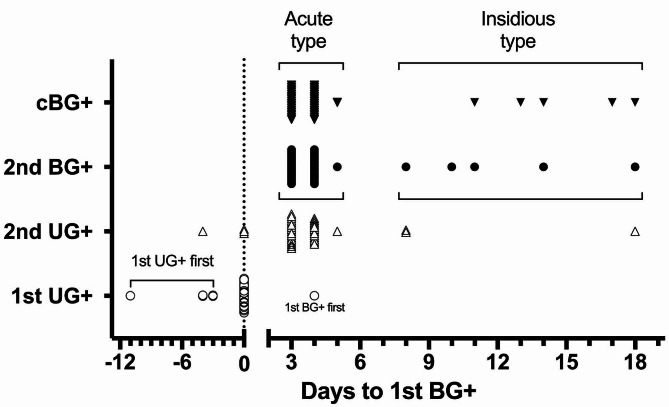
The observations unexpectedly revealed that small amounts of glucose detected in the urine often coincide with, sometimes even a couple days prior than elevated BG is diagnosed. Accordingly, we conducted the UG-based survey protocol in another cohort that was validated to accurately identified every individual near onset, who could then be confirmed by following few BG tests to fulfill the consecutive BG + criteria. This approach required fewer than 95 BG tests, compared to over 700 tests with traditional BG survey, to diagnose all the 37-38 diabetic mice out of total 60. The average BG level at diagnosis was slightly below 350 mg/dl, lower than the approximately 400 mg/dl observed with conventional BG monitoring.
We demonstrated a near perfect correlation between BG + and ultrasensitive UG + results in prospective survey with no lag period detected under twice weekly of testing frequency. This led to the refined protocol based on surveying with noninvasive UG testing, allowing for the early identification of newly onset diabetic mice with only a few BG tests required per mouse. This protocol significantly reduces the need for extensive blood sampling, lancet usage, labor, and animal distress, aligning with the 3Rs principle. It presents a convenient, accurate, and animal-friendly alternative for early diabetes diagnosis, facilitating research on diagnosis, pathogenesis, prevention, and treatment.
糖尿病的治疗干预在疾病新发病期进行时最为有效,但在实际中确定确切的发病时刻可能很困难。非肥胖型糖尿病(NOD)小鼠中的自发性自身免疫性糖尿病在12至32周龄之间随机出现,发病率在60%至90%之间。此外,该疾病通常在数天内迅速发展为严重糖尿病,导致新发病期的窗口非常短这给早期诊断带来了重大挑战。传统上,通常需要在几个月内对大量队列进行广泛的血糖(BG)检测以进行前瞻性调查。我们将超灵敏尿糖(UG)检测纳入普通的BG检测过程,最初目的是阐明在小鼠模型中糖尿病进展过程中过量葡萄糖从血液泄漏到尿液所需的滞后时间。
观察结果意外地显示,尿液中检测到的少量葡萄糖通常与血糖升高被诊断出的时间一致,有时甚至比血糖升高被诊断出的时间早几天。因此,我们在另一个队列中采用了基于UG的检测方案,该方案经验证可准确识别每个接近发病的个体,然后通过后续的几次BG检测来确认是否符合连续BG +标准。与传统BG检测需要超过700次检测相比,这种方法诊断出60只小鼠中所有37 - 38只糖尿病小鼠所需的BG检测次数少于95次。诊断时的平均BG水平略低于350mg/dl,低于传统BG监测观察到的约400mg/dl。
我们在前瞻性调查中证明了BG +和超灵敏UG +结果之间几乎完美的相关性,在每周两次的检测频率下未检测到滞后时间。这导致了基于非侵入性UG检测的优化方案,只需对每只小鼠进行少量BG检测就能早期识别新发病的糖尿病小鼠。该方案显著减少了大量采血、采血针使用、劳动力以及动物痛苦的需求,符合3R原则。它为早期糖尿病诊断提供了一种方便、准确且对动物友好的替代方法,有助于糖尿病的诊断、发病机制、预防和治疗研究。