Xia Yu, Wu Zifeng, He Rui, Gao Yahui, Qiu Yangyu, Cheng Qianqian, Ma Xiaoyuan, Wang Zhouping
State Key Laboratory of Food Science and Technology, Jiangnan University, Wuxi, 214122, China.
School of Food Science and Technology, Jiangnan University, Wuxi, 214122, China.
Bioresour Bioprocess. 2021 Jul 15;8(1):62. doi: 10.1186/s40643-021-00395-1.
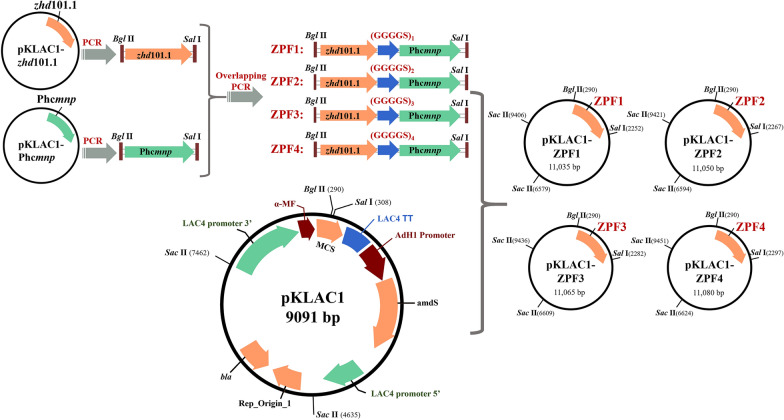
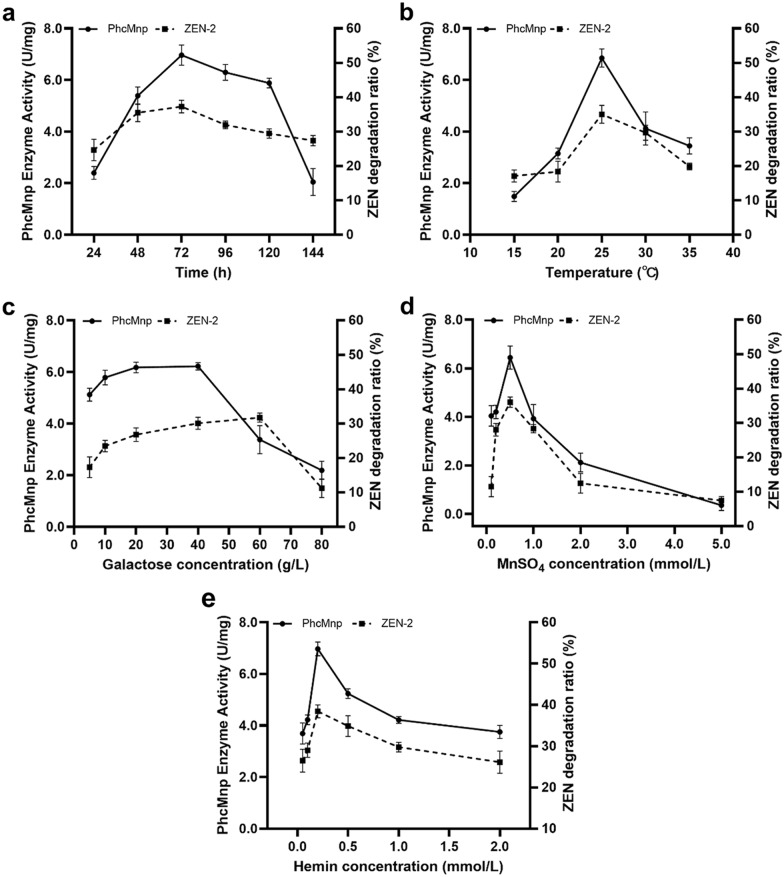
Aflatoxin B (AFB) and zearalenone (ZEN) are two predominant mycotoxins ubiquitously found in corn, peanuts, and other grains, which pose a great threat to human health. Therefore, safe and effective methods for detoxification of these mycotoxins are urgently needed. To achieve simultaneous degradation of multiple mycotoxins, a fusion enzyme ZPF1 was constructed by linking zearalenone hydrolase and manganese peroxidase with a linker peptide GGGGS. This fusion enzyme was secretory expressed successfully in the newly constructed food-grade recombinant strain Kluyveromyces lactis GG799(pKLAC1-ZPF1), and was investigated with the mycotoxins degradation efficiency in two reaction systems. Results showed that both AFB and ZEN can be degraded by ZPF1 in reaction system 1 (70.0 mmol/L malonic buffer with 1.0 mmol/L MnSO, 0.1 mmol/L HO, 5.0 µg/mL AFB and ZEN, respectively) with the ratios of 46.46% and 38.76%, respectively. In reaction system 2 (50.0 mmol/L Tris-HCl, with 5.0 µg/mL AFB and ZEN, respectively), AFB cannot be degraded while ZEN can be degraded with the ratio of 35.38%. To improve the degradation efficiency of these mycotoxins, optimization of the induction and degradation conditions were fulfilled subsequently. The degradation ratios of AFB and ZEN by ZPF1 in reaction system 1 reached 64.11% ± 2.93% and 46.21% ± 3.17%, respectively. While in reaction system 2, ZEN was degraded by ZPF1 at a ratio of 41.45% ± 3.34%. The increases of degradation ratios for AFB and ZEN in reaction system 1 were 17.65% and 7.45%, respectively, while that for ZEN in reaction system 2 was 6.07%, compared with the unoptimized results.
黄曲霉毒素B(AFB)和玉米赤霉烯酮(ZEN)是两种在玉米、花生和其他谷物中普遍存在的主要霉菌毒素,对人类健康构成巨大威胁。因此,迫切需要安全有效的这些霉菌毒素解毒方法。为实现多种霉菌毒素的同时降解,通过连接肽GGGGS将玉米赤霉烯酮水解酶和锰过氧化物酶连接构建了融合酶ZPF1。该融合酶在新构建的食品级重组菌株乳酸克鲁维酵母GG799(pKLAC1-ZPF1)中成功分泌表达,并在两个反应体系中研究了其对霉菌毒素的降解效率。结果表明,在反应体系1(含有1.0 mmol/L硫酸锰、0.1 mmol/L过氧化氢、分别为5.0 μg/mL AFB和ZEN的70.0 mmol/L丙二酸缓冲液)中,ZPF1能分别以46.46%和38.76%的比例降解AFB和ZEN。在反应体系2(50.0 mmol/L Tris-HCl,分别含有5.0 μg/mL AFB和ZEN)中,AFB不能被降解,而ZEN能以35.38%的比例被降解。为提高这些霉菌毒素的降解效率,随后对诱导和降解条件进行了优化。在反应体系1中,ZPF1对AFB和ZEN的降解率分别达到64.11%±2.93%和46.21%±3.17%。而在反应体系2中,ZPF1对ZEN的降解率为41.45%±3.34%。与未优化结果相比,反应体系1中AFB和ZEN降解率的提高分别为17.65%和7.45%,反应体系2中ZEN降解率的提高为6.07%。