Lin Joseph B, Pepple Kathryn L, Concepcion Christian, Korshunova Yulia, Paley Michael A, Paley Grace L, Laurent Jennifer, Apte Rajendra S, Hassman Lynn M
John F. Hardesty, MD, Department of Ophthalmology and Visual Sciences, Washington University School of Medicine, St. Louis, Missouri.
Neurosciences Graduate Program, Roy and Diana Vagelos Division of Biology and Biomedical Sciences, Washington University School of Medicine, St. Louis, Missouri.
Ophthalmol Sci. 2023 Dec 14;4(4):100453. doi: 10.1016/j.xops.2023.100453. eCollection 2024 Jul-Aug.
Uveitis is a heterogenous group of inflammatory eye disease for which current cytokine-targeted immune therapies are effective for only a subset of patients. We hypothesized that despite pathophysiologic nuances that differentiate individual disease states, all forms of eye inflammation might share common mechanisms for immune cell recruitment. Identifying these mechanisms is critical for developing novel, broadly acting therapeutic strategies.
Experimental study.
Biospecimens from patients with active or inactive uveitis and healthy controls.
Protein concentration and single cell gene expression were assessed in aqueous fluid biopsies and plasma samples from deidentified patients with uveitis or healthy controls.
The concentration of 31 inflammatory proteins was measured in all aqueous samples, as well as plasma samples from patients with active uveitis. Chemokine and cytokine ligand and receptor expression were assessed in individual cell types from aqueous biopsies obtained from patients with active uveitis.
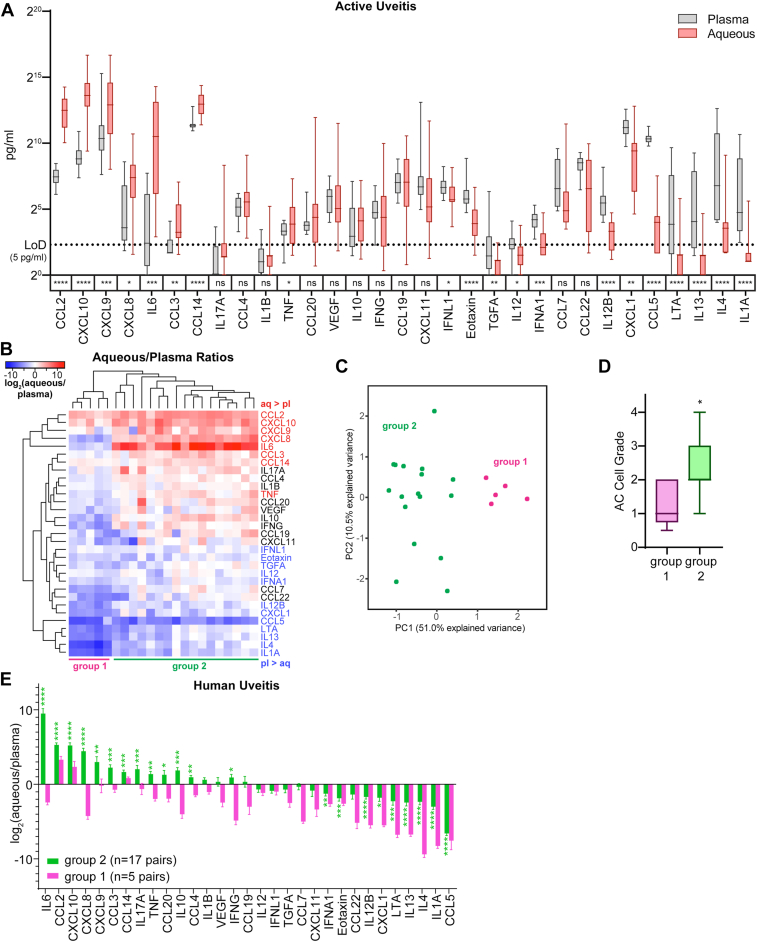
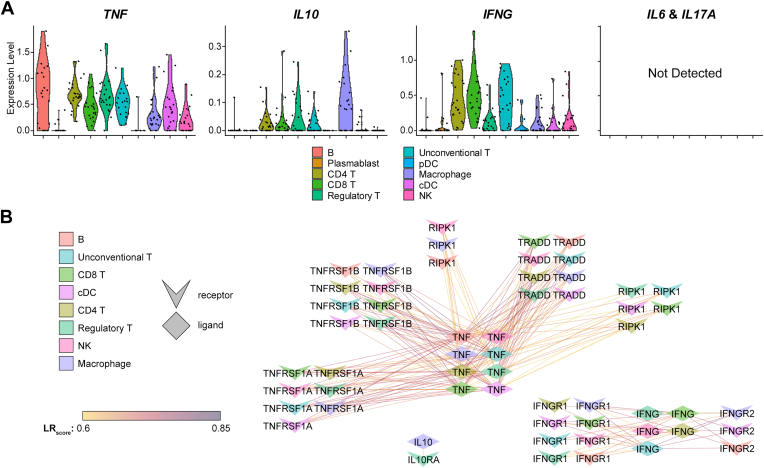
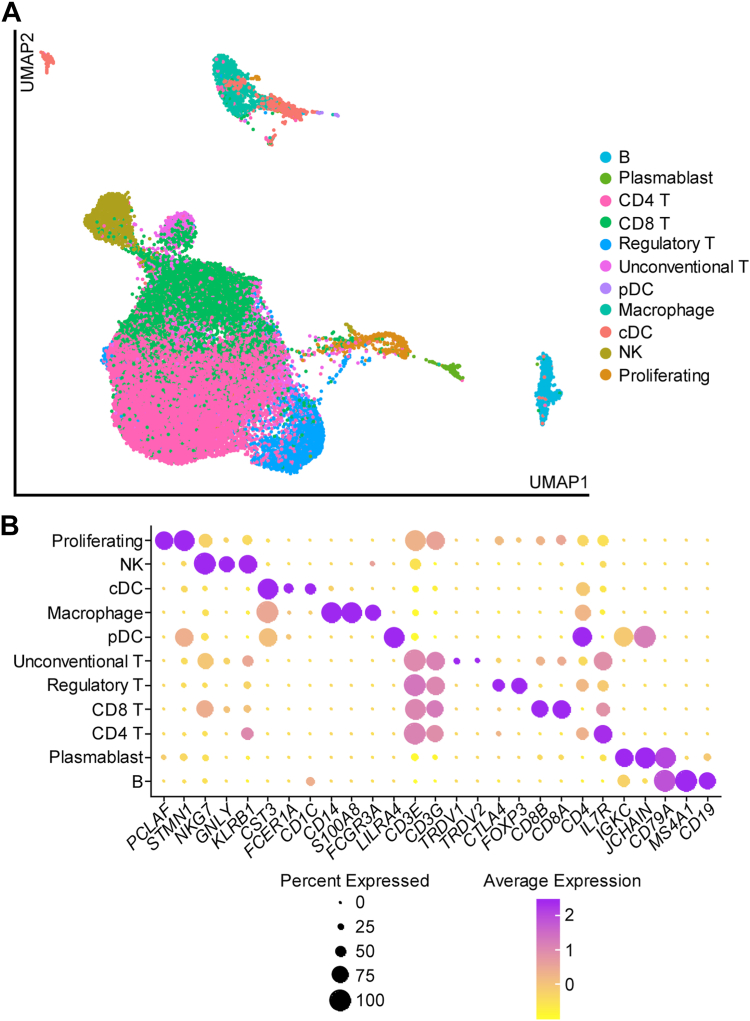
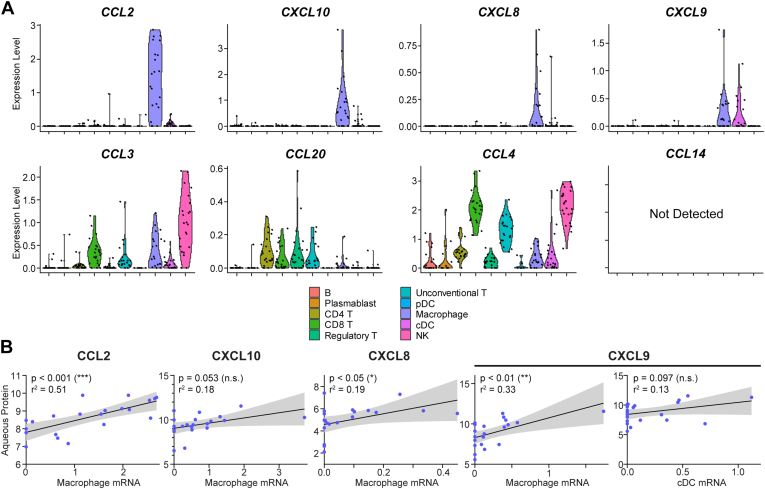
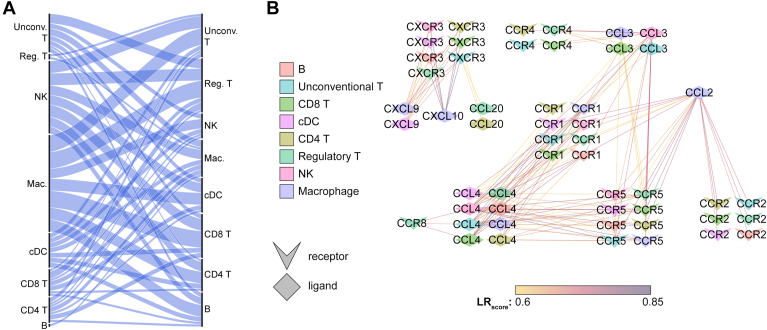
We identified 6 chemokines that were both elevated in active uveitis compared with controls and enriched in aqueous compared with plasma during active uveitis (C-C motif chemokine ligand [CCL]2, C-X-C motif chemokine ligand [CXCL]10, CXCL9, CXCL8, CCL3, and CCL14), forming potential gradients for migration of immune cells from the blood to the eye. Of these, CCL2 and CXCL10 were consistently enriched in the aqueous of all patients in our cohort, as well as in a larger cohort of patients from a previously published study. These data suggest that CCL2 and CXCL10 are key mediators in immune cell migration to the eye during uveitis. Next, single cell RNA sequencing suggested that macrophages contribute to aqueous enrichment of CCL2 and CXCL10 during human uveitis. Finally, using chemokine ligand and receptor expression mapping, we identified a broad signaling network for macrophage-derived CCL2 and CXCL10 in human uveitis.
These data suggest that ocular macrophages may play a central role, via CCL2 and CXCL10 production, in recruiting inflammatory cells to the eye in patients with uveitis.
Proprietary or commercial disclosure may be found in the Footnotes and Disclosures at the end of this article.
葡萄膜炎是一组异质性的眼部炎症性疾病,目前针对细胞因子的免疫疗法仅对部分患者有效。我们推测,尽管不同疾病状态在病理生理学上存在细微差别,但所有形式的眼部炎症可能在免疫细胞募集方面具有共同机制。识别这些机制对于开发新型、广泛有效的治疗策略至关重要。
实验研究。
来自活动性或非活动性葡萄膜炎患者及健康对照者的生物标本。
对身份不明的葡萄膜炎患者或健康对照者的房水活检样本和血浆样本进行蛋白质浓度及单细胞基因表达评估。
测定所有房水样本以及活动性葡萄膜炎患者血浆样本中31种炎症蛋白的浓度。评估来自活动性葡萄膜炎患者的房水活检样本中各细胞类型的趋化因子、细胞因子配体及受体表达情况。
我们鉴定出6种趋化因子,与对照相比,它们在活动性葡萄膜炎中均升高,且在活动性葡萄膜炎期间房水中的含量高于血浆(C-C基序趋化因子配体[CCL]2、C-X-C基序趋化因子配体[CXCL]10、CXCL9、CXCL8、CCL3和CCL14),形成了免疫细胞从血液向眼部迁移的潜在梯度。其中,CCL2和CXCL10在我们队列中的所有患者房水中以及先前发表研究中的更大患者队列中均持续富集。这些数据表明,CCL2和CXCL10是葡萄膜炎期间免疫细胞向眼部迁移的关键介质。接下来,单细胞RNA测序表明,巨噬细胞在人类葡萄膜炎期间促成了CCL2和CXCL10在房水中的富集。最后,通过趋化因子配体和受体表达图谱分析,我们在人类葡萄膜炎中确定了一个由巨噬细胞衍生的CCL2和CXCL10构成的广泛信号网络。
这些数据表明,眼部巨噬细胞可能通过产生CCL2和CXCL10,在葡萄膜炎患者的炎症细胞向眼部募集中发挥核心作用。
本文末尾的脚注和披露中可能会有专有或商业披露信息。