Barnett Adam, Jaine Fabrice R A, Bierwagen Stacy L, Lubitz Nicolas, Abrantes Kátya, Heupel Michelle R, Harcourt Rob, Huveneers Charlie, Dwyer Ross G, Udyawer Vinay, Simpfendorfer Colin A, Miller Ingo B, Scott-Holland Tracey, Kilpatrick Carley S, Williams Samuel M, Smith Daniel, Dudgeon Christine L, Hoey Andrew S, Fitzpatrick Richard, Osborne Felicity E, Smoothey Amy F, Butcher Paul A, Sheaves Marcus, Fisher Eric E, Svaikauskas Mark, Ellis Megan, Kanno Shiori, Cresswell Benjamin J, Flint Nicole, Armstrong Asia O, Townsend Kathy A, Mitchell Jonathan D, Campbell Matthew, Peddemors Victor M, Gustafson Johan A, Currey-Randall Leanne M
Marine Data Technology Hub, James Cook University, Townsville, QLD, 4811, Australia.
Biopixel Oceans Foundation, Cairns, QLD, 4878, Australia.
Mov Ecol. 2024 Apr 23;12(1):31. doi: 10.1186/s40462-024-00468-8.
Acoustic telemetry has become a fundamental tool to monitor the movement of aquatic species. Advances in technology, in particular the development of batteries with lives of > 10 years, have increased our ability to track the long-term movement patterns of many species. However, logistics and financial constraints often dictate the locations and deployment duration of acoustic receivers. Consequently, there is often a compromise between optimal array design and affordability. Such constraints can hinder the ability to track marine animals over large spatial and temporal scales. Continental-scale receiver networks have increased the ability to study large-scale movements, but significant gaps in coverage often remain.
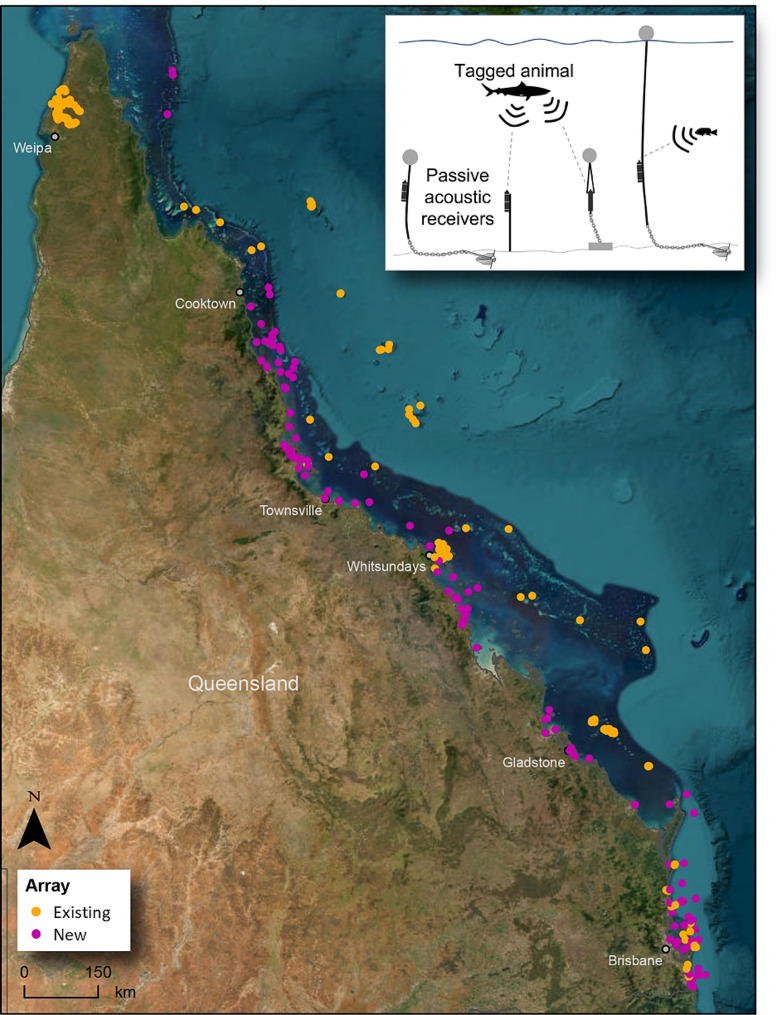
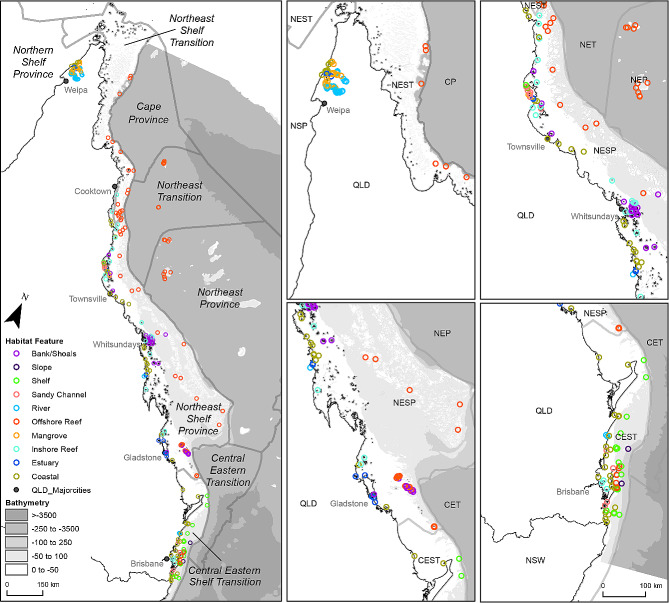
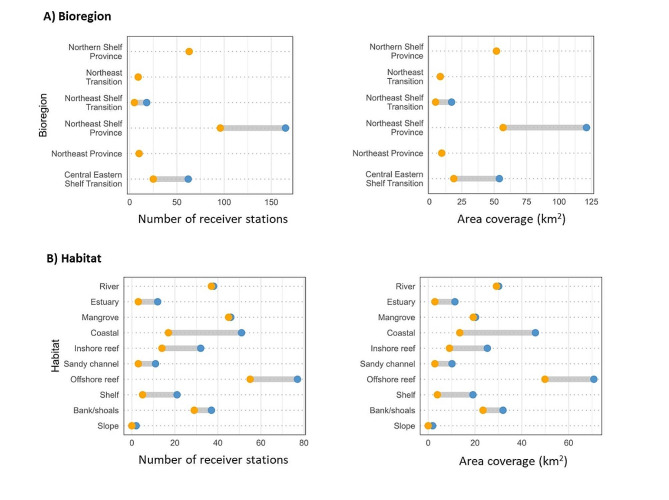
Since 2007, the Integrated Marine Observing System's Animal Tracking Facility (IMOS ATF) has maintained permanent receiver installations on the eastern Australian seaboard. In this study, we present the recent enhancement of the IMOS ATF acoustic tracking infrastructure in Queensland to collect data on large-scale movements of marine species in the northeast extent of the national array. Securing a relatively small initial investment for expanding receiver deployment and tagging activities in Queensland served as a catalyst, bringing together a diverse group of stakeholders (research institutes, universities, government departments, port corporations, industries, Indigenous ranger groups and tourism operators) to create an extensive collaborative network that could sustain the extended receiver coverage into the future. To fill gaps between existing installations and maximise the monitoring footprint, the new initiative has an atypical design, deploying many single receivers spread across 2,100 km of Queensland waters.
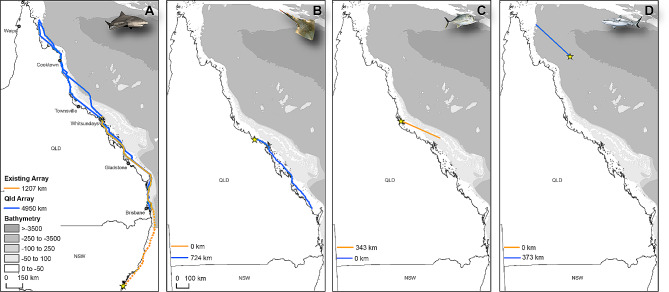
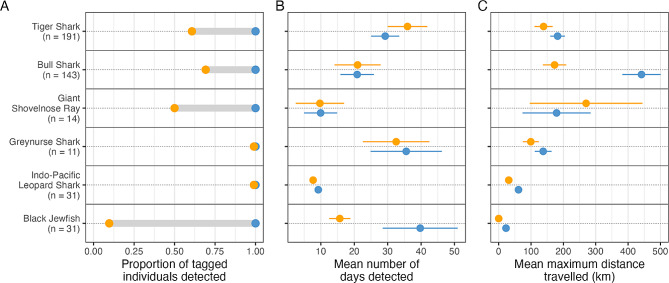
The approach revealed previously unknown broad-scale movements for some species and highlights that clusters of receivers are not always required to enhance data collection. However, array designs using predominantly single receiver deployments are more vulnerable to data gaps when receivers are lost or fail, and therefore "redundancy" is a critical consideration when designing this type of array.
Initial results suggest that our array enhancement, if sustained over many years, will uncover a range of previously unknown movements that will assist in addressing ecological, fisheries, and conservation questions for multiple species.
声学遥测已成为监测水生物种活动的一项基本工具。技术进步,特别是使用寿命超过10年的电池的开发,增强了我们追踪许多物种长期活动模式的能力。然而,后勤和资金限制常常决定了声学接收器的放置位置和部署时长。因此,在最优阵列设计和可承受性之间往往需要权衡。此类限制可能会阻碍在大空间和时间尺度上追踪海洋动物的能力。大陆尺度的接收器网络增强了研究大规模活动的能力,但覆盖范围仍常常存在显著空白。
自2007年以来,综合海洋观测系统的动物追踪设施(IMOS ATF)在澳大利亚东海岸维持了永久性接收器装置。在本研究中,我们展示了昆士兰州IMOS ATF声学追踪基础设施近期的增强情况,以收集有关国家阵列东北区域海洋物种大规模活动的数据。为昆士兰州扩大接收器部署和标记活动确保相对较少的初始投资起到了推动作用,汇聚了不同的利益相关者群体(研究机构、大学、政府部门、港口公司、行业、原住民护林员团体和旅游运营商),创建了一个广泛的合作网络,该网络能够将扩展后的接收器覆盖范围维持到未来。为了填补现有装置之间的空白并最大化监测范围,新举措采用了非典型设计,在昆士兰州2100公里的海域分散部署了许多单个接收器。
该方法揭示了一些物种此前未知的大规模活动,并突出表明增强数据收集并不总是需要接收器集群。然而,主要使用单个接收器部署的阵列设计在接收器丢失或出现故障时更容易出现数据空白,因此在设计此类阵列时,“冗余”是一个关键考虑因素。
初步结果表明,如果我们的阵列增强措施持续多年,将揭示一系列此前未知的活动,这将有助于解决多种物种的生态、渔业和保护问题。