Dini Filippo Maria, Caffara Monica, Magri Alice, Cantori Alessia, Luci Valentina, Monno Antonio, Galuppi Roberta
Department of Veterinary Medical Sciences (DIMEVET), Alma Mater Studiorum University of Bologna, Via Tolara di Sopra 50, 40064, Ozzano Emilia, BO, Italy.
Int J Parasitol Parasites Wildl. 2024 Apr 17;24:100939. doi: 10.1016/j.ijppaw.2024.100939. eCollection 2024 Aug.
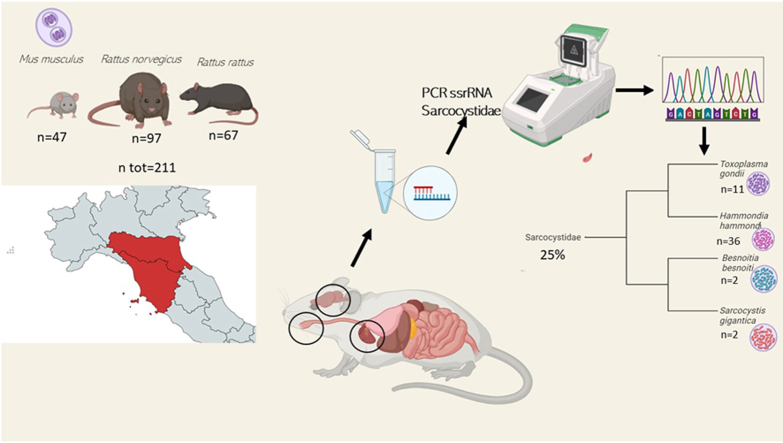
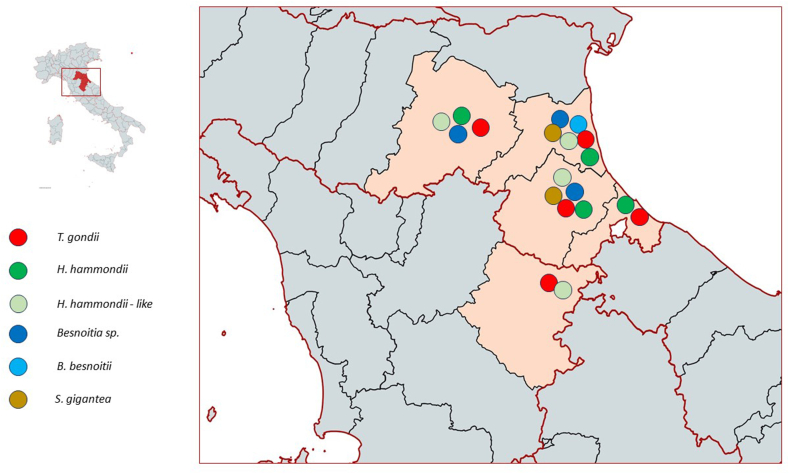
Synanthropic rodents play a crucial role in maintaining the life cycle of in anthropized regions and can serve as indicators of environmental oocyst contamination. This investigation aimed to explore the occurrence of infection within synanthropic rodent populations using a molecular diagnostic technique targeting the 18S rDNA gene, which is generic for Coccidia, with subsequent specific PCR confirmation. We examined 97 brown rats (), 67 black rats (), 47 house mice (), and 1 common shrew (). PCR tests were conducted on the brain, heart, and tongue tissues. PCR tested positive in at least one of the examined tissues in 26 (26.8%), 13 (19.4%), and 13 (27.6%). Sequencing comparisons by BLAST allowed us to identify four different species of cyst-forming Apicomplexa. In particular, DNA was detected in 13 (6.1%) rodents, (including -like organisms) in 36 (17%) subjects, sp. (in two cases identified as ) in 8 (3.7%), and in two (0.94%). Rodents from peri-urban and urban environments can act as indicators of environmental contamination by oocysts of apicomplexan parasites with cats as definitive hosts, such as , , and , the latter of which has never been previously recorded in rodents. Moreover, the presence of , a parasite with an unidentified definitive host in Europe, sheds light on the potential role of these hosts as infection sentinels.
伴人鼠类在人类活动频繁地区维持生命周期方面发挥着关键作用,并且可作为环境卵囊污染的指示生物。本研究旨在运用针对球虫纲通用的18S rDNA基因的分子诊断技术,探究伴人鼠类种群中[寄生虫名称]感染的发生情况,随后进行特异性PCR确认。我们检查了97只褐家鼠(Rattus norvegicus)、67只黑家鼠(Rattus rattus)、47只小家鼠(Mus musculus)和1只普通鼩鼱(Sorex araneus)。对脑、心脏和舌组织进行了PCR检测。在26只褐家鼠(26.8%)、13只黑家鼠(19.4%)和13只小家鼠(27.6%)的至少一种检测组织中,PCR检测呈阳性。通过BLAST进行的序列比较使我们能够鉴定出四种不同的形成包囊的顶复门物种。具体而言,在13只(6.1%)啮齿动物中检测到[寄生虫名称1]DNA,在36只(17%)个体中检测到[寄生虫名称2](包括[类似物种名称]),在8只(3.7%)个体中检测到[寄生虫名称3]种(在两例中鉴定为[具体物种名称]),在2只(0.94%)个体中检测到[寄生虫名称4]。来自城郊和城市环境的啮齿动物可作为以猫为终末宿主的顶复门寄生虫卵囊对环境污染的指示生物,例如[寄生虫名称1]、[寄生虫名称2]和[寄生虫名称3],其中后者此前从未在啮齿动物中记录过。此外,在欧洲具有未明确终末宿主的寄生虫[寄生虫名称4]的存在,揭示了这些宿主作为感染哨兵的潜在作用。