Cabral Aline Diniz, Su Chunlei, Soares Rodrigo Martins, Gennari Solange Maria, Sperança Márcia Aparecida, da Rosa Adriana Ruckert, Pena Hilda Fátima Jesus
Universidade de São Paulo, Faculdade de Medicina Veterinária e Zootecnia, Departamento de Medicina Veterinária Preventiva e Saúde Animal, Av. Prof. Dr. Orlando Marques de Paiva, 87, CEP 05508-270, São Paulo, SP, Brazil.
Department of Microbiology, University of Tennessee, Knoxville, TN, 37996, USA.
Int J Parasitol Parasites Wildl. 2021 Jan 19;14:91-96. doi: 10.1016/j.ijppaw.2021.01.003. eCollection 2021 Apr.
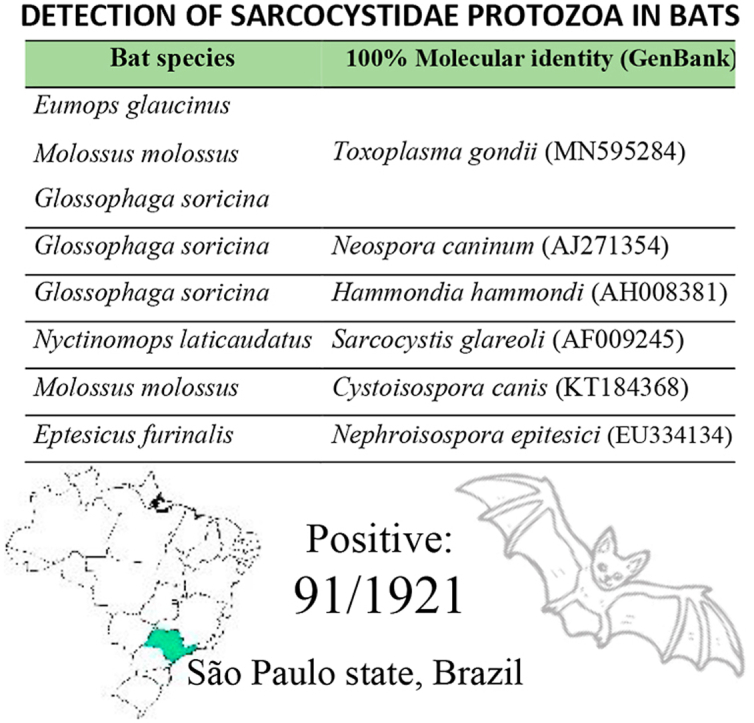
Studies on infectious and emerging diseases caused by bats have been increasing worldwide due to their well-recognised status as a reservoir species for various infectious agents as well as their close relationship to humans and animals. This study reports the molecular frequency and diversity of the parasites belonging to the Sarcocystidae family in bats in São Paulo state, Brazil. A total of 2892 tissue samples (brain and pectoral muscle/heart homogenates) from 1921 bats belonging to 36 species were collected, and the Sarcocystidae protozoan 18S ribosomal RNA encoding genes (18S rDNA) were detected by nested PCR and Sanger sequencing. The relative prevalence of Sarcocystidae species was 4.7% (91/1921) among 16 bat species, including insectivorous ( = 65), frugivorous ( = 13) and nectarivorous ( = 11) bats. From 66 sequenced positive samples, 50 were found to be suitable for analysis. Ten samples from insectivorous and nectarivorous bats showed 100% similarity with ( = 1), ( = 1), ( = 1), ( = 1), ( = 1), and ( = 5). The 45 non- samples revealed 15 different 18S rDNA alleles with identities varying from 96.1 to 100% with several Sarcocystidae species, which might suggest that bats can harbour a large variety of Sarcocystidae organisms. From the five -positive tissue samples, three samples from two different bat specimens of the insectivorous were characterised using 11 PCR-restriction fragment length polymorphism (RFLP) markers, revealing the non-archetypal ToxoDB genotypes #6 (type BrI), which is one of the most prevalent in different hosts and regions from Brazil, and #69. We recommend the inclusion of as a differential diagnosis for rabies and other neurological syndromes in bats.
由于蝙蝠作为多种传染源的储存宿主这一地位已得到广泛认可,且它们与人类和动物关系密切,因此全球范围内对蝙蝠所引发的传染病及新出现疾病的研究不断增加。本研究报告了巴西圣保罗州蝙蝠中肉孢子虫科寄生虫的分子频率和多样性。共收集了来自36个物种的1921只蝙蝠的2892份组织样本(脑以及胸肌/心脏匀浆),并通过巢式PCR和桑格测序法检测肉孢子虫原生动物18S核糖体RNA编码基因(18S rDNA)。在16种蝙蝠中,肉孢子虫科物种的相对患病率为4.7%(91/1921),包括食虫蝙蝠(n = 65)、食果蝙蝠(n = 13)和食蜜蝙蝠(n = 11)。在66个测序阳性样本中,发现50个样本适合分析。来自食虫和食蜜蝙蝠的10个样本与贝氏肉孢子虫(n = 1)、猪人肉孢子虫(n = 1)、犬人肉孢子虫(n = 1)、人肉孢子虫(n = 1)、哈氏肉孢子虫(n = 1)以及刚地弓形虫(n = 5)显示出100%的相似性。45个非弓形虫阳性样本揭示了15种不同的18S rDNA等位基因,与几种肉孢子虫科物种的同一性从96.1%到100%不等,这可能表明蝙蝠可能携带多种肉孢子虫科生物体。从5个弓形虫阳性组织样本中,对来自两种不同食虫蝙蝠标本的3个样本使用11种PCR限制性片段长度多态性(RFLP)标记进行了特征分析,揭示了非典型的ToxoDB基因型#6(BrI型),这是巴西不同宿主和地区最常见的基因型之一,以及#69。我们建议将弓形虫纳入蝙蝠狂犬病和其他神经综合征的鉴别诊断中。