Tian Shen, Asano Yoshimasa, Banerjee Tirtha Das, Wee Jocelyn Liang Qi, Lamb Abigail, Wang Yehan, Murugesan Suriya Narayanan, Ui-Tei Kumiko, Wittkopp Patricia J, Monteiro Antónia
Department of Biological Sciences, Faculty of Science, National University of Singapore; Singapore, 117543, Singapore.
Department of Biological Sciences, Graduate School of Science, The University of Tokyo; Tokyo, 113-0033, Japan.
bioRxiv. 2024 Apr 18:2024.02.09.579741. doi: 10.1101/2024.02.09.579741.
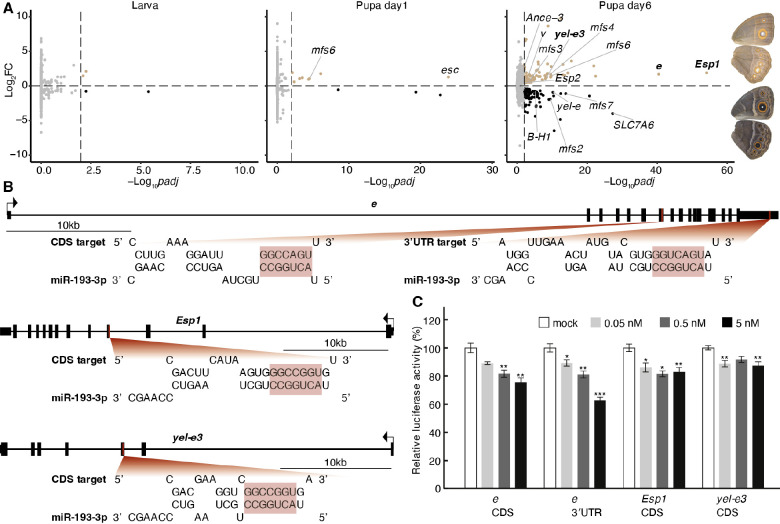
In Lepidoptera (butterflies and moths), the genomic region around the gene is a 'hotspot' locus, repeatedly used to generate intraspecific melanic wing color polymorphisms across 100-million-years of evolution. However, the identity of the effector gene regulating melanic wing color within this locus remains unknown. Here, we show that none of the four candidate protein-coding genes within this locus, including , serve as major effectors. Instead, a micro-RNA (miRNA), , serves as the major effector across three deeply diverged lineages of butterflies, and its function is conserved in . In Lepidoptera, is derived from a gigantic long non-coding RNA, , and it functions by directly repressing multiple pigmentation genes. We show that a miRNA can drive repeated instances of adaptive evolution in animals.
在鳞翅目昆虫(蝴蝶和蛾类)中,基因周围的基因组区域是一个“热点”位点,在长达1亿年的进化过程中,该位点被反复用于产生种内黑色翅膀颜色多态性。然而,该位点内调控黑色翅膀颜色的效应基因的身份仍然未知。在这里,我们表明该位点内的四个候选蛋白质编码基因,包括 ,都不是主要效应因子。相反,一种微小RNA(miRNA), 在三个深度分化的蝴蝶谱系中作为主要效应因子,并且其功能在 中是保守的。在鳞翅目中, 源自一个巨大的长链非编码RNA, ,它通过直接抑制多个色素沉着基因发挥作用。我们表明一种miRNA可以推动动物适应性进化的重复实例。