University of Kristianstad, Elmetorpsvägen 15, 29188, Kristianstad, Sweden.
Department of Periodontics, University of Washington, Seattle, WA, USA.
Clin Oral Investig. 2021 Jun;25(6):4085-4095. doi: 10.1007/s00784-020-03739-x. Epub 2021 Jan 28.
The present study assessed if individuals ≥ 60 years of age with periodontitis are more likely to develop stroke or ischemic heart diseases, or at a higher risk of death for 17 years.
At baseline individuals ≥ 60 received a dental examination including a panoramic radiograph. Periodontitis was defined as having ≥ 30% sites with ≥ 5-mm distance from the cementoenamel junction to the marginal bone level. Medical records were annually reviewed from 2001 to 2018. Findings from the medical records identifying an ICD-10 code of stroke and ischemic heart diseases or death were registered.
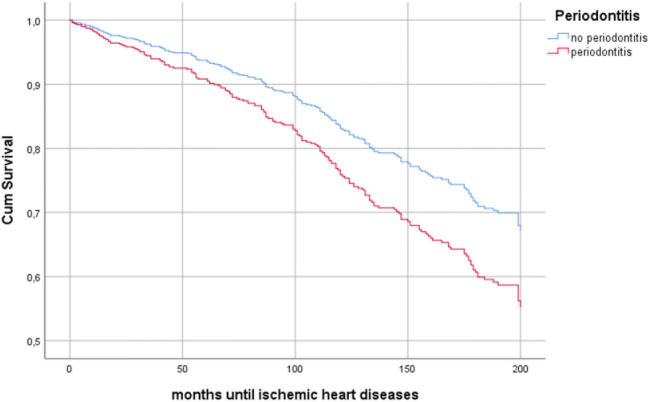
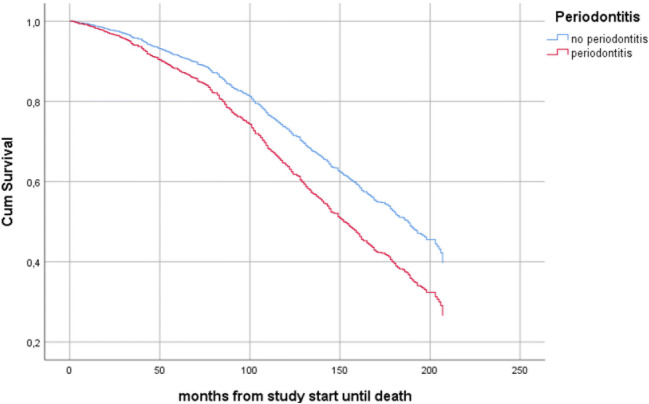
Associations between periodontitis and incidence of ischemic heart disease were found in this 17-year follow-up study in all individuals 60-93 years (HR: 1.5, CI: 1.1-2.1, p = 0.017), in women (HR: 2.1, CI: 1.3-3.4, p = 0.002), and in individuals 78-96 years (HR: 1.7, CI: 1.0-2.6, p = 0.033). Periodontitis was associated with mortality in all individuals (HR: 1.4, CI: 1.2-1.8, p = 0.002), specifically in men (HR: 1.5, CI: 1.1-1.9, p = 0.006) or in ages 60-72 years (HR: 2.2, CI: 1.5-3.2, p = 0.000). Periodontitis was more prevalent among men (OR: 1.8, CI: 1.3-2.4, p = 0.000).
Individuals with periodontitis have an increased risk for future events of ischemic heart diseases and death.
Improving periodontal health in older individuals may reduce overall mortality and ischemic heart diseases. Both dental and medical professionals should be aware of the associations and ultimately cooperate.
本研究旨在评估 60 岁及以上患有牙周炎的个体发生中风或缺血性心脏病的风险是否更高,或在 17 年内死亡的风险是否更高。
在基线时,≥60 岁的个体接受了牙科检查,包括全景放射检查。牙周炎的定义为≥30%的位点与牙骨质-釉质交界处到边缘骨水平的距离≥5 毫米。从 2001 年到 2018 年,每年对医疗记录进行审查。从医疗记录中确定 ICD-10 中风和缺血性心脏病代码或死亡的发现被登记。
在这项 17 年的随访研究中,我们发现牙周炎与所有 60-93 岁(HR:1.5,CI:1.1-2.1,p=0.017)、女性(HR:2.1,CI:1.3-3.4,p=0.002)和 78-96 岁(HR:1.7,CI:1.0-2.6,p=0.033)个体的缺血性心脏病发病风险之间存在关联。牙周炎与所有个体的死亡率相关(HR:1.4,CI:1.2-1.8,p=0.002),特别是在男性(HR:1.5,CI:1.1-1.9,p=0.006)或 60-72 岁(HR:2.2,CI:1.5-3.2,p=0.000)。牙周炎在男性中更为普遍(OR:1.8,CI:1.3-2.4,p=0.000)。
患有牙周炎的个体未来发生缺血性心脏病和死亡的风险增加。
改善老年个体的牙周健康可能会降低总体死亡率和缺血性心脏病。牙科和医疗专业人员都应该意识到这些关联,并最终进行合作。