MS Center, S. Andrea Hospital, Sapienza University, Rome, Italy.
Department of Human Neurosciences, Sapienza University, Rome, Italy.
BMC Neurol. 2024 Apr 25;24(1):138. doi: 10.1186/s12883-024-03643-x.
Physical fatigue is one of the most disabling symptoms in people with Multiple Sclerosis (PwMS). Several factors might influence the development of fatigue, such as gender, education, body mass index (BMI), Expanded Disability Status Scale (EDSS), disease duration, working status (Ws), physiotherapy (Ph), and disease-modifying therapies (DMTs). Fatigue Symptoms and Impacts Questionnaire-Relapsing Multiple Sclerosis (FSIQ-RMS) is a patient-reported outcome (PRO) that allows one to define the impact of fatigue in PwMS clearly. This study aimed to assess fatigue impact on PwMS by using FSIQ-RMS.
The participants were enrolled from May to July 2021 in MS Centers of Sant'Andrea Hospital and Policlinico Umberto I Hospital in Rome. Fatigue was evaluated using the FSIQ-RMS, validated, and culturally adapted in Italian. Clinical and demographic data were collected at the same time.
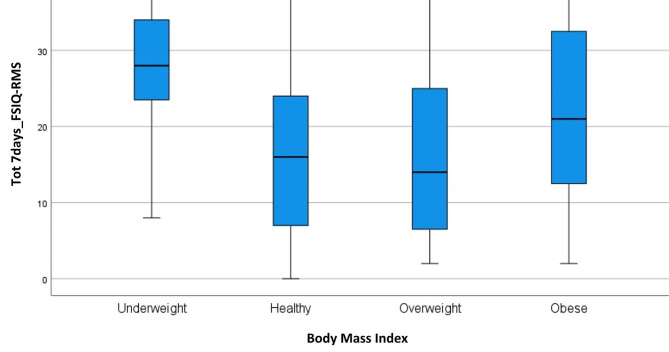
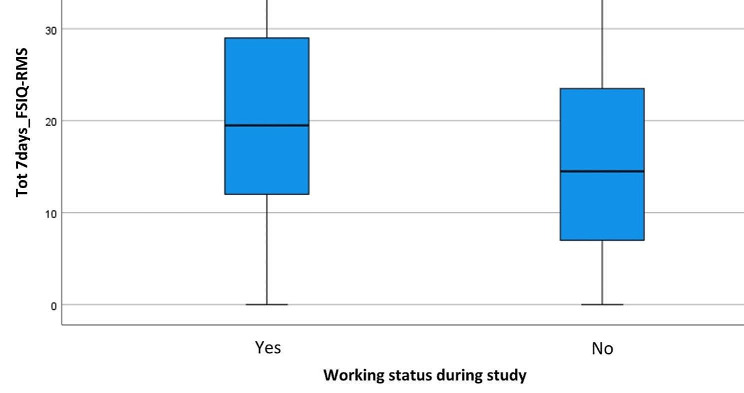
We enrolled 178 PwMS [Female 74.16%; RMS 82.58%, SPMS 17.52%]. FSIQ-RMS scores were significantly correlated with EDSS (p-value < 0.01). Analysis of variance between means showed a statistically significant difference between the BMI groups at the 24hours_FSIQ-RMS score and the 7days_FSIQ-RMS score (p < 0.01), with the lower BMI group having the highest scores. Furthermore, perceived fatigue significantly improved both in subjects performing Ph (p < 0.05) and in those who actively work (p < 0.01).
The use of FSIQ-RMS in a real-world setting confirmed that underweight and high levels of disability are closely related to fatigue. In addition, Ph and active Ws are strongly correlated with fatigue in PwMS.
身体疲劳是多发性硬化症(MS)患者最致残的症状之一。多种因素可能会影响疲劳的发展,如性别、教育程度、体重指数(BMI)、扩展残疾状态量表(EDSS)、病程、工作状态(Ws)、物理治疗(Ph)和疾病修正治疗(DMTs)。疲劳症状和影响问卷-复发型多发性硬化症(FSIQ-RMS)是一种患者报告的结局(PRO),可以明确定义 MS 患者疲劳的影响。本研究旨在使用 FSIQ-RMS 评估疲劳对 MS 患者的影响。
研究对象于 2021 年 5 月至 7 月在罗马圣安德烈亚医院和翁贝托一世医院的 MS 中心入组。使用经过验证和文化适应性改编的意大利语版本的 FSIQ-RMS 评估疲劳。同时收集临床和人口统计学数据。
共纳入 178 例 MS 患者[女性占 74.16%;复发型 MS(RMS)占 82.58%,继发进展型 MS(SPMS)占 17.52%]。FSIQ-RMS 评分与 EDSS 显著相关(p 值<0.01)。平均值之间的方差分析显示,24 小时 FSIQ-RMS 评分和 7 天 FSIQ-RMS 评分的 BMI 组之间存在统计学差异(p<0.01),较低的 BMI 组得分最高。此外,进行 Ph 的患者(p<0.05)和积极工作的患者(p<0.01)的主观疲劳感均显著改善。
FSIQ-RMS 在真实环境中的使用证实,体重不足和高残疾水平与疲劳密切相关。此外,Ph 和积极的 Ws 与 MS 患者的疲劳密切相关。