Centro de Investigação Em Educação Física, Desporto, Saúde e Exercício (CIDEFES), Universidade Lusófona, Lisbon, Portugal.
Centro de Investigação Formação Inovação e Intervenção em Desporto (CIFI2D), Universidade do Porto, Porto, Portugal.
Work. 2024;79(2):879-890. doi: 10.3233/WOR-230624.
Prolonged periods of sitting have been linked to negative health outcomes. Implementation of sit-stand desks in the workplace has been one strategy to reduce prolonged sitting.
To assess the effectiveness of sit-stand workstations on reducing sitting time and improving other health outcomes of office-based workers.
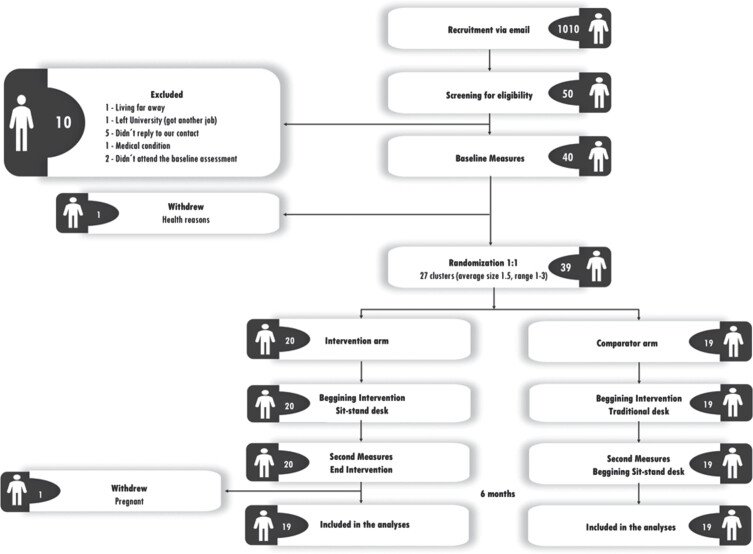
39 Portuguese office workers were randomized into a 6-month parallel-group cluster RCT consisting by the implementation of sit-stand desks in the workplace. The primary outcome of sitting time was assessed using ActivPAL. Secondary outcomes included biometric, psychological, and diet-related variables. All outcomes were assessed at baseline and 6 months for the whole sample and at 3 months for a sub-sample of the intervention group (n = 11).
No significant time*group interaction was found for the primary or secondary outcomes, apart from waist circumference favoring the control group (Δ-1.81 cm, pinteraction = 0.04). There were significant changes within the intervention group for sitting time (-44.0 min/day), prolonged sitting (>30 min) (-45.3 min/day) and standing time (51.7 min/day) at 3 months in the sub-sample and in prolonged sitting (>30 min) (-26 min/day) in the full intervention group (p < 0.05). Changes were also observed within the intervention group for percent body fat (Δ-3.7%) and ratings of quality of life (Δ2.2), musculoskeletal discomfort (Δ-4.9), overall fatigue (Δ-2.2), and the need for recovery after work (Δ-1.7) at 6-month follow-up (p < 0.05).
Although not being effective for reducing sitting time, the implementation of sit-stand desks in the Portuguese workspace was shown to be feasible over the long term, received well by users, and may offer other health benefits.
OSF Registration, OSF.IO/JHGPW. Registered 15 November 2022. https://doi.org/10.17605/OSF.IO/JHGPW.
长时间坐着与负面健康结果有关。在工作场所实施坐站两用办公桌是减少长时间坐着的一种策略。
评估坐站工作站在减少坐着时间和改善基于办公室工作人员的其他健康结果方面的有效性。
39 名葡萄牙办公室工作人员被随机分为 6 个月的平行组集群 RCT,其中包括在工作场所实施坐站两用办公桌。使用 ActivPAL 评估主要结局——坐着时间。次要结局包括生物计量、心理和饮食相关变量。对整个样本的基线和 6 个月以及干预组的亚样本(n=11)的 3 个月进行所有结局评估。
主要或次要结局均未发现时间*组间的显著交互作用,除了腰围有利于对照组(Δ-1.81cm,p 交互作用=0.04)。干预组内的显著变化包括:3 个月时的亚样本中的坐着时间(-44.0 分钟/天)、长时间坐着(>30 分钟)(-45.3 分钟/天)和站立时间(51.7 分钟/天),以及整个干预组内的长时间坐着(>30 分钟)(-26 分钟/天)(p<0.05)。干预组内还观察到身体脂肪百分比(Δ-3.7%)和生活质量评分(Δ2.2)、肌肉骨骼不适(Δ-4.9)、整体疲劳(Δ-2.2)和工作后恢复需求(Δ-1.7)的变化在 6 个月随访时(p<0.05)。
尽管在减少坐着时间方面无效,但在葡萄牙工作场所实施坐站两用办公桌被证明是可行的,并且长期以来受到用户的欢迎,并且可能带来其他健康益处。
OSF 注册,OSF.IO/JHGPW。2022 年 11 月 15 日注册。https://doi.org/10.17605/OSF.IO/JHGPW。