Rojas-Quintero Joselyn, Díaz María P, Palmar Jim, Galan-Freyle Nataly J, Morillo Valery, Escalona Daniel, González-Torres Henry J, Torres Wheeler, Navarro-Quiroz Elkin, Rivera-Porras Diego, Bermúdez Valmore
Medicine, Pulmonary, Critical Care, and Sleep Medicine Department, Baylor College of Medicine, Houston, TX 77030, USA.
Facultad de Medicina, Centro de Investigaciones Endocrino-Metabólicas, Universidad del Zulia, Maracaibo 4001, Venezuela.
Int J Mol Sci. 2024 Apr 10;25(8):4170. doi: 10.3390/ijms25084170.
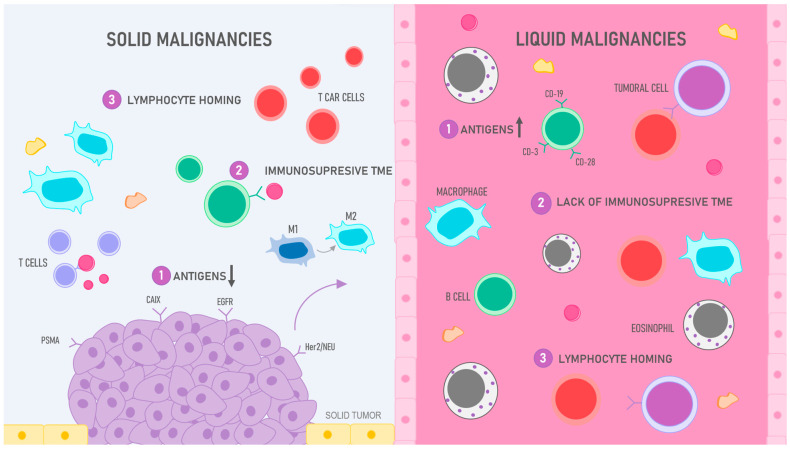
Chimeric antigen receptor T cell (CAR T cell) therapy has emerged as a prominent adoptive cell therapy and a therapeutic approach of great interest in the fight against cancer. This approach has shown notorious efficacy in refractory hematological neoplasm, which has bolstered its exploration in the field of solid cancers. However, successfully managing solid tumors presents considerable intrinsic challenges, which include the necessity of guiding the modified cells toward the tumoral region, assuring their penetration and survival in adverse microenvironments, and addressing the complexity of identifying the specific antigens for each type of cancer. This review focuses on outlining the challenges faced by CAR T cell therapy when used in the treatment of solid tumors, as well as presenting optimizations and emergent approaches directed at improving its efficacy in this particular context. From precise localization to the modulation of the tumoral microenvironment and the adaptation of antigen recognition strategies, diverse pathways will be examined to overcome the current limitations and buttress the therapeutic potential of CAR T cells in the fight against solid tumors.
嵌合抗原受体T细胞(CAR T细胞)疗法已成为一种重要的过继性细胞疗法,也是对抗癌症的一种备受关注的治疗方法。这种方法在难治性血液肿瘤中已显示出显著疗效,这推动了其在实体癌领域的探索。然而,成功治疗实体瘤存在相当大的内在挑战,其中包括引导修饰细胞到达肿瘤区域、确保它们在不利的微环境中渗透和存活,以及解决识别每种癌症类型的特异性抗原的复杂性。本综述重点概述了CAR T细胞疗法用于实体瘤治疗时面临的挑战,以及介绍旨在提高其在这种特定情况下疗效的优化方法和新兴方法。从精确的定位到肿瘤微环境的调节以及抗原识别策略的调整,将研究多种途径以克服当前的局限性,并增强CAR T细胞在对抗实体瘤中的治疗潜力。