Lahey Kevin C, Varsanyi Christopher, Wang Ziren, Aquib Ahmed, Gadiyar Varsha, Rodrigues Alcina A, Pulica Rachael, Desind Samuel, Davra Viralkumar, Calianese David C, Liu Dongfang, Cho Jong-Hyun, Kotenko Sergei V, De Lorenzo Mariana S, Birge Raymond B
Department of Microbiology, Biochemistry and Molecular Genetics, Center for Cell Signaling, Rutgers New Jersey Medical School, 205 South Orange Ave, Newark, NJ 07103, USA.
Department of Pathology, Immunology and Laboratory Medicine, Center for Immunity and Inflammation, Rutgers New Jersey Medical School, Newark, NJ 07101, USA.
Int J Mol Sci. 2024 Apr 17;25(8):4404. doi: 10.3390/ijms25084404.
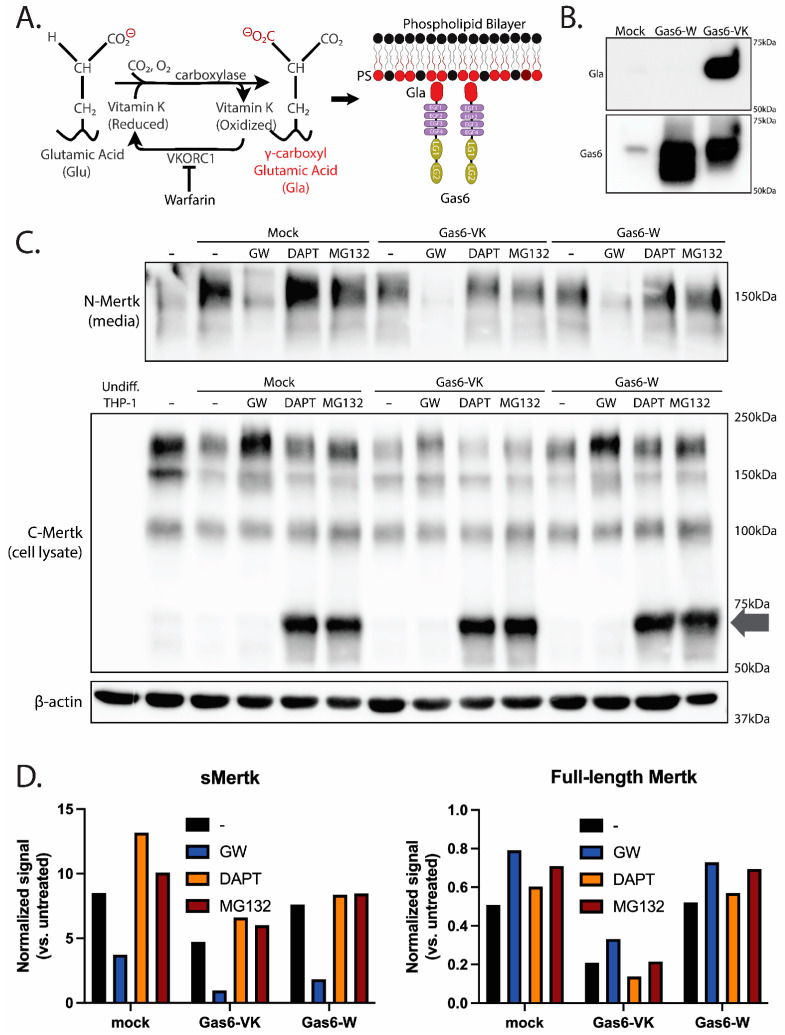
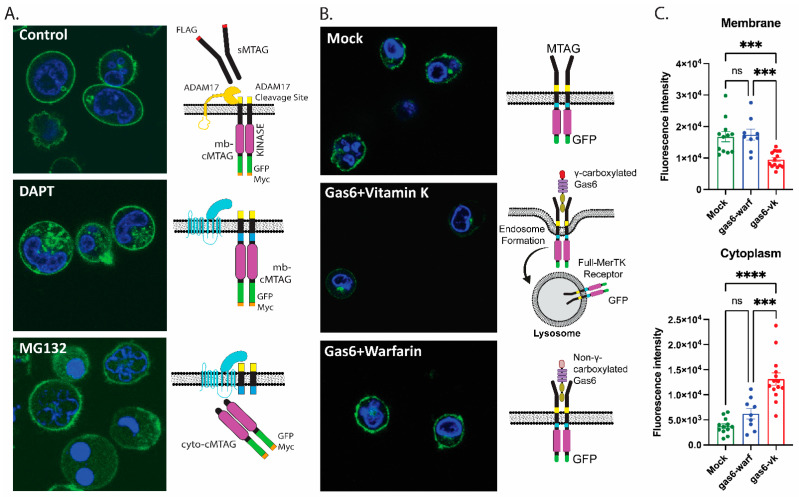
Mertk, a type I receptor tyrosine kinase and member of the TAM family of receptors, has important functions in promoting efferocytosis and resolving inflammation under physiological conditions. In recent years, Mertk has also been linked to pathophysiological roles in cancer, whereby, in several cancer types, including solid cancers and leukemia/lymphomas. Mertk contributes to oncogenic features of proliferation and cell survival as an oncogenic tyrosine kinase. In addition, Mertk expressed on macrophages, including tumor-associated macrophages, promotes immune evasion in cancer and is suggested to act akin to a myeloid checkpoint inhibitor that skews macrophages towards inhibitory phenotypes that suppress host T-cell anti-tumor immunity. In the present study, to better understand the post-translational regulation mechanisms controlling Mertk expression in monocytes/macrophages, we used a PMA-differentiated THP-1 cell model to interrogate the regulation of Mertk expression and developed a novel Mertk reporter cell line to study the intracellular trafficking of Mertk. We show that PMA treatment potently up-regulates Mertk as well as components of the ectodomain proteolytic processing platform ADAM17, whereas PMA differentially regulates the canonical Mertk ligands Gas6 and Pros1 (Gas6 is down-regulated and Pros1 is up-regulated). Under non-stimulated homeostatic conditions, Mertk in PMA-differentiated THP1 cells shows active constitutive proteolytic cleavage by the sequential activities of ADAM17 and the Presenilin/γ-secretase complex, indicating that Mertk is cleaved homeostatically by the combined sequential action of ADAM17 and γ-secretase, after which the cleaved intracellular fragment of Mertk is degraded in a proteasome-dependent mechanism. Using chimeric Flag-Mertk-EGFP-Myc reporter receptors, we confirm that inhibitors of γ-secretase and MG132, which inhibits the 26S proteasome, stabilize the intracellular fragment of Mertk without evidence of nuclear translocation. Finally, the treatment of cells with active γ-carboxylated Gas6, but not inactive Warfarin-treated non-γ-carboxylated Gas6, regulates a distinct proteolytic itinerary-involved receptor clearance and lysosomal proteolysis. Together, these results indicate that pleotropic and complex proteolytic activities regulate Mertk ectodomain cleavage as a homeostatic negative regulatory event to safeguard against the overactivation of Mertk.
Mertk是一种I型受体酪氨酸激酶,属于TAM受体家族成员,在生理条件下对促进胞葬作用和炎症消退具有重要功能。近年来,Mertk还与癌症的病理生理作用相关,在包括实体癌和白血病/淋巴瘤在内的多种癌症类型中,Mertk作为一种致癌酪氨酸激酶,促进增殖和细胞存活等致癌特性。此外,在巨噬细胞(包括肿瘤相关巨噬细胞)上表达的Mertk促进癌症中的免疫逃逸,并且被认为其作用类似于一种髓系检查点抑制剂,使巨噬细胞偏向抑制宿主T细胞抗肿瘤免疫的抑制性表型。在本研究中,为了更好地理解控制单核细胞/巨噬细胞中Mertk表达的翻译后调控机制,我们使用佛波酯(PMA)分化的THP-1细胞模型来探究Mertk表达的调控,并开发了一种新型的Mertk报告细胞系来研究Mertk的细胞内运输。我们发现,PMA处理可有效上调Mertk以及胞外域蛋白水解加工平台ADAM17的组分,而PMA对经典的Mertk配体Gas6和Pros1有不同的调控作用(Gas6下调而Pros1上调)。在非刺激的稳态条件下,PMA分化的THP1细胞中的Mertk通过ADAM17和早老素/γ-分泌酶复合物的顺序活性表现出活跃的组成型蛋白水解切割,这表明Mertk通过ADAM17和γ-分泌酶的联合顺序作用被稳态切割,之后Mertk的切割后的细胞内片段通过蛋白酶体依赖性机制被降解。使用嵌合的Flag-Mertk-EGFP-Myc报告受体,我们证实γ-分泌酶抑制剂和抑制26S蛋白酶体的MG132可稳定Mertk的细胞内片段,且无核转位的证据。最后,用活性γ-羧化的Gas6处理细胞,而不是用无活性的华法林处理的非γ-羧化Gas6处理细胞,可调节一种涉及不同蛋白水解途径的受体清除和溶酶体蛋白水解。总之,这些结果表明,多效性和复杂的蛋白水解活性将Mertk胞外域切割作为一种稳态负调控事件来调节,以防止Mertk过度激活。