Abreu Hugo, Lallukka Mari, Miola Marta, Spriano Silvia, Vernè Enrica, Raineri Davide, Leigheb Massimiliano, Ronga Mario, Cappellano Giuseppe, Chiocchetti Annalisa
Department of Health Sciences, Interdisciplinary Research Center of Autoimmune Diseases-IRCAD, Università del Piemonte Orientale, 28100 Novara, Italy.
Center for Translational Research on Autoimmune and Allergic Diseases-CAAD, Università del Piemonte Orientale, 28100 Novara, Italy.
Int J Mol Sci. 2024 Apr 19;25(8):4501. doi: 10.3390/ijms25084501.
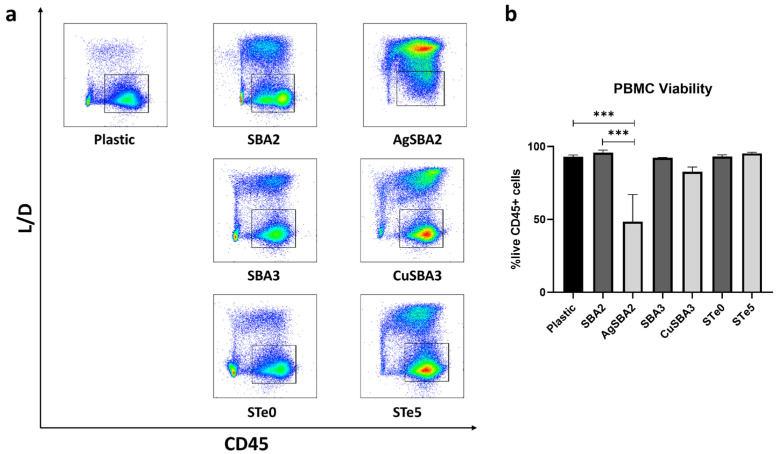
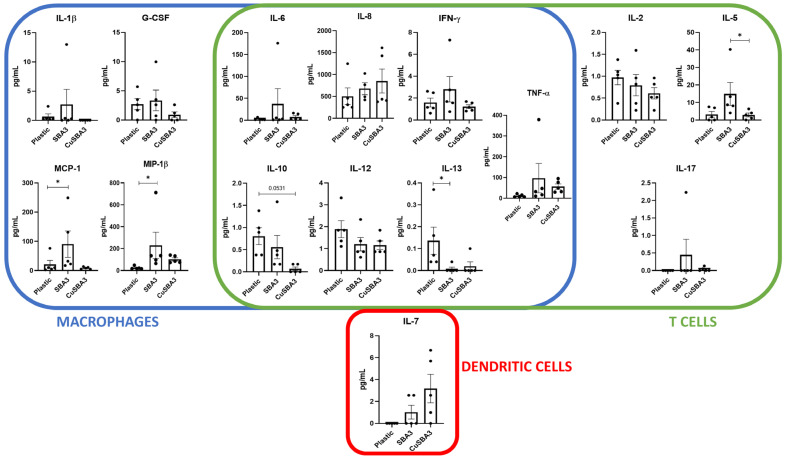
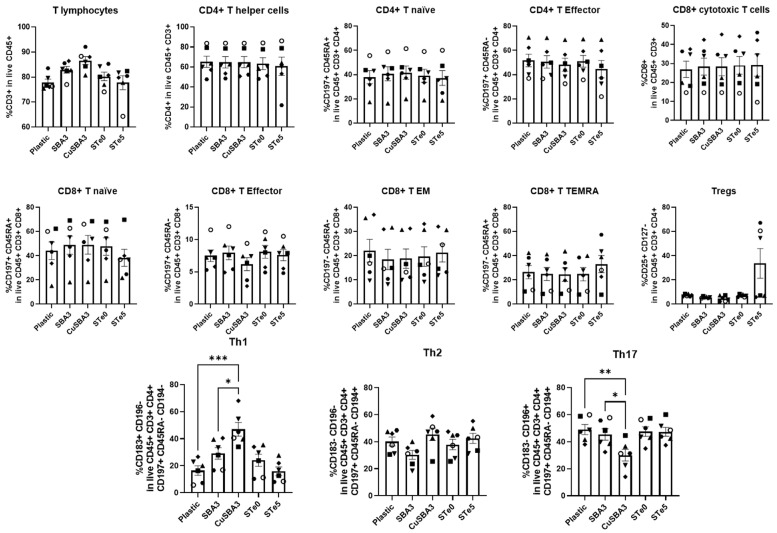
Biomaterials are extensively used as replacements for damaged tissue with bioactive glasses standing out as bone substitutes for their intrinsic osteogenic properties. However, biomaterial implantation has the following risks: the development of implant-associated infections and adverse immune responses. Thus, incorporating metallic ions with known antimicrobial properties can prevent infection, but should also modulate the immune response. Therefore, we selected silver, copper and tellurium as doping for bioactive glasses and evaluated the immunophenotype and cytokine profile of human T-cells cultured on top of these discs. Results showed that silver significantly decreased cell viability, copper increased the T helper (Th)-1 cell percentage while decreasing that of Th17, while tellurium did not affect either cell viability or immune response, as evaluated via multiparametric flow cytometry. Multiplex cytokines assay showed that IL-5 levels were decreased in the copper-doped discs, compared with its undoped control, while IL-10 tended to be lower in the doped glass, compared with the control (plastic) while undoped condition showed lower expression of IL-13 and increased MCP-1 and MIP-1β secretion. Overall, we hypothesized that the Th1/Th17 shift, and specific cytokine expression indicated that T-cells might cross-activate other cell types, potentially macrophages and eosinophils, in response to the scaffolds.
生物材料被广泛用作受损组织的替代品,具有生物活性的玻璃因其固有的成骨特性而成为突出的骨替代物。然而,生物材料植入存在以下风险:植入相关感染的发生和不良免疫反应。因此,掺入具有已知抗菌特性的金属离子可以预防感染,但也应调节免疫反应。因此,我们选择银、铜和碲作为生物活性玻璃的掺杂剂,并评估了在这些圆盘上培养的人T细胞的免疫表型和细胞因子谱。结果表明,通过多参数流式细胞术评估,银显著降低细胞活力,铜增加辅助性T(Th)-1细胞百分比,同时降低Th17细胞百分比,而碲既不影响细胞活力也不影响免疫反应。多重细胞因子检测显示,与未掺杂的对照相比,铜掺杂圆盘中的IL-5水平降低,与对照(塑料)相比,掺杂玻璃中的IL-10水平往往较低,而未掺杂条件下IL-13表达较低,MCP-1和MIP-1β分泌增加。总体而言,我们推测Th1/Th17的转变以及特定细胞因子的表达表明,T细胞可能会因支架而交叉激活其他细胞类型,可能是巨噬细胞和嗜酸性粒细胞。