Ahmed Ahmed Mahmoud Mabrouk, Buschmann Martin, Breyer Lara, Kuntner Claudia, Homolka Peter
Center for Medical Physics and Biomedical Engineering, Medical University of Vienna, 1090 Vienna, Austria.
Division of Medical Radiation Physics, Department of Radiation Oncology, Medical University of Vienna, and University Hospital Vienna, 1090 Vienna, Austria.
Polymers (Basel). 2024 Apr 16;16(8):1116. doi: 10.3390/polym16081116.
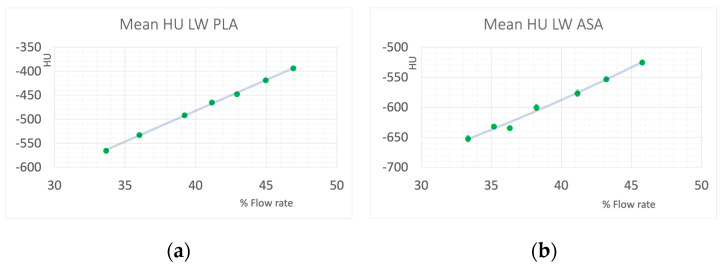
Additive manufacturing and 3D printing allow for the design and rapid production of radiographic phantoms for X-ray imaging, including CT. These are used for numerous purposes, such as patient simulation, optimization of imaging procedures and dose levels, system evaluation and quality assurance. However, standard 3D printing polymers do not mimic X-ray attenuation properties of tissues like soft, adipose, lung or bone tissue, and standard materials like liquid water. The mass density of printing polymers-especially important in CT-is often inappropriate, i.e., mostly too high. Different methods can be applied to reduce mass density. This work examines reducing density by controlled underfilling either realized by using 3D printing materials expanded through foaming during heating in the printing process, or reducing polymer flow to introduce microscopic air-filled voids. The achievable density reduction depends on the base polymer used. When using foaming materials, density is controlled by the extrusion temperature, and ranges from 33 to 47% of the base polymer used, corresponding to a range of -650 to -394 HU in CT with 120 kV. Standard filaments (Nylon, modified PLA and modified ABS) allowed density reductions by 20 to 25%, covering HU values in CT from -260 to 77 (Nylon), -230 to -20 (ABS) and -81 to 143 (PLA). A standard chalk-filled PLA filament allowed reproduction of bone tissue in a wide range of bone mineral content resulting in CT numbers from 57 to 460 HU. Controlled underfilling allowed the production of radiographic phantom materials with continuously adjustable attenuation in a limited but appropriate range, allowing for the reproduction of X-ray attenuation properties of water, adipose, soft, lung, and bone tissue in an accurate, predictable and reproducible manner.
增材制造和3D打印技术可用于设计和快速生产用于X射线成像(包括CT)的放射造影体模。这些体模有多种用途,如患者模拟、成像程序和剂量水平的优化、系统评估和质量保证。然而,标准的3D打印聚合物无法模拟软组织、脂肪组织、肺组织或骨组织等组织以及液态水等标准材料的X射线衰减特性。打印聚合物的质量密度(在CT中尤为重要)通常不合适,即大多过高。可以采用不同方法来降低质量密度。本研究探讨了通过控制欠填充来降低密度的方法,具体实现方式要么是使用在打印过程中加热时通过发泡膨胀的3D打印材料,要么是减少聚合物流动以引入微观的空气填充空隙。可实现的密度降低程度取决于所使用的基础聚合物。使用发泡材料时,密度由挤出温度控制,范围为所用基础聚合物的33%至47%,在120 kV的CT中对应-650至-394 HU的范围。标准细丝(尼龙、改性聚乳酸和改性丙烯腈-丁二烯-苯乙烯)可使密度降低20%至25%,在CT中的HU值范围为-260至77(尼龙)、-230至-20(丙烯腈-丁二烯-苯乙烯)和-81至143(聚乳酸)。一种标准的填充白垩聚乳酸细丝能够在广泛的骨矿物质含量范围内再现骨组织,CT值范围为57至460 HU。控制欠填充能够生产出在有限但合适范围内具有连续可调衰减的放射造影体模材料,从而能够以准确、可预测和可重复的方式再现水、脂肪、软组织、肺组织和骨组织的X射线衰减特性。