Potemkin Ilya A, Kyuregyan Karen K, Karlsen Anastasia A, Isaeva Olga V, Kichatova Vera S, Lopatukhina Maria A, Asadi Mobarkhan Fedor A, Zlobina Anna G, Zheltobriukh Andrey V, Bocharova Ksenia A, Belyakova Vera V, Rassolova Svetlana V, Ivanova Nadezhda V, Solonin Sergey A, Bazhenov Alexey I, Godkov Mikhail A, Mikhailov Mikhail I
Laboratory of Viral Hepatitis, Mechnikov Research Institute of Vaccines and Sera, 105064 Moscow, Russia.
Laboratory of Molecular Epidemiology of Viral Hepatitis, Central Research Institute of Epidemiology, 111123 Moscow, Russia.
Viruses. 2024 Mar 28;16(4):526. doi: 10.3390/v16040526.
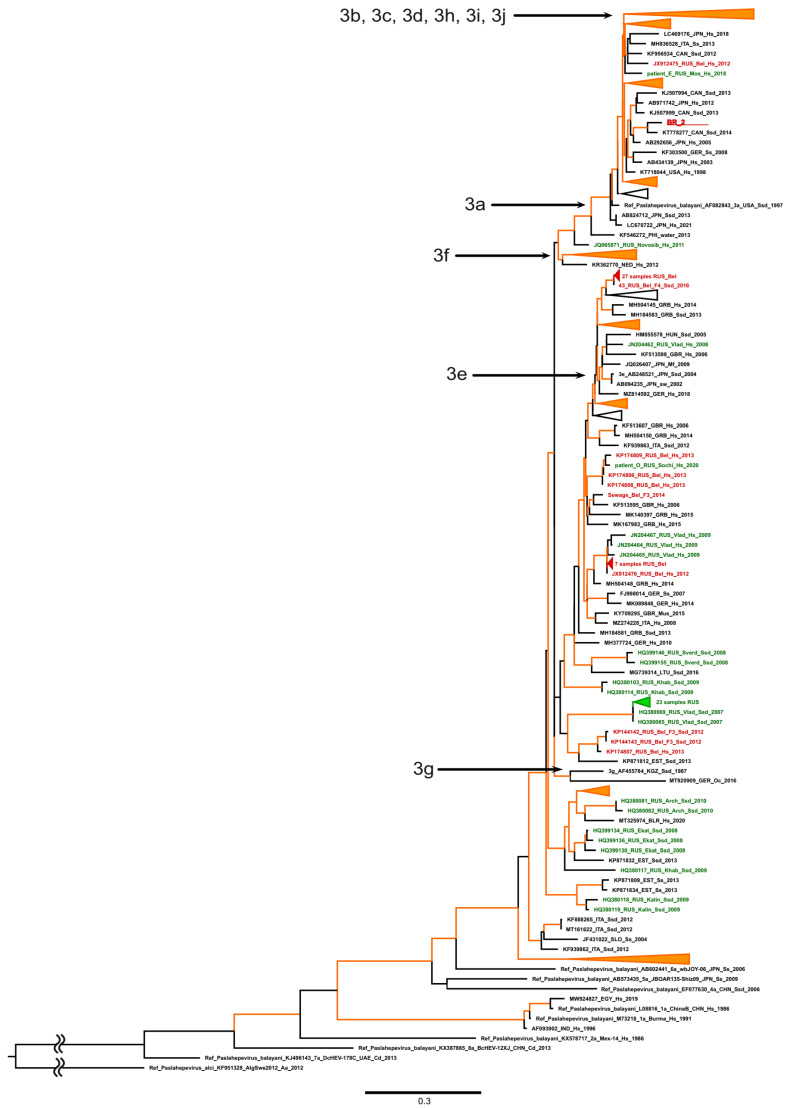
Transfusion-transmitted hepatitis E virus (HEV) infection is an increasing concern in many countries. We investigated the detection rate of HEV viremia in blood donors in Russia. A total of 20,405 regular repetitive voluntary non-renumerated blood donors from two regions (Moscow and Belgorod) were screened for HEV RNA using the cobas HEV test in mini-pools of six plasma samples. Samples from each reactive pool were tested individually. The average HEV RNA prevalence was 0.024% (95% CI: 0.01-0.05%), or 1 case per 4081 donations. No statistically significant differences in HEV RNA prevalence were observed between the two study regions. The PCR threshold cycle (Ct) values ranged from 25.0 to 40.5 in reactive pools, and from 20.9 to 41.4 in reactive plasma samples when tested individually. The HEV viremic donors had different antibody patterns. Two donor samples were reactive for both anti-HEV IgM and IgG antibodies, one sample was reactive for anti-HEV IgM and negative for anti-HEV IgG, and two samples were seronegative. At follow-up testing 6 months later, on average, four donors available for follow-up had become negative for HEV RNA and positive for anti-HEV IgG. The HEV ORF2 sequence belonging to HEV-3 sub-genotype 3a was obtained from one donor sample. The sequencing failed in the other four samples from viremic donors, presumably due to the low viral load. In conclusion, the HEV RNA detection rate in blood donors in Russia corresponds with data from other European countries, including those that implemented universal donor HEV screening. These data support the implementation of HEV RNA donor screening to reduce the risk of transfusion-transmitted HEV infection in Russia.
输血传播的戊型肝炎病毒(HEV)感染在许多国家日益受到关注。我们调查了俄罗斯献血者中HEV病毒血症的检出率。使用cobas HEV检测法对来自两个地区(莫斯科和别尔哥罗德)的20405名定期重复自愿无偿献血者的六份血浆样本混合池进行HEV RNA筛查。对每个反应性混合池的样本进行单独检测。HEV RNA的平均流行率为0.024%(95%置信区间:0.01 - 0.05%),即每4081次献血中有1例。在两个研究地区之间未观察到HEV RNA流行率的统计学显著差异。反应性混合池中的PCR阈值循环(Ct)值范围为25.0至40.5,单独检测时反应性血浆样本中的Ct值范围为20.9至41.4。HEV病毒血症献血者具有不同的抗体模式。两份献血者样本抗HEV IgM和IgG抗体均呈反应性,一份样本抗HEV IgM呈反应性而抗HEV IgG呈阴性,两份样本血清学阴性。在6个月后的随访检测中,平均而言,可供随访的四名献血者HEV RNA转为阴性且抗HEV IgG转为阳性。从一份献血者样本中获得了属于HEV - 3亚型基因3a的HEV ORF2序列。其他四名病毒血症献血者样本的测序失败,可能是由于病毒载量低。总之,俄罗斯献血者中HEV RNA的检出率与其他欧洲国家的数据一致,包括那些实施普遍献血者HEV筛查的国家。这些数据支持在俄罗斯实施HEV RNA献血者筛查以降低输血传播HEV感染的风险。