Department of Infectious Disease Research, National Institute for Health Development, 11619 Tallinn, Estonia.
North Estonia Medical Centre's Blood Center, North Estonia Medical Centre Foundation, 13419 Tallinn, Estonia.
Viruses. 2023 Oct 19;15(10):2118. doi: 10.3390/v15102118.
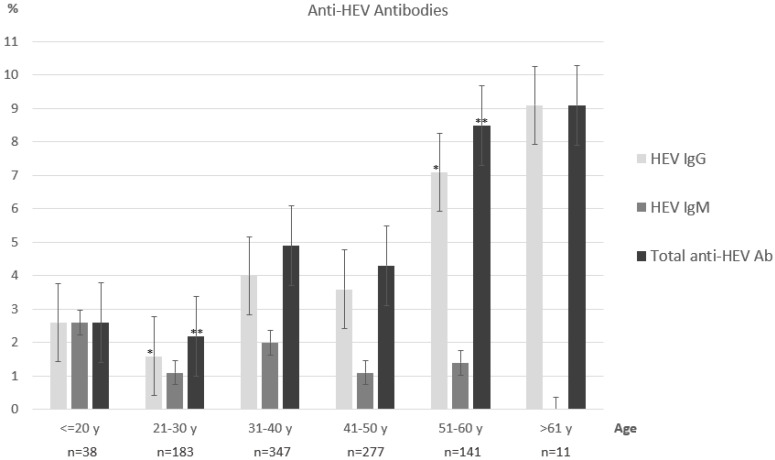
Hepatitis E virus (HEV) is now considered the most common cause of acute hepatitis worldwide. There are no published data about the prevalence of antibodies to HEV and RNA in donor sera in Estonia, and this precludes planning measures for preventing HEV proliferation through blood transfusion services. Here, were report data from an analysis of 1002 sera on the prevalence of anti-HEV IgG and IgM and the viral RNA. The antibodies were found in 48 donor sera (4.8%); of these, 40 (4%) harbored anti-HEV IgG, 15 (1.5%) contained anti-HEV IgM, and 7 donors had anti-HEV antibodies of both classes simultaneously. HEV RNA was not detected in any blood serum. Statistical associations of infection risk factors (gender, age, travel in the last six months, contact with pigs and/or wild boars in the last six months, consumption of thermally unprocessed/raw pork or boar meat, raw/unfiltered tap water or water from natural sources, unpasteurized farm dairy products, and unwashed berries and/or vegetables) were assessed. None of the listed factors were found to be associated with a higher or lower risk of anti-HEV antibody presence. At the same time, an increasing share of anti-HEV IgG carriers with age was found. The absence of HEV RNA in the analyzed donor plasma samples proves that HEV acute infection prevalence in Estonia does not exceed the average level of European countries. There is no urgent necessity to enter a requirement for a total screening of blood plasma for HEV RNA prevalence in Estonia.
戊型肝炎病毒(HEV)现已被认为是全球范围内最常见的急性肝炎病因。目前,在爱沙尼亚尚无关于供体血清中抗 HEV 抗体和 RNA 流行率的相关数据,这使得通过输血服务预防 HEV 传播的措施无法得到规划。在此,我们报告了对 1002 份血清进行的抗 HEV IgG 和 IgM 以及病毒 RNA 分析的数据。在 48 份供体血清中发现了这些抗体(4.8%);其中,40 份(4%)含有抗 HEV IgG,15 份(1.5%)含有抗 HEV IgM,7 份供体同时具有两种类型的抗 HEV 抗体。在任何血清中均未检测到 HEV RNA。我们评估了感染危险因素(性别、年龄、过去六个月内的旅行、过去六个月内与猪和/或野猪的接触、食用未经热处理/生猪肉或野猪肉、未经处理的自来水或天然水源水、未经巴氏消毒的农场奶制品以及未经清洗的浆果和/或蔬菜)与感染风险之间的统计学关联。列表中的任何因素都与抗 HEV 抗体存在的更高或更低风险无关。与此同时,我们发现抗 HEV IgG 携带者的比例随着年龄的增长而增加。分析的供体血浆样本中未检测到 HEV RNA,这证明 HEV 急性感染在爱沙尼亚的流行率并未超过欧洲国家的平均水平。因此,在爱沙尼亚,目前尚无必要对血浆进行 HEV RNA 流行率的全面筛查。