Shakil Husain, Malhotra Armaan K, Badhiwala Jetan H, Karthikeyan Vishwathsen, Essa Ahmad, He Yingshi, Fehlings Michael G, Sahgal Arjun, Dea Nicolas, Kiss Alex, Witiw Christopher D, Redelmeier Donald A, Wilson Jefferson R
Division of Neurosurgery, Department of Surgery, University of Toronto, Toronto, Ontario, Canada.
Institute of Health Policy Management and Evaluation, University of Toronto, Toronto, Ontario, Canada.
Neurooncol Adv. 2024 Apr 18;6(1):vdae051. doi: 10.1093/noajnl/vdae051. eCollection 2024 Jan-Dec.
Spinal metastases are a significant complication of advanced cancer. In this study, we assess temporal trends in the incidence and timing of spinal metastases and examine underlying patient demographics and primary cancer associations.
In this population-based retrospective cohort study, health data from 2007 to 2019 in Ontario, Canada were analyzed ( = 37, 375 patients identified with spine metastases). Primary outcomes were annual incidence of spinal metastasis, and time to metastasis after primary diagnosis.
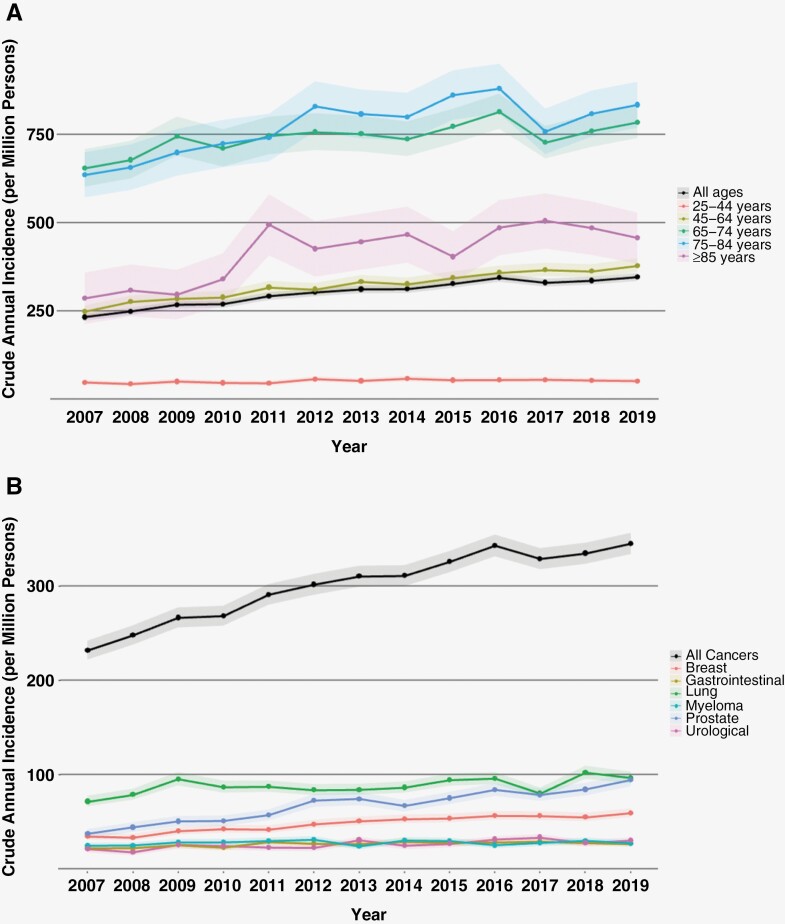
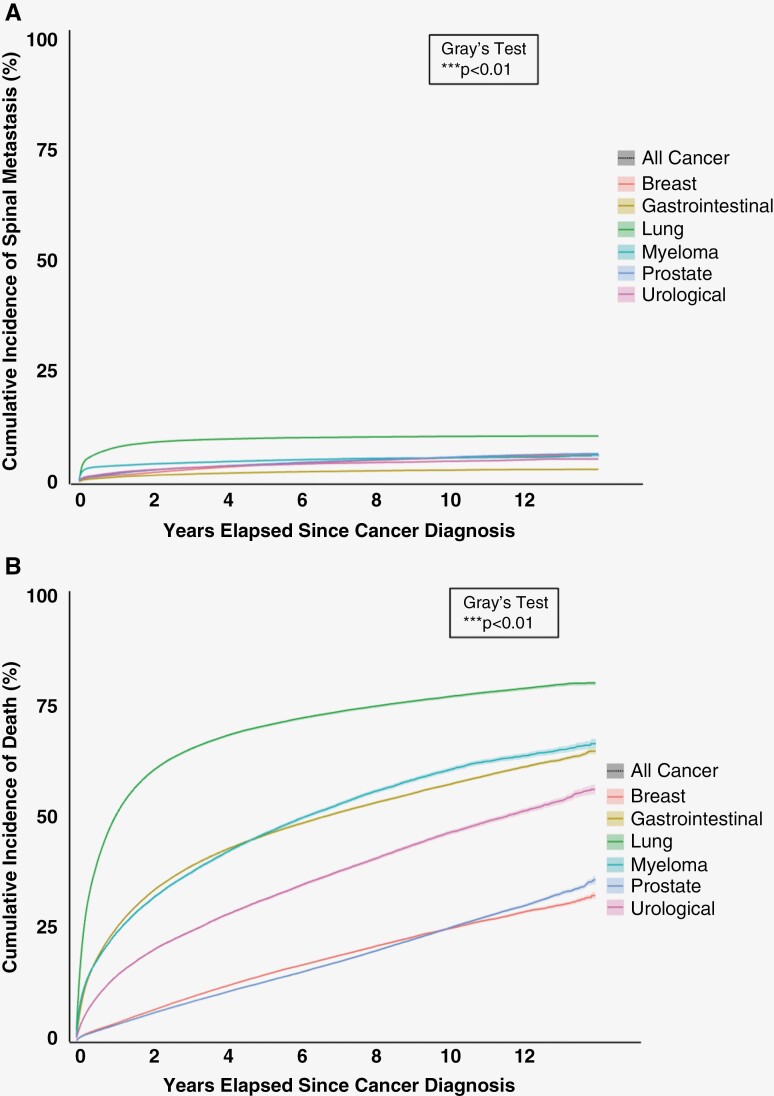
The age-standardized incidence of spinal metastases increased from 229 to 302 cases per million over the 13-year study period. The average annual percent change (AAPC) in incidence was 2.2% (95% CI: 1.4% to 3.0%) with patients aged ≥85 years demonstrating the largest increase (AAPC 5.2%; 95% CI: 2.3% to 8.3%). Lung cancer had the greatest annual incidence, while prostate cancer had the greatest increase in annual incidence (AAPC 6.5; 95% CI: 4.1% to 9.0%). Lung cancer patients were found to have the highest risk of spine metastasis with 10.3% (95% CI: 10.1% to 10.5%) of patients being diagnosed at 10 years. Gastrointestinal cancer patients were found to have the lowest risk of spine metastasis with 1.0% (95% CI: 0.9% to 1.0%) of patients being diagnosed at 10 years.
The incidence of spinal metastases has increased in recent years, particularly among older patients. The incidence and timing vary substantially among different primary cancer types. These findings contribute to the understanding of disease trends and emphasize a growing population of patients who require subspecialty care.
脊柱转移瘤是晚期癌症的一种重要并发症。在本研究中,我们评估脊柱转移瘤的发病率和发生时间的时间趋势,并研究相关患者人口统计学特征及与原发癌的关联。
在这项基于人群的回顾性队列研究中,分析了加拿大安大略省2007年至2019年的健康数据(n = 37375例确诊为脊柱转移瘤的患者)。主要结局指标为脊柱转移瘤的年发病率以及初次诊断后至发生转移的时间。
在13年的研究期间,脊柱转移瘤的年龄标准化发病率从每百万229例增至302例。发病率的平均年变化百分比(AAPC)为2.2%(95%CI:1.4%至3.0%),其中85岁及以上患者的发病率增长最为显著(AAPC 5.2%;95%CI:2.3%至8.3%)。肺癌的年发病率最高,而前列腺癌的年发病率增长幅度最大(AAPC 6.5;CI:4.1%至9.0%)。发现肺癌患者发生脊柱转移的风险最高,10年时10.3%(95%CI:10.1%至10.5%)的患者被诊断为脊柱转移。胃肠道癌患者发生脊柱转移的风险最低,10年时1.0%(95%CI:0.9%至1.0%)的患者被诊断为脊柱转移。
近年来脊柱转移瘤的发病率有所上升,尤其是在老年患者中。不同原发癌类型的发病率和发生时间差异很大。这些发现有助于了解疾病趋势,并强调需要专科护理的患者群体在不断增加。