Memon Anjum, Bannister Peter, Rogers Imogen, Sundin Josefin, Al-Ayadhy Bushra, James Peter W, McNally Richard J Q
Department of Primary Care and Public Health, Brighton and Sussex Medical School, UK.
Department of Pathology, Faculty of Medicine, Kuwait University, Kuwait.
Lancet Reg Health Eur. 2021 Jan 6;2:100024. doi: 10.1016/j.lanepe.2021.100024. eCollection 2021 Mar.
The incidence of cutaneous malignant melanoma, which is mostly attributable (86%) to UV radiation exposure, has been steadily increasing over the past four decades in predominantly fair-skinned populations. Although public health campaigns are increasing sun-protective behaviour in England, their effect on melanoma incidence is largely unknown. We conducted a retrospective population-based cohort study to examine whether there have been changes in the epidemiology of melanoma in England during the past four decades.
Individual level data for patients diagnosed with melanoma in England during 1981-2018 were obtained from the Office for National Statistics/Public Health England. Average annual incidence rates were calculated by three age categories (0-34, 35-64, 65+ years), gender and anatomical site during the seven five-year time periods (1981-85 to 2011-15) and the recent three-year period (2016-18). The percentage change in incidence was calculated as change in the average incidence rate from the first (1981-85) to the last time period (2016-18). The Average Annual Percentage Change (AAPC) was estimated using the slope of the linear trend line fitted to the incidence rates by year of diagnosis.
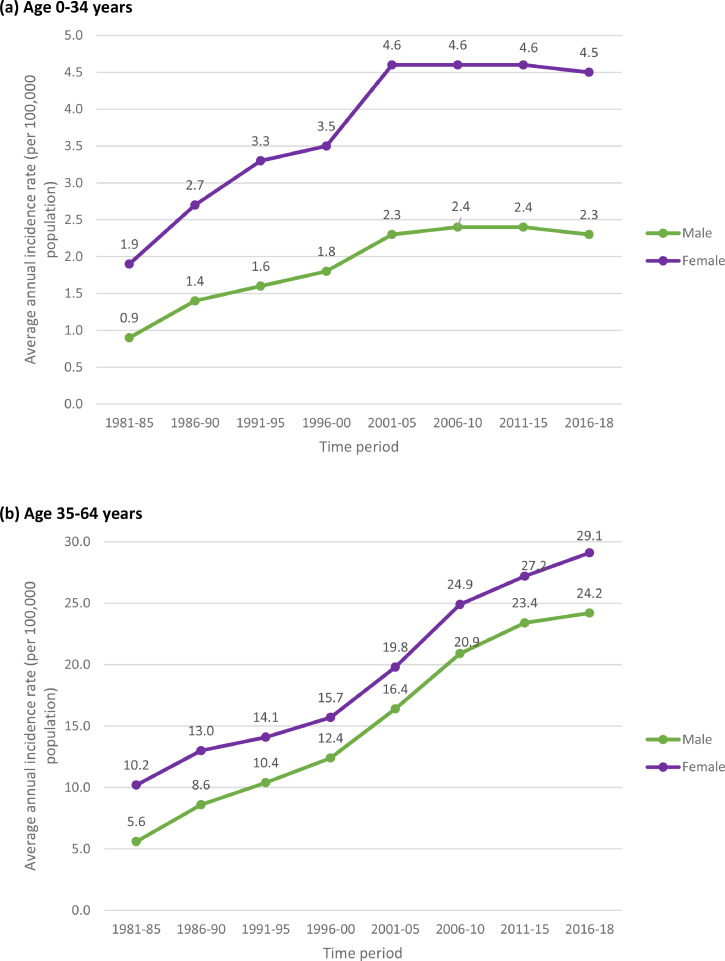
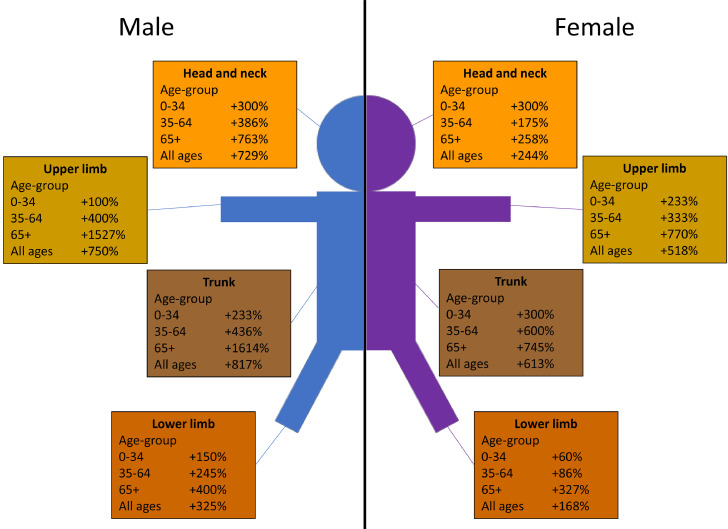
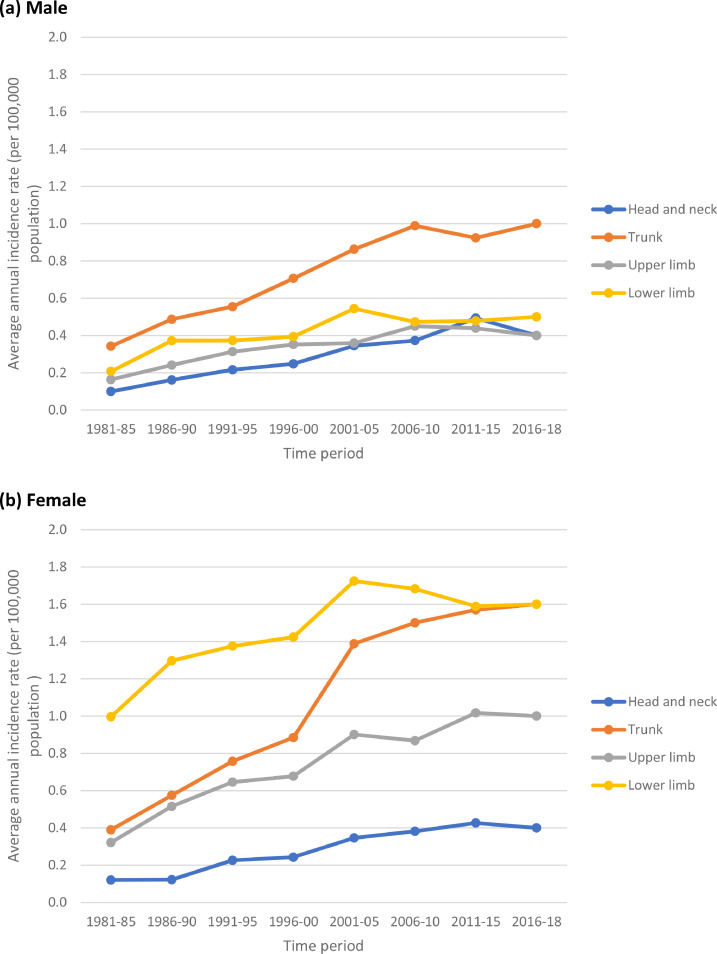
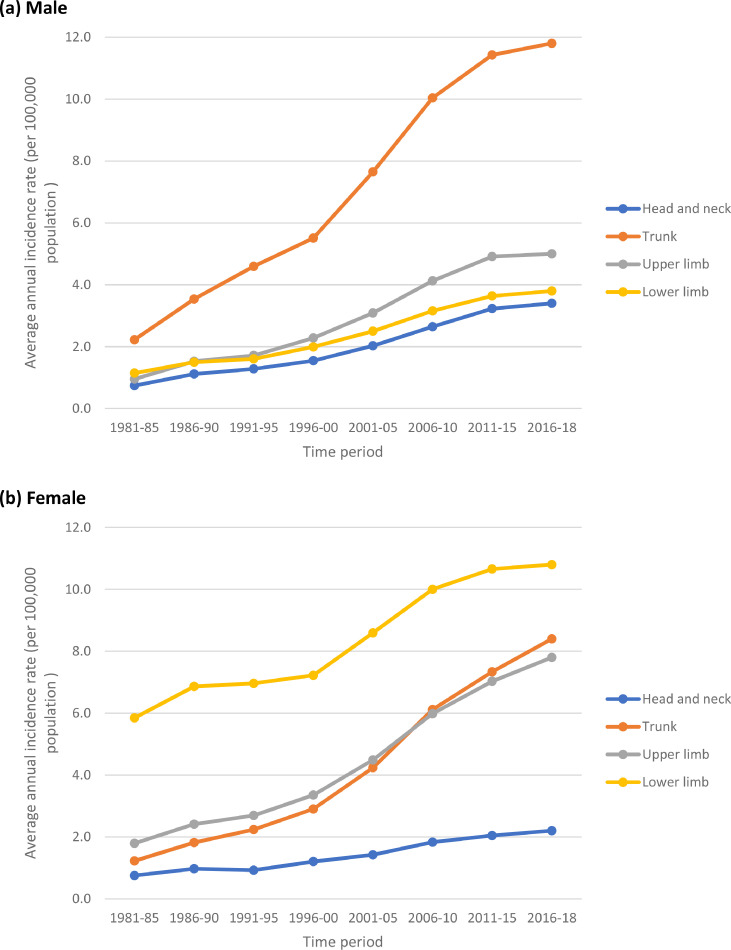
During the 38-year period (1981-2018), a total of 265,302 cases of melanoma (45.7% males, 54.3% females) were registered in England. The average annual number of cases increased from 837/year in 1981-85 to 6963/year in 2016-18 in males (+732%), and from 1609/year in 1981-85 to 6952/year in 2016-18 in females (+332%). In the young age-group (0-34 years), the average annual incidence rates initially increased from 1981-85 to 2001-05 and then stabilised during the recent period (2006-18). In the middle age group (35-64 years), the rates increased by +332% (AAPC, 10.4%) in males (from 5.6/100,000 in 1981-85 to 24.2/100,000 in 2016-18) and +185% (AAPC, 5.7%) in females (from 10.2/100,000 in 1981-85 to 29.1/100,000 in 2016-18); and in the old age-group (65+ years) the rates increased by +842% (AAPC, 25.7%) in males (from 9.6/100,000 in 1981-85 to 90.4/100,000 in 2016-18) and +381% (AAPC, 11.2%) in females (from 12.5/100,000 in 1981-85 to 60.1/100,000 in 2016-18). The largest increase in incidence in both males and females was observed for melanoma of the trunk (+817%, AAPC, 24.8% in males and +613%, AAPC, 18.3% in females), followed by melanoma of upper limb (+750%, AAPC, 22.9% in males and 518%, AAPC, 15.5% in females).
It appears that the incidence of melanoma among young people in England has stabilised (or levelled off) in recent decades, whereas it continues to increase substantially in older population. These findings suggest that public health campaigns targeted at children/adolescents/parents may be favourably influencing melanoma incidence. The steeper increase in incidence in males is consistent with their relatively greater sun exposure and poor sun-protective behaviour. All the available evidence suggests that the enormous increase in the melanoma of the trunk and upper limb, since the 1980s, is most likely due to increasing trend in intermittent high intensity recreational UV radiation exposure (e.g. sunbathing, holidaying in places with strong sunlight, indoor tanning).
This work was supported by Brighton and Sussex Medical School (BSMS).
皮肤恶性黑色素瘤的发病率在过去四十年中在主要为白皮肤的人群中稳步上升,其中大部分(86%)归因于紫外线辐射暴露。尽管英国的公共卫生运动正在增加防晒行为,但其对黑色素瘤发病率的影响在很大程度上尚不清楚。我们进行了一项基于人群的回顾性队列研究,以检查过去四十年来英国黑色素瘤的流行病学是否发生了变化。
1981 - 2018年期间在英国被诊断为黑色素瘤的患者的个体水平数据来自英国国家统计局/英国公共卫生署。在七个五年时间段(1981 - 85年至2011 - 15年)和最近三年时间段(2016 - 18年)内,按三个年龄组(0 - 34岁、35 - 64岁、65岁及以上)、性别和解剖部位计算平均年发病率。发病率的百分比变化计算为从第一个时间段(1981 - 85年)到最后一个时间段(2016 - 18年)平均发病率的变化。使用拟合到按诊断年份划分的发病率的线性趋势线的斜率估计平均年度百分比变化(AAPC)。
在38年期间(1981 - 2018年),英国共登记了265,302例黑色素瘤病例(男性占45.7%,女性占54.3%)。男性的年均病例数从1981 - 85年的每年837例增加到2016 - 18年的每年6963例(增长732%),女性从1981 - 85年的每年1609例增加到2016 - 18年的每年6952例(增长332%)。在年轻年龄组(0 - 34岁),平均年发病率最初从1981 - 85年到2001 - 05年上升,然后在最近时期(2006 - 18年)稳定下来。在中年年龄组(35 - 64岁),男性发病率增加了332%(AAPC为10.4%)(从1981 - 85年的每10万人5.6例增加到2016 - 18年的每10万人24.2例),女性增加了185%(AAPC为5.7%)(从1981 - 85年的每10万人10.2例增加到2016 - 18年的每10万人29.1例);在老年年龄组(65岁及以上),男性发病率增加了842%(AAPC为25.7%)(从1981 - 85年的每10万人9.6例增加到2016 - 18年的每10万人90.4例),女性增加了381%(AAPC为11.2%)(从1981 - 85年的每10万人12.5例增加到2016 - 18年的每10万人60.1例)。男性和女性发病率增加最大的是躯干黑色素瘤(男性增加817%,AAPC为24.8%;女性增加613%,AAPC为18.3%),其次是上肢黑色素瘤(男性增加750%,AAPC为22.9%;女性增加518%,AAPC为15.5%)。
近几十年来,英国年轻人中的黑色素瘤发病率似乎已经稳定(或趋于平稳),而在老年人群中仍在大幅上升。这些发现表明,针对儿童/青少年/家长的公共卫生运动可能对黑色素瘤发病率产生了有利影响。男性发病率上升幅度更大与他们相对更多的阳光暴露和较差的防晒行为一致。所有现有证据表明,自20世纪80年代以来,躯干和上肢黑色素瘤的大幅增加很可能是由于间歇性高强度娱乐性紫外线辐射暴露(如日光浴、在阳光强烈的地方度假、室内晒黑)的增加趋势。
这项工作得到了布莱顿和萨塞克斯医学院(BSMS)的支持。