Zhu Canmin, Wang Dili, Chang Chang, Liu Aofei, Zhou Ji, Yang Ting, Jiang Yuanfeng, Li Xia, Jiang Weijian
Department of Neurology, The First People's Hospital of Jiangxia District, Wuhan 430200, Hubei, China.
Department of Medicine, Soochow University, Suzhou 215006, Jiangsu, China.
Korean J Physiol Pharmacol. 2024 May 1;28(3):239-252. doi: 10.4196/kjpp.2024.28.3.239.
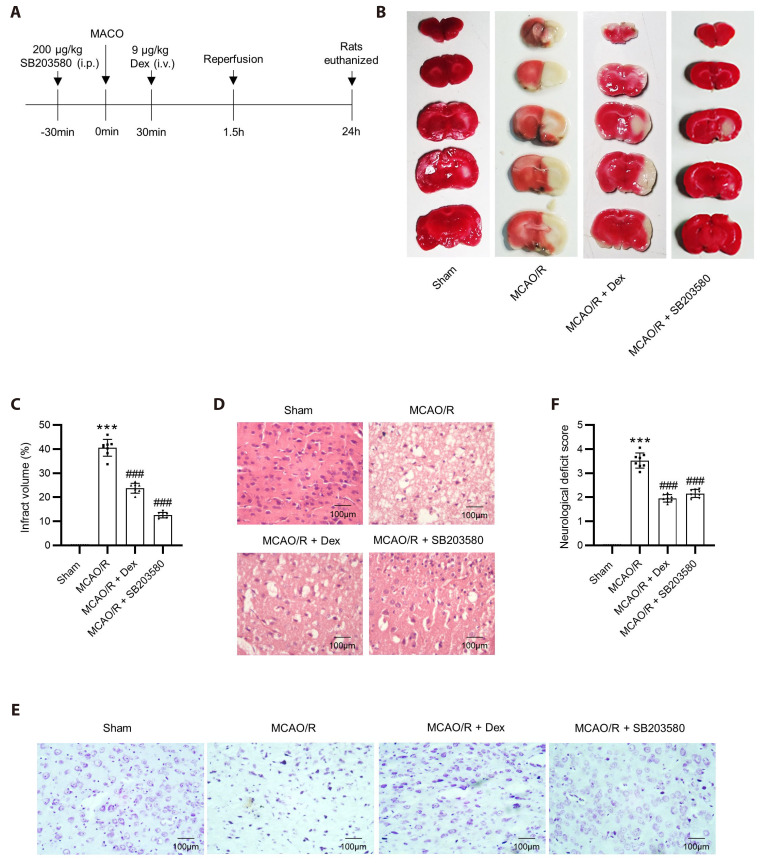
Dexmedetomidine displays multiple mechanisms of neuroprotection in ameliorating ischemic brain injury. In this study, we explored the beneficial effects of dexmedetomidine on blood-brain barrier (BBB) integrity and neuroinflammation in cerebral ischemia/reperfusion injury. Sprague-Dawley rats were subjected to middle cerebral artery occlusion (MCAO) for 1.5 h and reperfusion for 24 h to establish a rat model of cerebral ischemia/reperfusion injury. Dexmedetomidine (9 g/kg) was administered to rats 30 min after MCAO through intravenous injection, and SB203580 (a p38 MAPK inhibitor, 200 g/kg) was injected intraperitoneally 30 min before MCAO. Brain damages were evaluated by 2,3,5-triphenyltetrazolium chloride staining, hematoxylin-eosin staining, Nissl staining, and brain water content assessment. BBB permeability was examined by Evans blue staining. Expression levels of claudin-5, zonula occludens-1, occludin, and matrix metalloproteinase-9 (MMP-9) as well as M1/M2 phenotypes-associated markers were assessed using immunofluorescence, RT-qPCR, Western blotting, and gelatin zymography. Enzyme-linked immunosorbent assay was used to examine inflammatory cytokine levels. We found that dexmedetomidine or SB203580 attenuated infarct volume, brain edema, BBB permeability, and neuroinflammation, and promoted M2 microglial polarization after cerebral ischemia/reperfusion injury. Increased MMP-9 activity by ischemia/reperfusion injury was inhibited by dexmedetomidine or SB203580. Dexmedetomidine inhibited the activation of the ERK, JNK, and p38 MAPK pathways. Moreover, activation of JNK or p38 MAPK reversed the protective effects of dexmedetomidine against ischemic brain injury. Overall, dexmedetomidine ameliorated brain injury by alleviating BBB permeability and promoting M2 polarization in experimental cerebral ischemia/reperfusion injury model by inhibiting the activation of JNK and p38 MAPK pathways.
右美托咪定在改善缺血性脑损伤方面具有多种神经保护机制。在本研究中,我们探讨了右美托咪定对脑缺血/再灌注损伤中血脑屏障(BBB)完整性和神经炎症的有益作用。将Sprague-Dawley大鼠进行大脑中动脉闭塞(MCAO)1.5小时并再灌注24小时,以建立脑缺血/再灌注损伤大鼠模型。在MCAO后30分钟通过静脉注射给予大鼠右美托咪定(9μg/kg),并在MCAO前30分钟腹腔注射SB203580(一种p38 MAPK抑制剂,200μg/kg)。通过2,3,5-三苯基氯化四氮唑染色、苏木精-伊红染色、尼氏染色和脑含水量评估来评价脑损伤。通过伊文思蓝染色检查BBB通透性。使用免疫荧光、RT-qPCR、蛋白质印迹和明胶酶谱法评估紧密连接蛋白-5、闭合蛋白-1、闭合蛋白和基质金属蛋白酶-9(MMP-9)的表达水平以及M1/M2表型相关标志物。采用酶联免疫吸附测定法检测炎性细胞因子水平。我们发现右美托咪定或SB203580可减轻脑缺血/再灌注损伤后的梗死体积、脑水肿、BBB通透性和神经炎症,并促进M2小胶质细胞极化。右美托咪定或SB203580可抑制缺血/再灌注损伤引起的MMP-9活性增加。右美托咪定抑制ERK、JNK和p38 MAPK通路的激活。此外,JNK或p38 MAPK的激活逆转了右美托咪定对缺血性脑损伤的保护作用。总体而言,在实验性脑缺血/再灌注损伤模型中,右美托咪定通过抑制JNK和p38 MAPK通路的激活,减轻BBB通透性并促进M2极化,从而改善脑损伤。