Kisbye Lea Wold, Rickert Annika, Hasselstrøm Jørgen Bo, Andersen Charlotte Uggerhøj, Lund Henriette Askjær, Rohde Marianne Cathrine, Boel Lene Warner Thorup
Department of Forensic Medicine, Aarhus University, Palle Juul- Jensens Boulevard 99, Aarhus N, 8200, Denmark.
Forensic Sci Med Pathol. 2025 Mar;21(1):229-238. doi: 10.1007/s12024-024-00819-2. Epub 2024 Apr 29.
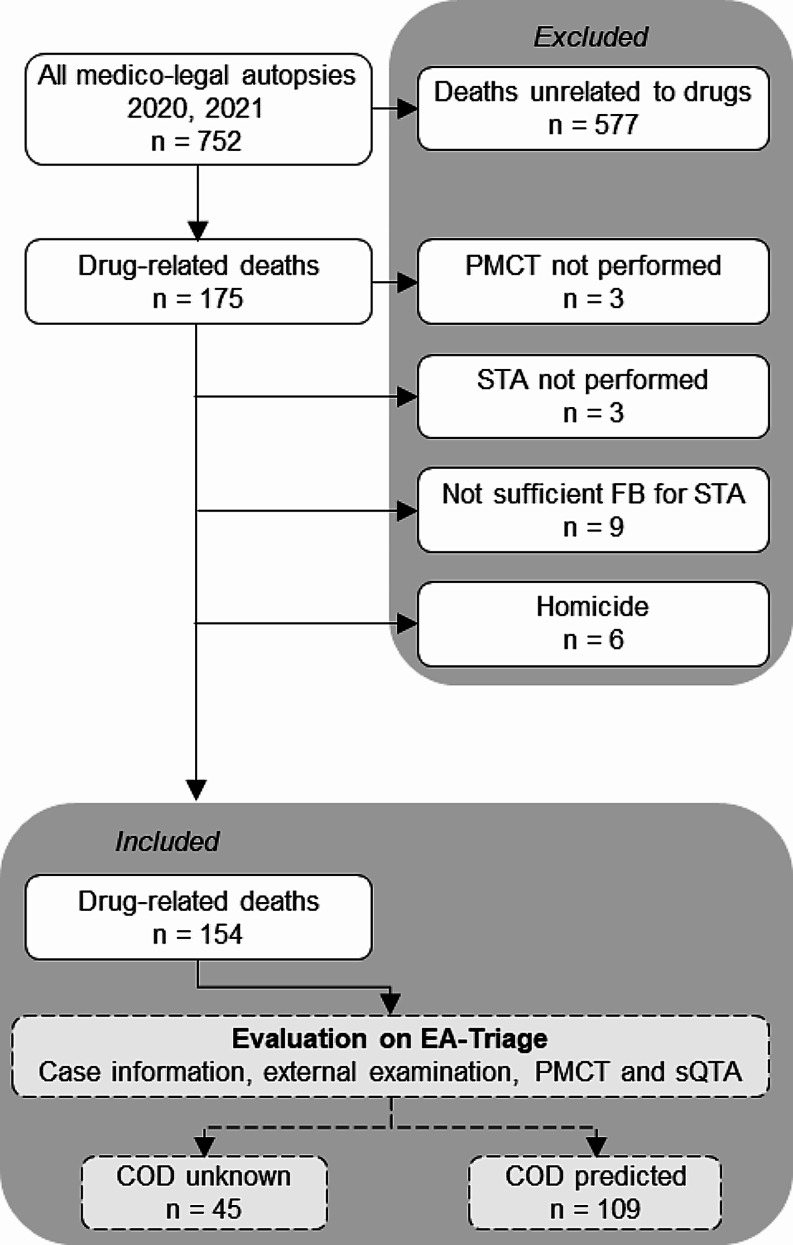
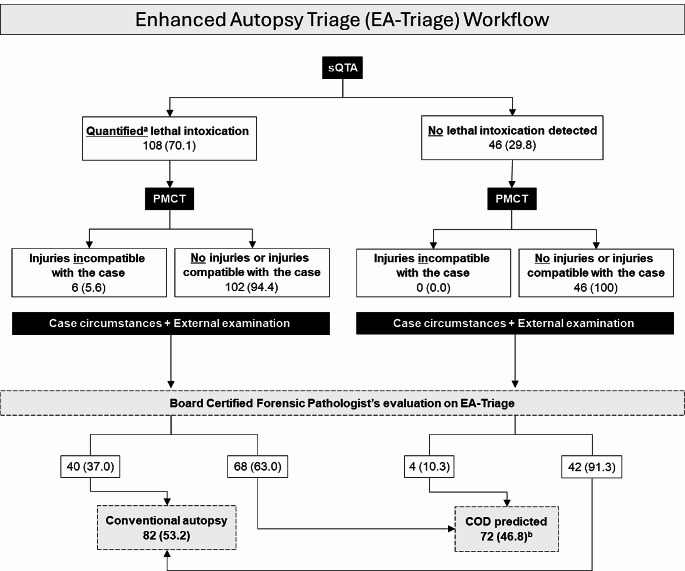
The objective was to assess the diagnostic accuracy of an enhanced autopsy triage (EA-Triage) setup consisting of postmortem computed tomography (PMCT), simulated quick toxicological analysis (sQTA), external examination, and case information in determining cause of death (COD) in persons with past or current use of illegal drugs (drug-related deaths). Information on drug-related deaths selected for medico-legal autopsy in 2020-2021 at the Department of Forensic Medicine, Aarhus University, Denmark, was analyzed retrospectively. The included cases underwent conventional autopsy, PMCT, and systematic toxicological analysis. A board-certified forensic pathologist, who was blinded to the internal examination and COD from the medico-legal autopsy, determined COD based on the EA-Triage setup. 154 cases with a median age of 40.6 years (range 17-70 years, 82% males) were included. The COD determined by medico-legal autopsy and that determined by EA-Triage matched in 113 cases (73%), including those with an unknown COD. EA-Triage and medico-legal autopsy determined unknown COD in 45 (29%) and 5 cases (3%), respectively. Excluding cases with an unknown COD, EA-Triage predicted COD in 109 cases (71%); of those, 72 (66%) had no unexplained case circumstances or suspicion of a criminal act. In these 72 cases, the CODs determined by EA-Triage and medico-legal autopsy matched in 71 cases (99%), and the sensitivity and specificity for detecting lethal intoxication were 100% and 90%, respectively. EA-Triage showed strong diagnostic accuracy for determining COD in drug-related deaths. This method may be suitable for enhancing preautopsy triage and guiding police investigations at an early stage.
目的是评估一种增强型尸检分类(EA-Triage)设置的诊断准确性,该设置包括死后计算机断层扫描(PMCT)、模拟快速毒理学分析(sQTA)、外部检查和病例信息,用于确定过去或当前使用非法药物者(药物相关死亡)的死因(COD)。对2020 - 2021年丹麦奥胡斯大学法医学系选择进行法医尸检的药物相关死亡信息进行回顾性分析。纳入的病例接受了传统尸检、PMCT和系统毒理学分析。一名获得委员会认证的法医病理学家,对法医尸检的内部检查和COD不知情,根据EA-Triage设置确定COD。纳入了154例病例,中位年龄为40.6岁(范围17 - 70岁,82%为男性)。法医尸检确定的COD与EA-Triage确定的COD在113例(73%)中匹配,包括那些COD未知的病例。EA-Triage和法医尸检分别在45例(29%)和5例(3%)中确定了未知的COD。排除COD未知的病例后,EA-Triage在109例(71%)中预测了COD;其中,72例(66%)没有无法解释的病例情况或犯罪行为嫌疑。在这72例中,EA-Triage和法医尸检确定的COD在71例(99%)中匹配,检测致命中毒的敏感性和特异性分别为100%和90%。EA-Triage在确定药物相关死亡的COD方面显示出很强的诊断准确性。这种方法可能适用于加强尸检前分类并在早期指导警方调查。