Department of Neurology, Washington University School of Medicine, St Louis, Missouri.
Department of Neurology, Ludwig-Maximilians-Universität München, Munich, Germany.
JAMA Neurol. 2024 Jun 1;81(6):582-593. doi: 10.1001/jamaneurol.2024.0991.
Effects of antiamyloid agents, targeting either fibrillar or soluble monomeric amyloid peptides, on downstream biomarkers in cerebrospinal fluid (CSF) and plasma are largely unknown in dominantly inherited Alzheimer disease (DIAD).
To investigate longitudinal biomarker changes of synaptic dysfunction, neuroinflammation, and neurodegeneration in individuals with DIAD who are receiving antiamyloid treatment.
DESIGN, SETTING, AND PARTICIPANTS: From 2012 to 2019, the Dominantly Inherited Alzheimer Network Trial Unit (DIAN-TU-001) study, a double-blind, placebo-controlled, randomized clinical trial, investigated gantenerumab and solanezumab in DIAD. Carriers of gene variants were assigned 3:1 to either drug or placebo. The present analysis was conducted from April to June 2023. DIAN-TU-001 spans 25 study sites in 7 countries. Biofluids and neuroimaging from carriers of DIAD gene variants in the gantenerumab, solanezumab, and placebo groups were analyzed.
In 2016, initial dosing of gantenerumab, 225 mg (subcutaneously every 4 weeks) was increased every 8 weeks up to 1200 mg. In 2017, initial dosing of solanezumab, 400 mg (intravenously every 4 weeks) was increased up to 1600 mg every 4 weeks.
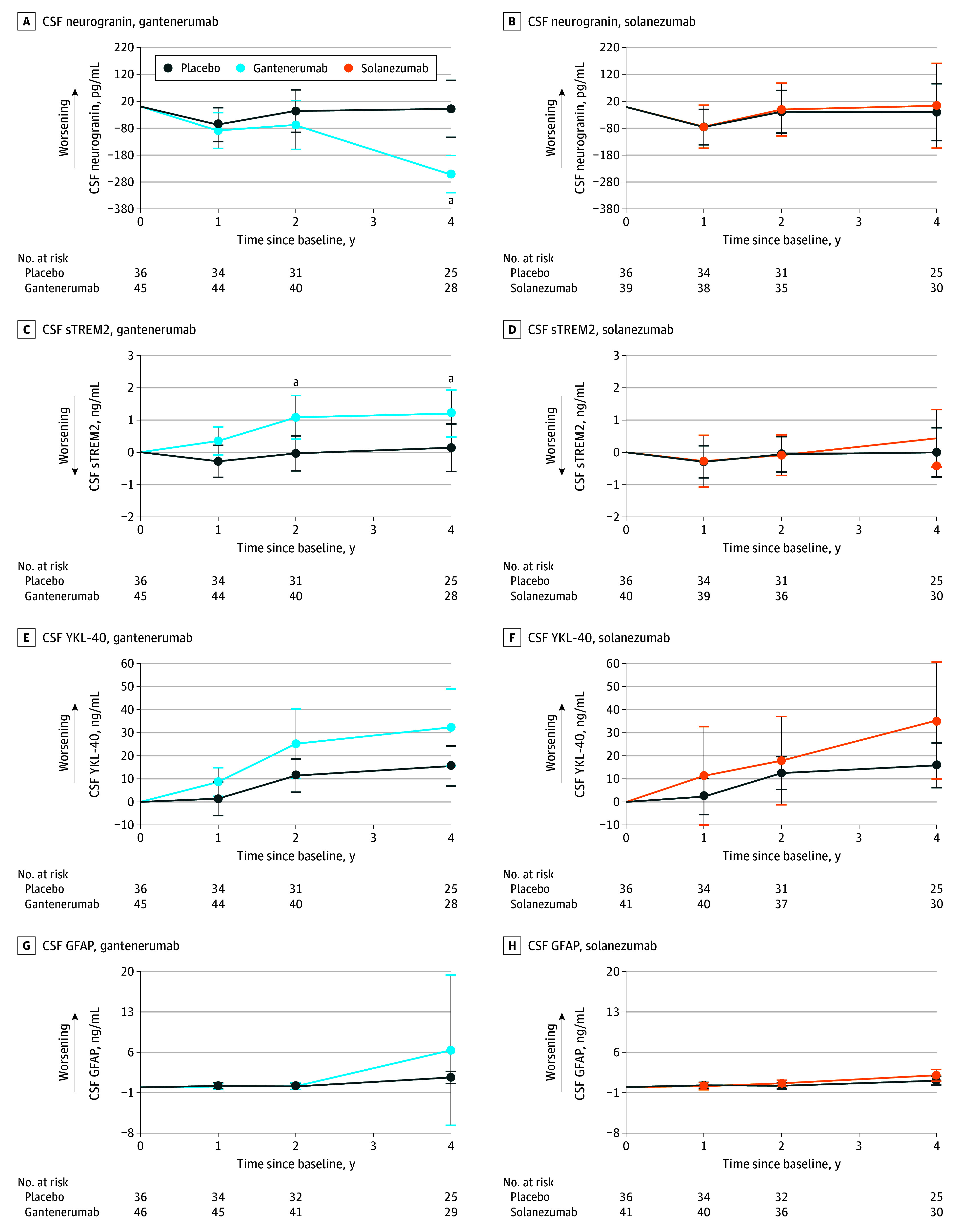
Longitudinal changes in CSF levels of neurogranin, soluble triggering receptor expressed on myeloid cells 2 (sTREM2), chitinase 3-like 1 protein (YKL-40), glial fibrillary acidic protein (GFAP), neurofilament light protein (NfL), and plasma levels of GFAP and NfL.
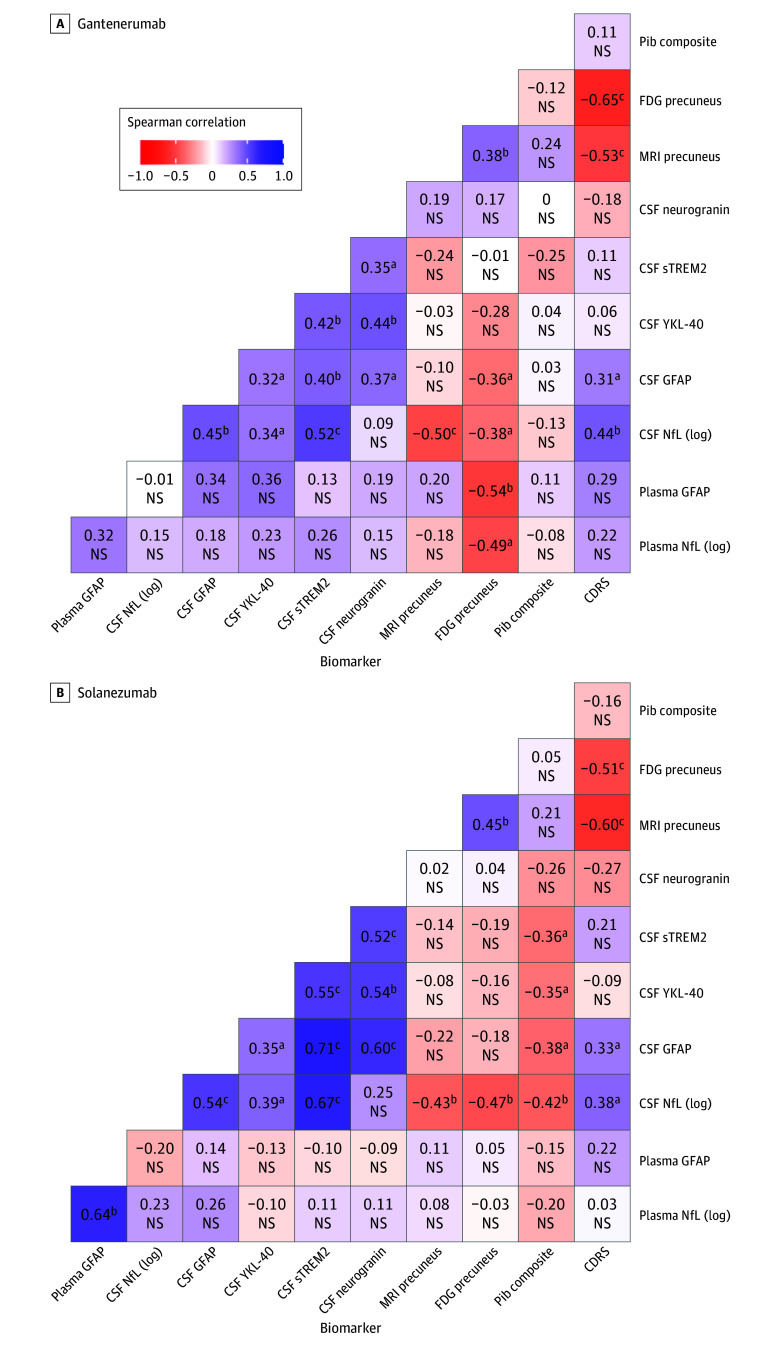
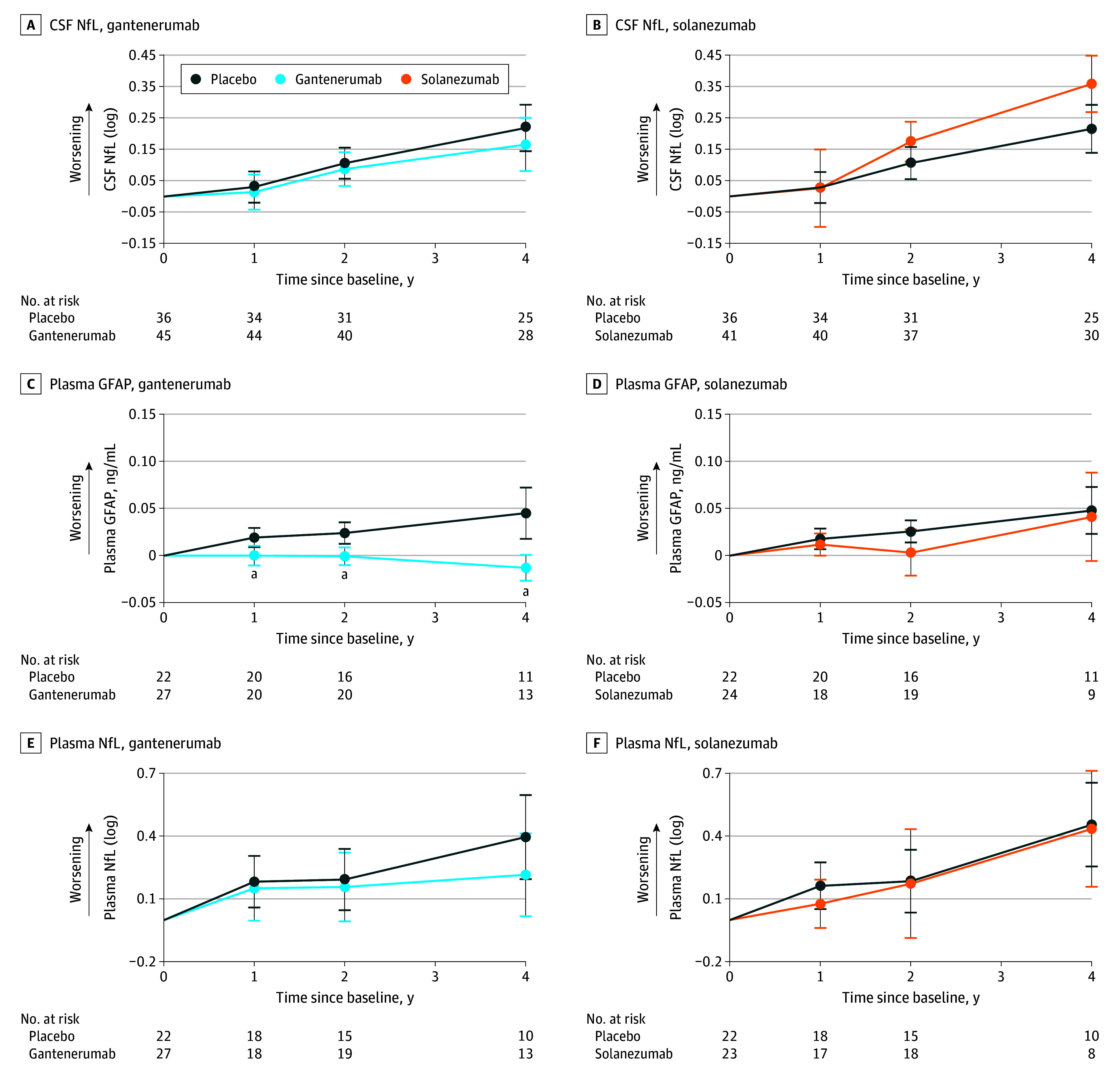
Of 236 eligible participants screened, 43 were excluded. A total of 142 participants (mean [SD] age, 44 [10] years; 72 female [51%]) were included in the study (gantenerumab, 52 [37%]; solanezumab, 50 [35%]; placebo, 40 [28%]). Relative to placebo, gantenerumab significantly reduced CSF neurogranin level at year 4 (mean [SD] β = -242.43 [48.04] pg/mL; P < .001); reduced plasma GFAP level at year 1 (mean [SD] β = -0.02 [0.01] ng/mL; P = .02), year 2 (mean [SD] β = -0.03 [0.01] ng/mL; P = .002), and year 4 (mean [SD] β = -0.06 [0.02] ng/mL; P < .001); and increased CSF sTREM2 level at year 2 (mean [SD] β = 1.12 [0.43] ng/mL; P = .01) and year 4 (mean [SD] β = 1.06 [0.52] ng/mL; P = .04). Solanezumab significantly increased CSF NfL (log) at year 4 (mean [SD] β = 0.14 [0.06]; P = .02). Correlation analysis for rates of change found stronger correlations between CSF markers and fluid markers with Pittsburgh compound B positron emission tomography for solanezumab and placebo.
This randomized clinical trial supports the importance of fibrillar amyloid reduction in multiple AD-related processes of neuroinflammation and neurodegeneration in CSF and plasma in DIAD. Additional studies of antiaggregated amyloid therapies in sporadic AD and DIAD are needed to determine the utility of nonamyloid biomarkers in determining disease modification.
ClinicalTrials.gov Identifier: NCT04623242.
重要性:在遗传性阿尔茨海默病(DIAD)中,靶向纤维状或可溶性单体淀粉样肽的抗淀粉样蛋白药物对脑脊液(CSF)和血浆中下游生物标志物的影响在很大程度上尚不清楚。
目的:研究 DIAD 患者接受抗淀粉样蛋白治疗时突触功能障碍、神经炎症和神经退行性变的纵向生物标志物变化。
设计、地点和参与者:2012 年至 2019 年,显性遗传性阿尔茨海默病网络试验单位(DIAN-TU-001)研究是一项双盲、安慰剂对照、随机临床试验,研究了 gantenerumab 和 solanezumab 在 DIAD 中的作用。基因变异携带者按 3:1 的比例随机分配至药物组或安慰剂组。本分析于 2023 年 4 月至 6 月进行。DIAN-TU-001 在 7 个国家的 25 个研究地点进行。对 gantenerumab、solanezumab 和安慰剂组 DIAD 基因变异携带者的生物流体和神经影像学进行了分析。
干预措施:2016 年,gantenerumab 的初始剂量为 225mg(每 4 周皮下注射一次),每 8 周增加一次,最高剂量为 1200mg。2017 年,solanezumab 的初始剂量为 400mg(每 4 周静脉注射一次),每 4 周增加至 1600mg。
主要结果和措施:CSF 神经颗粒蛋白、可溶性触发受体表达在髓样细胞 2(sTREM2)、几丁质酶 3 样蛋白 1(YKL-40)、神经胶质纤维酸性蛋白(GFAP)、神经丝轻蛋白(NfL)的水平以及血浆 GFAP 和 NfL 水平的纵向变化。
结果:在筛选的 236 名合格参与者中,有 43 名被排除。共有 142 名参与者(平均年龄[标准差],44[10]岁;女性 72 名[51%])被纳入研究(gantenerumab 组 52 名[37%];solanezumab 组 50 名[35%];安慰剂组 40 名[28%])。与安慰剂相比,gantenerumab 组在第 4 年时 CSF 神经颗粒蛋白水平显著降低(平均[标准差]β=-242.43[48.04]pg/mL;P<0.001);第 1 年时血浆 GFAP 水平降低(平均[标准差]β=-0.02[0.01]ng/mL;P=0.02)、第 2 年时(平均[标准差]β=-0.03[0.01]ng/mL;P=0.002)和第 4 年时(平均[标准差]β=-0.06[0.02]ng/mL;P<0.001);CSF sTREM2 水平在第 2 年(平均[标准差]β=1.12[0.43]ng/mL;P=0.01)和第 4 年(平均[标准差]β=1.06[0.52]ng/mL;P=0.04)升高。Solanezumab 组 CSF NfL(log)在第 4 年时显著增加(平均[标准差]β=0.14[0.06];P=0.02)。对变化率的相关分析发现,与安慰剂相比,CSF 标志物与 Pittsburgh 化合物 B 正电子发射断层扫描(solanezumab 和安慰剂)在脑脊液和血浆中与淀粉样蛋白相关的神经炎症和神经退行性变的多个 AD 相关过程具有更强的相关性。需要进一步研究淀粉样蛋白聚集抑制剂在散发性 AD 和 DIAD 中的作用,以确定非淀粉样生物标志物在确定疾病修饰中的效用。
试验注册:ClinicalTrials.gov 标识符:NCT04623242。