Department of Neurosurgery, University of Michigan, Ann Arbor.
Division of Neurosurgery, Children's Hospital of Orange County Neuroscience Institute, Children's Hospital of Orange County, Orange, California.
JAMA Netw Open. 2024 Apr 1;7(4):e248762. doi: 10.1001/jamanetworkopen.2024.8762.
Several studies have reported a higher incidence of neurodevelopmental delays and cognitive deficits in patients with single-suture craniosynostosis; however, there are few studies examining the associations of repair type with cognitive outcomes.
To measure differences in neuropsychological outcomes between school-age children who were treated for sagittal craniosynostosis and unaffected controls and explore differences in cognitive function among children with sagittal craniosynostosis who were previously treated with either endoscopic strip craniectomy or open calvarial vault surgery.
DESIGN, SETTING, AND PARTICIPANTS: This cohort study was performed between 2018 and 2022. Eligible participants included patients aged 5 to 17 years who had previously been seen as infants or toddlers (<3 years) at 1 of 3 surgical centers for craniosynostosis repair with either endoscopic surgery or open calvarial vault surgery. A separate cohort of unaffected controls were included for comparison. Data analysis was conducted from November 2023 to February 2024.
Open calvarial vault surgery or endoscopic repair for single-suture craniosynostosis.
The primary outcome was the Differential Ability Scales-II (DAS-II) General Conceptual Ability (GCA) score, an index for overall intellectual ability. Secondary outcomes included DAS-II subscale scores (Verbal Ability, Nonverbal Reasoning, Spatial Ability, Working Memory, and Processing Speed), and Patient-Reported Outcomes Measurement Information System (PROMIS) cognitive function scores.
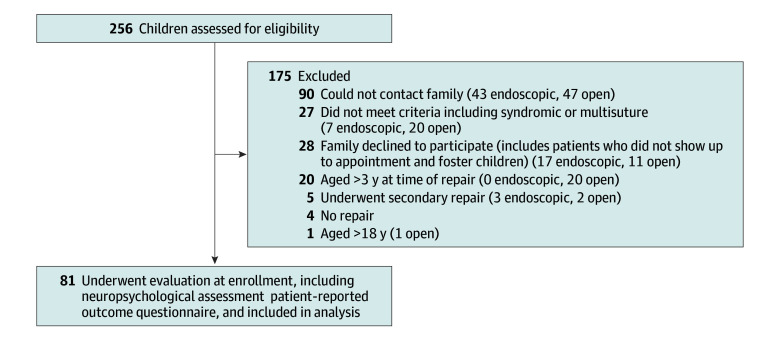
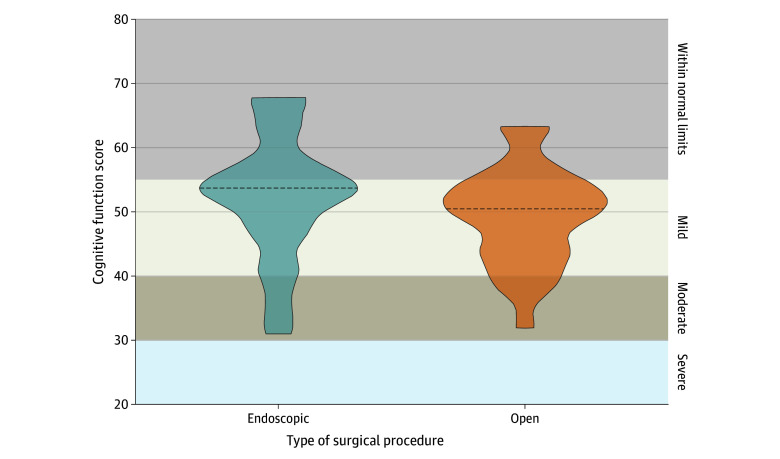
A total of 81 patients with sagittal craniosynostosis (59 male [73%]; 22 female [27%]) and 141 controls (81 male [57%]; 60 female [43%]) were included. Of the 81 participants with sagittal craniosynostosis, 46 underwent endoscopic repair and 35 underwent open repair. Median (range) age at time of follow-up assessment was 7.7 (5.0-14.8) years for children with sagittal craniosynostosis and median age at assessment was 8.5 (7.7-10.5) years for controls. After controlling for age at assessment, sex, and socioeconomic status, there was no statistically significant or clinically meaningful difference in GCA scores between children who underwent endoscopic repair (adjusted mean score, 100; 95% CI, 96-104) and open repair (adjusted mean score, 103; 95% CI, 98-108) (P > .99). We found no significant difference in PROMIS scores between repair types (median [range] for endoscopic repair 54 [31-68] vs median [range] for open repair 50 [32-63]; P = .14). When comparing the treatment groups with the unaffected controls, differences in subscale scores for GCA and working memory were observed but were within normal range.
In this cohort study, there were no statistically or clinically significant differences in cognitive outcomes among school-age children by and type of surgical procedure used to repair nonsyndromic sagittal craniosynostosis. These findings suggest primary care clinicians should be educated about different options for craniosynostosis surgery to ensure early referral of these patients so that all treatment options remain viable.
几项研究报告称,单一颅缝早闭患者的神经发育迟缓及认知缺陷发生率较高;然而,鲜有研究检查修复类型与认知结果之间的关系。
测量接受矢状缝早闭治疗的学龄儿童与未受影响的对照组之间神经心理结果的差异,并探讨以前接受内镜下颅骨切除术或开放式颅穹窿手术治疗的矢状缝早闭儿童之间认知功能的差异。
设计、地点和参与者:这是一项在 2018 年至 2022 年期间进行的队列研究。合格的参与者包括年龄在 5 至 17 岁之间的患者,他们曾在 3 家颅缝早闭修复外科中心中的 1 家作为婴儿或幼儿(<3 岁)接受过治疗,接受过内镜手术或开放式颅穹窿手术。还纳入了一组未受影响的对照组进行比较。数据分析于 2023 年 11 月至 2024 年 2 月进行。
开放式颅穹窿手术或内镜修复单一颅缝早闭。
主要结果是差异能力量表-II(DAS-II)的一般概念能力(GCA)评分,这是一个整体智力能力的指标。次要结果包括 DAS-II 子量表评分(言语能力、非言语推理、空间能力、工作记忆和处理速度)和患者报告的结果测量信息系统(PROMIS)认知功能评分。
共纳入 81 例矢状缝早闭患者(59 例男性[73%];22 例女性[27%])和 141 例对照组(81 例男性[57%];60 例女性[43%])。在 81 例矢状缝早闭患者中,46 例接受内镜修复,35 例接受开放修复。矢状缝早闭儿童的随访评估时的中位(范围)年龄为 7.7(5.0-14.8)岁,对照组的中位年龄为 8.5(7.7-10.5)岁。在控制评估时的年龄、性别和社会经济地位后,接受内镜修复的儿童与接受开放修复的儿童之间 GCA 评分无统计学意义或临床意义上的差异(调整后的平均评分,100;95%CI,96-104 与 103;95%CI,98-108)(P > .99)。我们发现修复类型之间的 PROMIS 评分没有显著差异(内镜修复的中位数[范围]为 54[31-68]与开放修复的中位数[范围]为 50[32-63];P = .14)。当将治疗组与未受影响的对照组进行比较时,发现 GCA 和工作记忆的子量表评分存在差异,但仍在正常范围内。
在这项队列研究中,接受非综合征性矢状缝早闭治疗的学龄儿童之间在认知结果方面没有统计学或临床上显著的差异,且与手术方式无关。这些发现表明,初级保健临床医生应该接受有关颅缝早闭手术不同选择的教育,以确保这些患者尽早转介,从而使所有治疗选择仍然可行。